
JEB
JEB is a reverse-engineering platform for disassembling, decompiling, debugging, and analyzing code and document files.
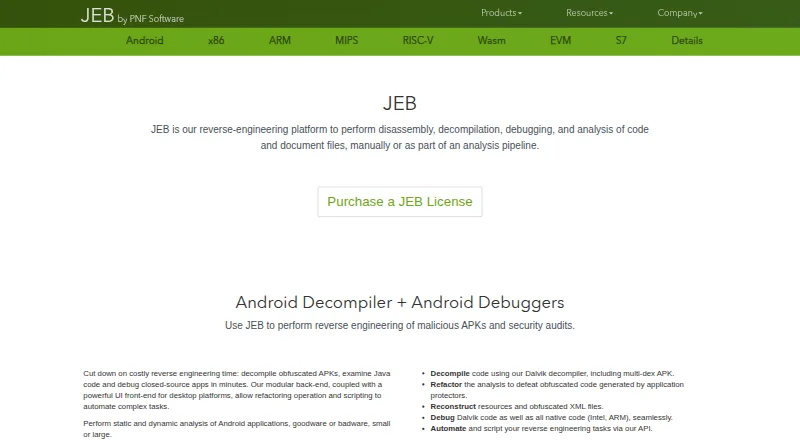
What JEB is
JEB is a reverse-engineering platform for disassembling, decompiling, debugging, and analyzing code and document files. Its Android tools cover static and dynamic analysis, including multi-dex decompilation, resource reconstruction, and debugging Dalvik and native code. Other modules address Intel x86 and x86-64, ARM, MIPS, RISC-V, WebAssembly, Ethereum contracts, Siemens S7 PLC programs, and PDF documents. Python and Java scripts and plugins can automate analysis, including through headless front ends. The Windows, Linux, and macOS GUI supports x64 and arm64 systems and requires JDK 21 or later. JEB offers a free Community Edition for x86 and x86-64 decompilation, as well as a demo with restrictions on decompilation, project saving and loading, clipboard use, session length, and internet access. PNF Software, founded in 2013, is based in Silicon Valley, California.
Good
- Android static and dynamic analysis tools.
- Modules cover diverse processor and file targets.
- Python and Java scripting and plugins.
- GUI supports Windows, Linux, and macOS.
Watch out
- Demo restricts decompilation and project handling.
- Demo sessions are time-limited and require internet.
- GUI requires JDK 21 or above.
- RISC-V support excludes several listed extensions.
Who it suits
JEB suits reverse engineers, researchers, students, and hobbyists who need code or document analysis. Its Community Edition is aimed at those groups and reverse engineers at nonprofit organizations.
Verdict
JEB combines Android analysis with modules for many other code and document targets. The free edition is limited to x86 and x86-64 decompilation, while paid plans add broader modules and capabilities.
Plans and prices
From JEB's own pricing page, checked 15 Oct 2026.
| Plan | Price | What it gives you |
|---|---|---|
| JEB Demo | Free | subset decompilation · no project save/load · no clipboard · time-limited sessions · internet required |
| JEB Community Edition | Free | x86/x64 focus · researchers, students, hobbyists and nonprofits · most disassemblers and file analyzers |
| JEB Android | $140 a month | Android modules · official UI · extensions · offline use · Monthly |
| JEB Android | $1,200 a year | Android modules · official UI · extensions · offline use · Yearly |
| JEB Pro | $2,000 a year | All modules · official UI · extensions · offline use · third-party clients · Yearly |
| JEB Pro Floating | $4,000 a year | All modules · floating seats · extensions · offline use · Yearly |
| JEB Pro OEM | $8,000 a year | All modules · SaaS/back-end integrations · third-party clients · offline use · Yearly |
The facts
Each one read from JEB's own pages, with the date it was checked.
What it does
- AI and integrations
- JEB's VIBRE assistant and MCP server connect to OpenAI, Anthropic, Google Gemini, and AWS Bedrock compatible endpoints, and MCP clients including Codex CLI, Claude CLI, OpenCode, and LM Studio.checked 29 Sep 2026
- API and SDK
- JEB exposes Java and Python APIs for scripts, plugins, analysis modules and custom front ends under the com.pnfsoftware.jeb namespace.checked 15 Oct 2026
- Automation API
- Users can write scripts and plugins in Python or Java and build headless front ends for automated analysis.checked 29 Sep 2026
- Change: JEB 5.40
- The May 6, 2026 release added a Java Embedded Python runner, improved API documentation and broadened JDK support.checked 15 Oct 2026
- Change: JEB 5.48
- The October 7, 2026 release hardened ELF parsing, upgraded emulators, fixed dexdec optimizers and added MCP bytecode and asynchronous script tools.checked 15 Oct 2026
- Demo limits
- The demo limits decompilation to a subset of code, disables saving and loading projects and clipboard use, has time-limited sessions, and requires an internet connection.checked 29 Sep 2026
- Developer repository
- PNF's public JEB sample-code repository contains client, plugin and script examples and is shown with 223 stars and 52 forks.checked 15 Oct 2026
- Documentation depth
- The manual covers installation, analysis workflows, debugging, Android, native, WebAssembly, Ethereum, S7, MCP, scripting, plugins, front ends and configuration.checked 15 Oct 2026
- Documentation limitation
- The manual says its user section is not exhaustive and directs readers to the blog for additional use cases.checked 15 Oct 2026
- Extensibility
- Client scripts are generally Python, back-end plugins are Java, and users can provide intermediate-representation optimizers and headless clients.checked 15 Oct 2026
- Floating license
- A floating license allows up to its licensed seat count to connect concurrently, with a seat freed when a client leaves.checked 29 Sep 2026
- G2 listing
- G2's alternatives page identifies JEB Decompiler but displays no JEB star rating or review count.checked 15 Oct 2026
- Installation model
- Registered users receive a custom-generated ZIP package electronically by email containing the back end and desktop UI client.checked 15 Oct 2026
Where it runs
- Android analysis
- Its Android tooling performs static and dynamic analysis, including multi-dex Dalvik decompilation, resource reconstruction and obfuscation refactoring.checked 15 Oct 2026
- Android debugging
- JEB debugs Dalvik and native Intel or ARM code and can hook sensitive APIs.checked 15 Oct 2026
- Desktop platforms
- The GUI runs on Windows, Linux/GTK and macOS, each in x64 and arm64 variants.checked 15 Oct 2026
The company
- Company
- PNF Software is located in Silicon Valley, California, and was founded by Nicolas Falliere in 2013.checked 29 Sep 2026
- Company customers
- LinkedIn says hundreds of paying customers use JEB, including government agencies, defense contractors, antivirus vendors, laboratories, universities and technology companies.checked 15 Oct 2026
- Company founding
- PNF Software says Nicolas Falliere founded the company in 2013 in Silicon Valley, California.checked 15 Oct 2026
- Company legal record
- A California business directory reports PNF Software, Inc. as an active Cupertino corporation filed on January 8, 2015.checked 15 Oct 2026
- Company size
- LinkedIn lists PNF Software as a public software-development company with 2–10 employees.checked 15 Oct 2026
- Founded
- 2013checked 28 Sep 2026
- Headquarters
- Silicon Valley, California, United Stateschecked 28 Sep 2026
Money
- Free edition audience
- JEB Community Edition is described as suitable for researchers, students, hobbyists, and reverse engineers at nonprofit organizations.checked 29 Sep 2026
The full review of JEB
JEB is a reverse-engineering workbench for examining Android applications, native binaries, bytecode, and specialist document targets. It suits security researchers and engineering teams whose projects move between several architectures or require scripted analysis. The central trade-off is scope: serious multi-target use requires a paid license, while the free and demo experiences are deliberately constrained.
Overview
JEB combines disassembly, decompilation, debugging, and analysis of code and document files in one desktop-oriented platform. Its module catalogue reaches Intel x86 and x86-64, ARM, MIPS, RISC-V, WebAssembly, Ethereum contracts, Siemens S7 PLC programs, and PDF documents. That breadth can reduce tool switching for practitioners handling mixed workloads, although the edition you buy determines which modules you can actually use.
PNF Software, founded by Nicolas Falliere in 2013, operates from Silicon Valley, California. Licensing spans a free community edition, a monthly Android edition, annual individual and floating licenses, and an OEM server plan.
Key features
Android and multi-architecture analysis
JEB supports both static and dynamic Android investigation, with multi-dex decompilation, resource reconstruction, and debugging for Dalvik and native code. The Android edition therefore targets app-focused work without requiring the complete module collection. Native-code and bytecode decompilation, together with debugger integration, make the platform useful when an investigation crosses managed and machine code.
Automation and integrations
Python and Java scripting, plugins, and headless front ends let teams turn repeatable analysis into automated workflows rather than relying solely on the graphical client. The VIBRE assistant and MCP server can connect with OpenAI, Anthropic, Google Gemini, and AWS Bedrock-compatible endpoints, as well as MCP clients such as Codex CLI, Claude CLI, OpenCode, and LM Studio. Those connections are most relevant to organizations already operating an AI-assisted analysis pipeline; they add little value to occasional manual inspection.
Client and support options
The official GUI runs on Windows, Linux, and macOS on x64 and arm64 systems and requires JDK 21 or newer. Eligible JEB Pro license holders can add priority support for 30% of the license cost, with replies targeted within one business day and bug reports prioritized. RISC-V coverage is not universal: RV128, RVE, and several unusual extensions are excluded, and floating-point decompilation is planned rather than presented as complete.
Pricing
| Plan | Price | What it includes |
|---|---|---|
| JEB Community Edition | free | x86 and x86-64 decompilation |
| JEB Android | $140 a month | Android modules, official UI client, extensions, offline work |
| JEB Pro | $2,000 a year | All modules, official UI client, extensions, offline work |
| JEB Pro Floating | $4,000 a year | All modules, floating seats, official UI client, extensions |
| JEB Pro OEM | $8,000 a year | All modules, SaaS/back-end integrations, third-party front-end clients |
The Community Edition is a genuine no-cost starting point for students, researchers, hobbyists, and nonprofit reverse engineers, but its architecture coverage is narrow. The Android subscription is the sensible choice for teams concentrated on mobile applications and needing offline work. Pro is aimed at a professional who needs every module; at $2,000 per user annually, it is difficult to justify for infrequent or single-target use. Floating licensing costs $4,000 per seat yearly and allows only the licensed number of concurrent connections, freeing a seat when a client leaves, which suits shared teams rather than one dedicated analyst. OEM pricing is $8,000 per server for organizations embedding JEB behind their own services or clients. A free trial is offered, while the demo imposes subset decompilation, no project saving or loading, no clipboard, time-limited sessions, and an internet connection requirement.
Platforms
JEB provides an API and desktop clients for Windows, Linux, and macOS, with x64 and arm64 GUI support. The JDK 21-or-newer requirement is a deployment consideration for managed workstations and build environments.
Who it's for
Choose JEB when Android analysis must coexist with native, bytecode, industrial-control, smart-contract, WebAssembly, or document work, or when Python/Java automation and headless operation are central requirements. Community Edition fits learning and nonprofit use; Android fits mobile specialists; Pro and Floating fit professional teams with broader or shared needs; OEM is for product integration. It is a poor fit if you only need occasional x86 inspection or a permanently free general decompiler.
Pros and cons
- Pros: unusually broad modules across Android, native and bytecode targets; static and dynamic Android capabilities; scripting, plugins, and headless automation; desktop support on all three major operating systems; optional prioritized support.
- Cons: the free edition covers only x86 and x86-64 decompilation; demo restrictions interrupt normal project workflows; full access is expensive; RISC-V support omits several extensions and does not yet include floating-point decompilation; GUI use requires JDK 21 or newer.
Alternatives
Decompiler Software and Reverse Engineering Tools provide broader category comparisons. Pick Binary Ninja instead if its free evaluation or $199 perpetual Personal plan meets your needs and you can accept five decompilation architectures without API or plugin access on Free. rev.ng is the better starting point when a free-software decompilation pipeline matters. Boomerang suits readers wanting a BSD-licensed open-source decompiler at no cost. Choose IDA Pro for its established free x86-32/x86-64 option or paid Essential edition. uncompyle6 is the focused choice for GPL-3.0 Python bytecode decompilation. Bytecode Viewer, CFR, and Ghidra are free alternatives when their respective bytecode or general reverse-engineering scope is sufficient.
Verdict
JEB is a strong recommendation for professionals who need one automatable platform spanning Android and multiple specialist targets. Its main reason to choose it is the combination of breadth, debugging, and extensibility; its main reason to look elsewhere is the high recurring price and sharply limited free tier.
Alternatives to JEB
- 1

Binary Ninja
Free planWebAPILinuxmacOS7.8$199 one-time - 2
Frida
Free planOpen sourceAndroidiOSAPILinux7.7Free plan - 3

rev.ng
Free planOpen sourceWebAPILinuxmacOS7.7Free plan - 4
Ghidra
Free planOpen sourceAPIExtensionLinuxmacOS7.3Free plan - 5

IDA Pro
Free planLinuxmacOSWindows7.0From $1,099 a year - 6
Boomerang
Free planLinuxmacOSWindows6.7Free plan