Ghidra
Ghidra is a free software reverse-engineering framework maintained by the NSA Research Directorate.
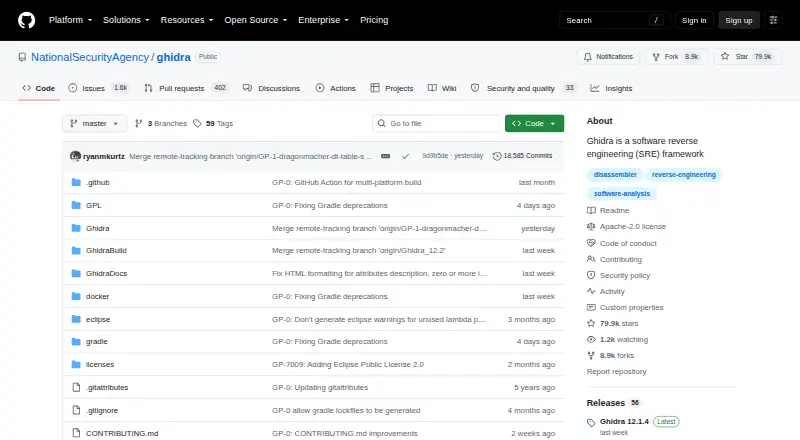
What Ghidra is
Ghidra is a free software reverse-engineering framework maintained by the NSA Research Directorate. It analyzes compiled code with tools for disassembly, assembly, decompilation, graphing, and scripting, and supports a wide variety of processor instruction sets and executable formats. The framework can run interactively or in automated modes and is designed to help with complex reverse-engineering work, including team analysis. Users can create extensions and scripts with Java or Python. Development resources include a GhidraDev plugin for Eclipse and support for editing scripts and creating module projects in Visual Studio Code. Ghidra supports compiled-code analysis on Windows, macOS, and Linux. Installation requires a 64-bit JDK 25 and an official multi-platform release archive. The project includes the Apache License, Version 2.0, which grants no-charge, royalty-free copyright and patent licenses subject to its terms. The repository warns that certain versions have known security vulnerabilities and points users to its security advisories. Vulnerability reports should go through GitHub private vulnerability reporting rather than public issues.
Good
- Free under the Apache License, Version 2.0.
- Supports a wide variety of processor instruction sets and executable formats.
- Offers interactive and automated modes.
- Extensions and scripts can use Java or Python.
- Compiled-code analysis is supported on Windows, macOS, and Linux.
Watch out
- Installation requires a 64-bit JDK 25.
- Certain versions have known security vulnerabilities.
Who it suits
Ghidra suits people analyzing compiled software who need disassembly, decompilation, scripting, or automated workflows. Its extension options may also fit users developing analysis tools in Java or Python.
Verdict
Ghidra offers a broad set of reverse-engineering tools and can fit both interactive and automated work. Check the JDK requirement and security advisories before installation.
Plans and prices
From Ghidra's own pricing page, checked 15 Oct 2026.
| Plan | Price | What it gives you |
|---|---|---|
| Ghidra | Free | Free download and use · no paid editions stated |
The facts
Each one read from Ghidra's own pages, with the date it was checked.
What it does
- Analysis features
- Its tools include disassembly, assembly, decompilation, graphing, and scripting for analyzing compiled code.checked 29 Sep 2026
- Analysis tools
- The suite includes disassembly, assembly, decompilation, graphing, scripting and many additional analysis tools.checked 15 Oct 2026
- Build requirements
- Source builds require JDK 25, Gradle 9.1.0 or newer, Python 3.9 through 3.15 and platform C/C++ build tools.checked 15 Oct 2026
- Build system
- Development uses Gradle, Git and Eclipse, with documented tasks for building natives, Javadocs, PyGhidra packages and distributions.checked 15 Oct 2026
- Collaboration
- The official announcement lists a multi-user collaboration repository and undo/redo support.checked 15 Oct 2026
- Decompiler
- The product translates low-level machine code into higher-level C-like output through its decompiler.checked 15 Oct 2026
- Developer languages
- The developer guide lists Java as primary and C++, Sleigh, Python 3 and Jython 2.7 as secondary languages.checked 15 Oct 2026
- Development integrations
- The project documents a GhidraDev plugin for Eclipse and support for editing scripts and creating module projects in Visual Studio Code.checked 29 Sep 2026
- Disclosure process
- The security policy describes private triage and says an advisory may be published sometime after an official release containing the patch.checked 29 Sep 2026
- Documentation depth
- The installation includes documentation, release notes, API files, tutorials and online help, while the user guide explicitly excludes architecture and programming-API details.checked 15 Oct 2026
- Extensibility
- Users can develop Ghidra extensions and scripts using Java or Python.checked 29 Sep 2026
- Extension architecture
- Ghidra uses installable extensions and plugins, including Eclipse, Ghidra extensions and IDA Pro transfer plugins.checked 15 Oct 2026
- IDE integrations
- The project supplies the GhidraDev Eclipse plugin, an Eclipse Sleigh editor and Visual Studio Code script and module-project support.checked 15 Oct 2026
- Independent comparison
- GhidraLite.net describes Ghidra as free, open source, multi-platform and equipped with decompilation, scripting and plugin support.checked 15 Oct 2026
- Independent editor rating
- GhidraLite.net gives Ghidra an editorial rating of 4.7 out of 5.checked 15 Oct 2026
- Installation requirement
- The repository's installation instructions require a 64-bit JDK 25 and an official multi-platform release archive.checked 29 Sep 2026
- Install limitation
- Archive installation does not create desktop shortcuts or Start-menu entries automatically.checked 15 Oct 2026
- Install method
- Ghidra is distributed as an archive to extract in place rather than through a traditional installer.checked 15 Oct 2026
- Interactive and automated modes
- Ghidra runs as an interactive application or in automated headless mode.checked 15 Oct 2026
- Licence
- The main Ghidra software is released under Apache License 2.0, with separate GPL-3 support programs and other third-party licenses.checked 15 Oct 2026
- License
- The repository includes the Apache License, Version 2.0, which grants no-charge, royalty-free copyright and patent licenses subject to its terms.checked 29 Sep 2026
- Limit: build burden
- TopGit notes that Windows source builds require Visual Studio or Build Tools with MSVC, Windows SDK and C++ ATL.checked 15 Oct 2026
- Limit: learning curve
- TopGit says users seeking a quick binary inspection may find the JDK setup and desktop interface demanding, and describes a real learning curve.checked 15 Oct 2026
Where it runs
- Independent platform description
- SourceForge lists the mirrored project for Linux, Mac and Windows and states that it is not affiliated with Ghidra.checked 15 Oct 2026
The full review of Ghidra
Overview
Ghidra is a free reverse-engineering framework maintained by the NSA Research Directorate, aimed at people analyzing compiled software. Its breadth is the draw: it combines several code-analysis tools and supports both interactive and automated work, though installation has a demanding JDK requirement and security advisories deserve attention.
Apache License 2.0 grants no-charge, royalty-free copyright and patent licenses subject to its terms. Ghidra is therefore a strong fit for users seeking a capable framework without a purchase price, especially those prepared to work with an extensible tool rather than a narrowly focused utility.
Key features
Analysis in one framework
Ghidra brings disassembly, assembly, decompilation, graphing, and scripting together for compiled-code analysis. It supports native-code and bytecode decompilation, debugger integration, and a scripting API, with broad processor-instruction-set and executable-format support. That range suits varied analysis work; the supported architectures and formats are not enumerated here, so readers with a specific target should confirm it before committing.
Flexible workflows and extensions
Users can work interactively or automate analysis, and extend the framework with Java or Python scripts and extensions. The project also documents a GhidraDev plugin for Eclipse, plus script editing and module-project creation in Visual Studio Code. This combination offers room to adapt workflows, though it may be more framework than someone seeking only a focused decompiler needs.
Ghidra was built to address scaling and collaboration challenges in complex reverse-engineering work. That makes it relevant to team analysis as well as individual use, without requiring a separate paid plan.
Pricing
Ghidra: free. The free plan has no price or usage limits stated on the opened pages, and there is no free trial because the software is free. No paid tier is described, so there is no lower-cost plan that trades away capabilities; users should still weigh the installation requirement and their own setup needs.
The repository includes Apache License 2.0, granting no-charge, royalty-free copyright and patent licenses subject to its terms. The installation instructions require a 64-bit JDK 25 and an official multi-platform release archive, a concrete prerequisite to check before downloading.
Platforms
Ghidra supports Windows, macOS, and Linux for compiled-code analysis. It is also categorized as an extension. The operating-system support gives desktop users multiple choices, but the 64-bit JDK 25 requirement applies when installing it.
Who it's for
Choose Ghidra if you need a free, extensible environment that can combine several reverse-engineering tasks and accommodate both manual and automated analysis. Its scripting options and focus on complex team work make it a sensible choice for users who want to shape repeatable workflows. It is less compelling for someone who wants a single-purpose decompiler or cannot meet the JDK requirement.
Security is part of the maintenance decision: the repository warns that certain versions have known vulnerabilities and points users to its security advisories. The security policy directs vulnerability reports through GitHub private vulnerability reporting rather than public issues, with private triage and possible advisory publication sometime after an official patched release. Users should check advisories and use an appropriate version.
Pros and cons
- Pros: Free access under Apache License 2.0, with no usage limits stated on the opened pages, makes it accessible for sustained work.
- Pros: Disassembly, decompilation, graphing, scripting, and debugger integration in one framework suit varied compiled-code analysis.
- Pros: Interactive and automated modes, plus Java or Python extensibility, support tailored and repeatable workflows.
- Cons: Installation requires a 64-bit JDK 25, which is an important prerequisite rather than a lightweight setup assumption.
- Cons: Known vulnerabilities affect certain versions, so version choice and security-advisory checks matter.
- Cons: Broad coverage may be unnecessary overhead for readers seeking only a focused decompiler.
Alternatives
For a directory-wide comparison, see Decompiler Software and Reverse Engineering Tools.
- Binary Ninja is worth considering if a freemium option fits better: its free plan is for evaluation and education, limited to five decompilation architectures, and excludes API and plugin access.
- IDA Pro offers a free plan for x86-32 and x86-64 disassembly with two cloud-based decompilers and a named license; consider it if that narrower scope suits your work.
- JEB has a free Community Edition for x86 and x86-64 decompilation, aimed at researchers, students, hobbyists, and nonprofit reverse engineers.
- rev.ng may appeal if you want its free-software decompilation pipeline, with a UI described as commercially offered in cloud and standalone versions.
- RetDec is an open-source alternative under the MIT license.
- JADX is a free Apache 2.0-licensed alternative; its decompilation may not recover all code.
- ILSpy is another free, open-source option under the MIT License.
- Recaf is a free alternative for Linux, macOS, and Windows.
Verdict
Ghidra is the right choice for users who want a free, adaptable reverse-engineering framework spanning interactive and automated analysis. Its breadth and scripting flexibility are compelling reasons to choose it; the JDK 25 requirement and need to keep clear of vulnerable versions are the strongest reasons to look elsewhere.
Alternatives to Ghidra
- 1

Binary Ninja
Free planWebAPILinuxmacOS7.8$199 one-time - 2
Frida
Free planOpen sourceAndroidiOSAPILinux7.7Free plan - 3

rev.ng
Free planOpen sourceWebAPILinuxmacOS7.7Free plan - 4

JEB
Free planAPILinuxmacOSSelf-hosted7.6From $1,200 a year - 5

IDA Pro
Free planLinuxmacOSWindows7.0From $1,099 a year - 6
Boomerang
Free planLinuxmacOSWindows6.7Free plan