FIR (Fast Incident Response)
FIR (Fast Incident Response) is a free, open-source cybersecurity incident management platform for creating, tracking, and reporting incidents.
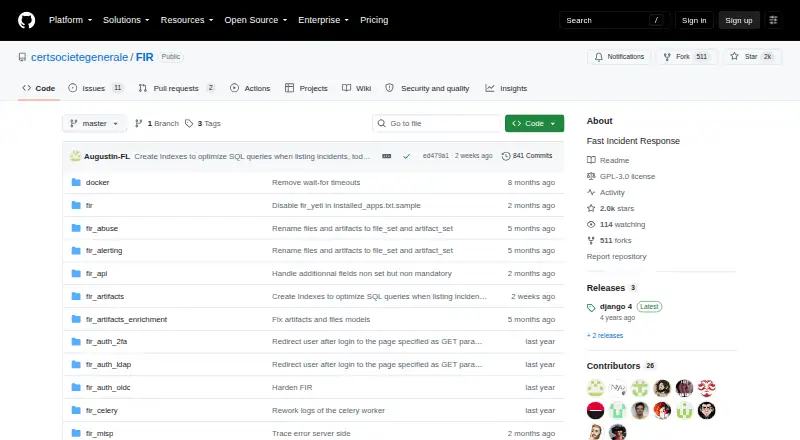
What FIR (Fast Incident Response) is
FIR (Fast Incident Response) is a free, open-source cybersecurity incident management platform for creating, tracking, and reporting incidents. It is intended for teams such as CSIRTs, CERTs, and SOCs. Incident records can include category, status, detection method, severity from 1 to 4, date and time, description, and TLP confidentiality. FIR extracts artifacts such as IP addresses, hostnames, URLs, email addresses, and hashes, and can show correlated artifacts from other incidents. Teams can add comments, files, attributes, todos, or nuggets, then change an event's status to open, blocked, or closed. A follow-up action creates a one-page report intended for printing as a PDF for business lines. Templates can prefill incident fields, though none are defined by default, and teams can define numeric attributes for statistics. Optional plugins cover MISP, LDAP, OIDC, two-factor authentication, and an API. FIR is written in Python with Django and Bootstrap and identifies GPL-3.0 as its license.
Good
- Tracks incidents with severity and confidentiality fields
- Correlates extracted artifacts across incidents
- Supports comments, files, todos, and status changes
- Optional plugins include MISP, LDAP, and OIDC
Watch out
- No templates are defined by default
- Docker is described for testing or occasional use
- Self-hosted deployment requires installation for daily production use
Who it suits
FIR suits cybersecurity response teams that need to track incidents, artifacts, and follow-up actions. It is designed for self-hosted use, with Docker noted for testing or occasional use.
Verdict
FIR provides incident tracking, artifact correlation, and printable follow-up reporting for security response teams. Teams should plan for self-hosting and configure templates and plugins to suit their workflows.
Plans and prices
From FIR (Fast Incident Response)'s own pricing page, checked 4 Oct 2001.
| Plan | Price | What it gives you |
|---|---|---|
| FIR | Free | GPL-3.0 · self-hosted |
The facts
Each one read from FIR (Fast Incident Response)'s own pages, with the date it was checked.
What it does
- Artifacts
- FIR extracts artifacts such as IP addresses, hostnames, URLs, email addresses, and hashes, and displays correlated artifacts from other incidents.checked 4 Oct 2001
- Custom attributes
- Teams can define numeric incident attributes such as financial loss, stolen credential counts, or downtime and use them for statistics.checked 4 Oct 2001
- Deployment
- FIR can be run with Docker for testing or occasional use, or installed in a production environment for daily use.checked 4 Oct 2001
- Deployment requirements
- The README says FIR can run smoothly on an Ubuntu virtual machine with 1 core, 40 GB disk, and 1 GB RAM.checked 4 Oct 2001
- Incident fields
- Incidents can include category, status, detection method, severity from 1 to 4, date and time, description, and TLP confidentiality.checked 4 Oct 2001
- Incident workflow
- Users can add comments, files, attributes, todos, or nuggets and change an event's status to open, blocked, or closed.checked 4 Oct 2001
- Integrations
- The repository includes optional plugins for MISP, LDAP, OIDC, two-factor authentication, and an API.checked 4 Oct 2001
- Intended users
- The project says FIR is for teams that track cybersecurity incidents, including CSIRTs, CERTs, and SOCs.checked 4 Oct 2001
- License
- The public repository identifies its license as GPL-3.0.checked 4 Oct 2001
- Purpose
- FIR is a cybersecurity incident management platform for creating, tracking, and reporting incidents.checked 4 Oct 2001
- Reporting
- The incident follow-up action opens a one-page report intended to be printed as a PDF for business lines.checked 4 Oct 2001
- Technical stack
- FIR is written in Python with Django and Bootstrap, and the README describes MySQL while allowing other Django-compatible database adapters.checked 4 Oct 2001
- Templates
- Incident templates can prefill incident creation fields, and the project documentation says none are defined by default.checked 4 Oct 2001
Alternatives to FIR (Fast Incident Response)
- 1

PagerDuty
Free planAndroidiOSWebAPI8.2From $21 a month - 2

xMatters
Free planAndroidiOSWebAPI8.2From $15 a month - 3

AlertOps
Free planAndroidiOSWebAPI8.1From $8 a month - 4

DFIR-IRIS
Free planOpen sourceWebAPILinuxmacOS7.7Free plan - 5

DFIRe
Free planWebAPILinuxSelf-hosted7.6Free plan - 6

incident.io
Free planAndroidiOSWebAPI7.5From $15 a month