
Fastfetch
Fastfetch is a free, open-source command-line tool that displays operating system, hardware, and software details in a terminal, alongside customizable logos.
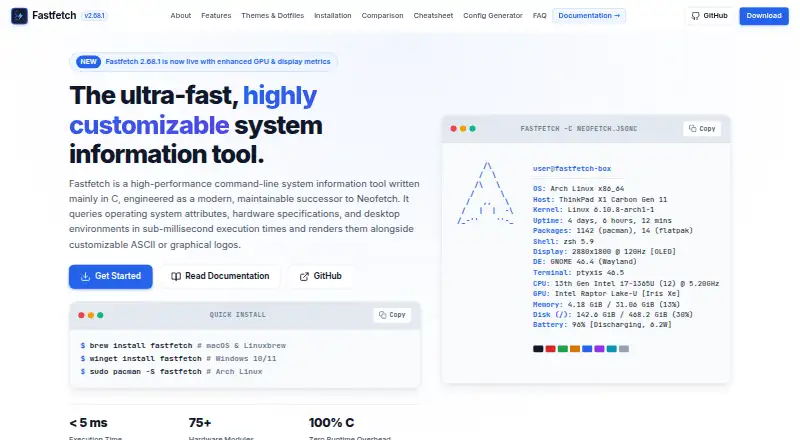
What Fastfetch is
Fastfetch is a free, open-source command-line tool that displays operating system, hardware, and software details in a terminal, alongside customizable logos. Its more than 75 built-in modules include information about CPU, GPU, memory, disks, battery, TPM, audio, and Wi-Fi. It can show ASCII logos or render images using supported terminal graphics protocols. Configuration uses JSONC, and an official JSON schema supports editor autocomplete and validation. The maker lists native support for Windows, macOS, Linux, BSD, and Android through Termux, with installation options including package managers and downloads. Fastfetch can run in shell startup setups for Bash, Zsh, Fish, PowerShell, and Nushell, and is described as compatible with Starship and Oh My Posh. The maker highlights startup greetings, hardware auditing and diagnostics, and desktop screenshot showcases as use cases. A sample configuration can query Spotify, MPD, MPRIS, or Apple Music for media information. One caveat: unconditionally printing Fastfetch in a shell startup file can disrupt SCP, SFTP, and other non-interactive shell operations.
Good
- Includes more than 75 information modules.
- Supports Windows, macOS, Linux, BSD, and Android via Termux.
- Uses JSONC with an official schema.
- Supports multiple terminal graphics protocols.
- MIT-licensed and free.
Watch out
- Unconditional shell startup output can disrupt SCP and SFTP.
- The maker does not state a dedicated support service.
Who it suits
Fastfetch suits command-line users who want system details and customizable terminal displays. It may also help with hardware auditing, diagnostics, or terminal screenshots.
Verdict
Fastfetch offers configurable system information displays across several operating systems and terminal setups. Take care with shell startup configuration to avoid disrupting non-interactive operations.
Plans and prices
From Fastfetch's own pricing page, checked 30 Sep 2026.
| Plan | Price | What it gives you |
|---|---|---|
| Fastfetch | Free | MIT-licensed open-source command-line tool · 75+ system information modules |
| Free | Free | open-source CLI · all documented modules and platforms |
The facts
Each one read from Fastfetch's own pages, with the date it was checked.
What it does
- Architecture support
- The project says it is actively tested only on x86-64 and AArch64; other architectures are not guaranteed.checked 15 Oct 2026
- Build requirements
- Current source builds require CMake with GCC 13 or newer or Clang 16 or newer; MSVC is unsupported.checked 15 Oct 2026
- Config generation
- The --gen-config command creates an interactive configuration at ~/.config/fastfetch/config.jsonc.checked 15 Oct 2026
- Configuration
- Configuration uses JSONC files and an official JSON schema that supports editor completion and validation.checked 15 Oct 2026
- Containers
- The maker provides a Docker command for running Fastfetch in a container to inspect host, container, and runtime metrics.checked 30 Sep 2026
- Hardware modules
- The product page lists more than 75 built-in modules, including CPU, GPU, memory, disk, battery, TPM, audio, and Wi-Fi information.checked 30 Sep 2026
- Implementation
- Fastfetch is an open-source system information tool written mainly in C and licensed under MIT.checked 30 Sep 2026
- Independent documentation
- The fastfetch.dev resource describes itself as a community-written guide independent of and unaffiliated with the fastfetch-cli project.checked 15 Oct 2026
- Install channels
- Install methods include distribution packages, Homebrew, MacPorts, winget, Scoop, Chocolatey, Termux and GitHub release archives.checked 15 Oct 2026
- Install options
- The maker lists package-manager or download options including winget, Scoop, Homebrew, MacPorts, APT, Pacman, DNF, FreeBSD pkg, and Termux.checked 30 Sep 2026
- Integrations
- The installation documentation lists package-manager integrations including APT, pacman, DNF, Homebrew, MacPorts, Scoop, Chocolatey, winget and Termux.checked 15 Oct 2026
- Latest release
- Release 2.69.0 was published September 25, 2026.checked 15 Oct 2026
- License
- The project is distributed under the MIT License.checked 15 Oct 2026
- Limit: output and icons
- Softpedia says enabling all modules can require scrolling or terminal resizing and that icons may need Nerd Fonts.checked 15 Oct 2026
- Limit: support boundaries
- Hysen Labs notes that only x86-64 and AArch64 are actively tested and that outdated distribution packages are unsupported.checked 15 Oct 2026
- Limit: terminal focus
- OMG! Ubuntu notes that default output can become lengthy and that Ubuntu repositories may lag behind current releases.checked 15 Oct 2026
- Maintainers
- The project identifies Carter Li as maintainer and Linus Dierheimer as original author.checked 15 Oct 2026
- Media integrations
- A sample configuration is described as querying Spotify, MPD, MPRIS, or Apple Music for media information.checked 30 Sep 2026
- Modules
- Version 2.69.0 documents 76 information modules.checked 15 Oct 2026
- Operating systems
- The maker lists native support for Windows, macOS, Linux, BSD, and Android through Termux.checked 30 Sep 2026
- Optional dependencies
- Missing optional library headers cause the related feature to be omitted instead of making the build fail.checked 15 Oct 2026
- Output formats
- Fastfetch can emit machine-readable JSON with --format json for scripts.checked 15 Oct 2026
Where it runs
- Limit: iOS availability
- An unofficial iOS port states it is jailbreak-oriented and is not intended as a normal App Store application.checked 15 Oct 2026
- Logos
- The documentation lists 540 built-in logos and supports image logos through Kitty, Sixel, iTerm2 and Chafa protocols.checked 15 Oct 2026
The full review of Fastfetch
Overview
Fastfetch is a free, open-source command-line utility for showing system details beside a logo in the terminal. It suits people who want a configurable system readout in their terminal workflow, rather than a separate graphical dashboard. Its breadth and platform range are compelling, but shell startup configuration needs care.
Written mainly in C and licensed under MIT, Fastfetch can serve as a terminal greeting, a hardware check, or a compact system summary for a desktop screenshot. Its more than 75 built-in modules cover CPU, GPU, memory, disks, battery, TPM, audio and Wi-Fi, as well as firmware and installed software. The terminal interface makes it a poor fit for anyone who wants system information presented primarily through a graphical app.
Compare more options in our System Information Software directory.
Key features
Broad system reporting
The module range lets users assemble a readout that spans core components and less routine details such as TPM status and battery information. That makes Fastfetch useful for quick auditing, though a terminal summary is not the same as a dedicated sensor-monitoring dashboard.
Configurable output
Fastfetch uses JSONC configuration, with an official JSON schema for editor autocomplete and validation. That support is useful for people tailoring output and reduces avoidable configuration errors; it still asks users to work with a configuration file rather than a visual setup interface.
Logos, media and integrations
It supports ASCII logos and image rendering through Kitty, Sixel, iTerm2 or Chafa protocols, so the visual result depends in part on the terminal setup. A sample configuration can query Spotify, MPD, MPRIS or Apple Music for media information. Shell startup integration covers Bash, Zsh, Fish, PowerShell and Nushell, and the project describes compatibility with Starship and Oh My Posh.
A Docker command can run Fastfetch to inspect host, container and runtime metrics. This provides a container-based option, but does not change the command-line nature of its output.
Pricing
Fastfetch is free: the plan costs nothing and includes the MIT-licensed command-line tool with 75+ system information modules. There is no free trial because no paid plan is needed to use the software. The free plan is the full stated offering, not a time-limited evaluation.
Platforms
Native support includes Windows, macOS, Linux, BSD and Android through Termux. Install options include winget, Scoop, Homebrew, MacPorts, APT, Pacman, DNF, FreeBSD pkg and Termux. This breadth gives users on varied systems a common style of terminal readout, though setup varies by platform and package manager.
Who it's for
Fastfetch is a strong fit for terminal users who want a customizable startup display, a compact hardware audit, or a system summary for screenshots. Its modules and configuration schema also suit users comfortable editing structured configuration. Readers who need an approachable graphical report or rely on non-interactive shell sessions should weigh the command-line format and startup caveat carefully.
Pros and cons
- Pros: More than 75 modules, including firmware, installed software and TPM status, provide a broad system snapshot without a paid plan.
- Pros: JSONC configuration and an official schema support tailored output with editor assistance.
- Pros: Support across desktop systems and Android through Termux makes it useful beyond a single operating system family.
- Cons: Output is terminal-based, so it is not the right choice for users seeking a graphical system-information interface.
- Cons: Unconditionally printing Fastfetch from a shell startup file can disrupt SCP, SFTP and other non-interactive shell operations; startup integration needs conditional handling.
- Cons: Image rendering depends on supported terminal graphics protocols, limiting the usefulness of visual logos in incompatible terminal setups.
Alternatives
HWiNFO is worth considering for Windows users looking for a freemium alternative on that platform.
Argus Monitor is a Windows alternative with a free plan and a 1-year license priced at $16.45 a year.
ASTRA32 offers a Windows freemium option with non-commercial use free.
Conky is another free option for Linux, macOS and self-hosted setups.
hw-probe is a free Linux and self-hosted alternative from the Linux Hardware Project, which anonymously collects hardware details from Linux and BSD computers to help people collaboratively debug hardware problems.
HWMonitor is a free alternative for Windows and Android, with a free trial also offered.
EtreCheckPro suits macOS users who want basic reports and diagnostics, including command-line use, at no cost for unlimited use; its Power User package is a one-time 19.99 USD purchase.
inxi is a free alternative for Linux users who want a GNU/Linux-focused tool written in Perl.
Verdict
Choose Fastfetch if you want a free, highly configurable terminal system summary with broad hardware coverage and support across several operating systems. Its range of modules and customization options make it particularly useful for terminal-based audits and startup displays. Look elsewhere if you want a graphical interface, or if you cannot safely manage shell startup behavior for non-interactive operations.
Getting started
- Open the Fastfetch website.
- Choose a listed package manager or download option for a supported system.
- Install through winget, Scoop, Homebrew, MacPorts, APT, Pacman, DNF, FreeBSD pkg, or Termux.
- Configure Fastfetch using JSONC and the official schema if desired.
- Add it to a supported shell startup setup, avoiding unconditional output for non-interactive operations.
Questions
How much does Fastfetch cost?
Fastfetch is free, and the listed plan is free.
Which operating systems does it support?
The maker lists Windows, macOS, Linux, BSD, and Android through Termux.
Is Fastfetch open source?
Yes. It is mainly written in C and licensed under MIT.
What information can it display?
Its more than 75 modules include CPU, GPU, memory, disk, battery, TPM, audio, and Wi-Fi information.
Can it show media information?
A sample configuration is described as querying Spotify, MPD, MPRIS, or Apple Music.
What should I know before adding it to shell startup?
Unconditionally printing Fastfetch can disrupt SCP, SFTP, and other non-interactive shell operations.
Alternatives to Fastfetch
- 1
Facter
Free planOpen sourceAPILinuxmacOSSelf-hosted7.4Free plan - 2
AIDA64
AndroidiOSWindows7.0€59.95 one-time - 3
Btrfsmaintenance
Free planOpen sourceLinuxSelf-hosted6.9Free plan - 4
SIW
Free planWindows6.6From $39.99 a year - 5

Speccy
Free planWindows6.6$19.95 one-time - 6

EtreCheckPro
Free planmacOS6.5$19.99 one-time