EMBA
EMBA is a free, open-source Linux environment for examining embedded-device firmware.
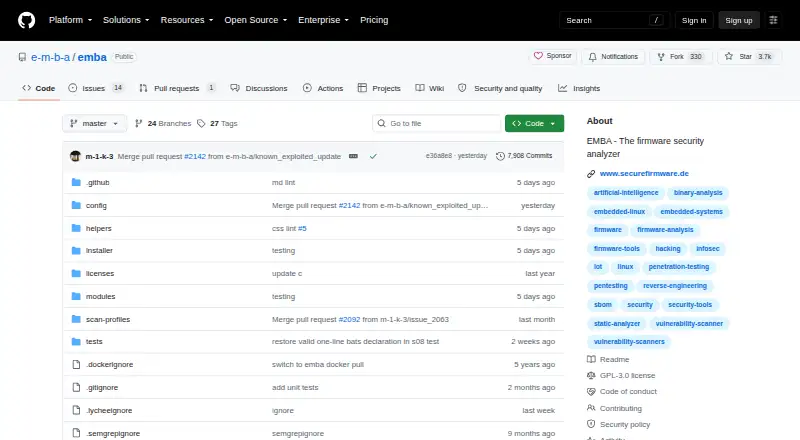
What EMBA is
EMBA is a free, open-source Linux environment for examining embedded-device firmware. It extracts firmware and combines static and dynamic analysis, then produces software inventories and web-based vulnerability reports. Checks look for outdated components, vulnerable scripts, hard-coded passwords, weak binary functions, and weak file permissions. The F15 module creates a JSON software bill of materials using CycloneDX, while F20 gathers detected versions and searches for known vulnerabilities and possible exploits. The project announces integration with Dependency-Track. EMBA is intended for penetration testers, product security teams, developers, and responsible product managers. Its guide recommends a virtual machine with current Kali Linux and default Docker mode; Ubuntu 22.04 or 24.04 should also work. Requirements include at least 16 GB RAM, eight or more processor cores recommended, and 30–100 GB free disk space. It is designed for x86-64 and does not run on ARM. Maintainers caution against productive or unprotected use.
Good
- Free and open-source firmware analysis
- Static and dynamic analysis modes
- CycloneDX JSON SBOM generation
- Vulnerability and exploit searching
- Web-based reporting
Watch out
- Does not run on ARM architecture
- Requires 16 GB or more RAM
- Needs 30–100 GB free disk space
- Developer mode can execute malicious code
Who it suits
It suits security practitioners and developers analyzing embedded firmware in controlled Linux environments. Users need substantial memory, processor capacity, and disk space.
Verdict
EMBA offers broad firmware inspection, inventory, and vulnerability workflows without a license fee. Treat it as a research and testing platform and isolate its runtime as advised.
Plans and prices
From EMBA's own pricing page, checked 4 Oct 2026.
| Plan | Price | What it gives you |
|---|---|---|
| EMBA | Free | Free and open source firmware analysis environment |
The facts
Each one read from EMBA's own pages, with the date it was checked.
What it does
- Architecture support
- EMBA is designed for x86-64 and the guide says it does not run on ARM architecture.checked 4 Oct 2026
- Firmware checks
- Its modules check for issues including outdated software, vulnerable scripts, hard-coded passwords, weak binary functions, and weak file permissions.checked 4 Oct 2026
- Integration
- The project site announces an integration with Dependency-Track.checked 4 Oct 2026
- Intended users
- EMBA is designed for penetration testers, product security teams, developers, and responsible product managers.checked 4 Oct 2026
- Project maturity
- The FAQ describes EMBA as a research and testing platform that may include raw code and says it is not recommended for productive or unprotected environments.checked 4 Oct 2026
- Purpose
- EMBA analyzes embedded-device firmware through extraction, static and dynamic analysis, SBOM generation, and web-based vulnerability reporting.checked 4 Oct 2026
- Run environment
- The project recommends running EMBA in a virtual machine with current Kali Linux and using its default Docker mode.checked 4 Oct 2026
- SBOM
- The F15 module generates a JSON SBOM from identified software inventory using CycloneDX.checked 4 Oct 2026
- Security caution
- The maintainers warn that developer mode can execute malicious code and harm the host system.checked 4 Oct 2026
- Support
- The FAQ directs users to open a GitHub issue with the question label for help.checked 4 Oct 2026
- System requirements
- The installation guide lists 16 GB or more of RAM, at least 8 processor cores recommended, and 30–100 GB of free disk space.checked 4 Oct 2026
- Vulnerability aggregation
- The F20 module aggregates detected version numbers and searches for known vulnerabilities and possible exploits.checked 4 Oct 2026
Where it runs
- Linux support
- The installation guide says current Kali Linux is recommended and Ubuntu 22.04 or 24.04 should also work.checked 4 Oct 2026
Alternatives to EMBA
- 1

Binary Ninja
Free planWebAPILinuxmacOS7.8$199 one-time - 2
Frida
Free planOpen sourceAndroidiOSAPILinux7.7Free plan - 3

rev.ng
Free planOpen sourceWebAPILinuxmacOS7.7Free plan - 4

JEB
Free planAPILinuxmacOSSelf-hosted7.6From $1,200 a year - 5
Ghidra
Free planOpen sourceAPIExtensionLinuxmacOS7.3Free plan - 6

IDA Pro
Free planLinuxmacOSWindows7.0From $1,099 a year