
Elastic Cloud Enterprise
Elastic Cloud Enterprise is a self-managed system for deploying and managing Elasticsearch clusters at scale.
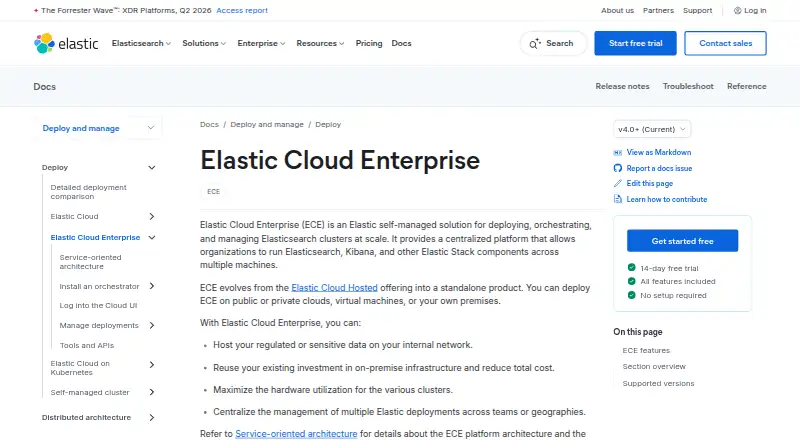
What Elastic Cloud Enterprise is
Elastic Cloud Enterprise is a self-managed system for deploying and managing Elasticsearch clusters at scale. It automates provisioning, scaling, and upgrades, with a web interface and API for cluster management. Deployments can run on public or private clouds, virtual machines, or on-premises infrastructure; listed public cloud providers are Amazon Web Services, Google Cloud Platform, and Microsoft Azure. ECE supports high availability through multiple Availability Zones, data replication, and automated restore and snapshots. Deployments can include Elasticsearch and Kibana, with optional APM and Fleet services. For deployments on version 8.0 and later, users can add a combined APM Server and Fleet Server. Access management includes platform role-based controls and external providers such as Active Directory, LDAP, and SAML. Network traffic is encrypted by default, but encryption at rest is not provided out of the box and requires configuration on hosts and snapshot targets. ECE does not support placing a specific cluster on hardware entirely dedicated apart from other clusters. Pricing is on request, with licensing based on node count and used RAM.
Good
- Automates cluster provisioning, scaling, and upgrades.
- Runs on cloud, virtual machines, or on-premises infrastructure.
- Supports high availability with replication and snapshots.
- Provides a web interface and API for cluster management.
Watch out
- Encryption at rest requires configuration on hosts and snapshot targets.
- A cluster cannot use hardware entirely dedicated from other clusters.
- FIPS compliance is not officially supported or validated.
- Pricing is on request.
Who it suits
ECE suits organizations that want to manage Elasticsearch deployments across teams or geographies, reuse on-premises infrastructure, or host sensitive data on an internal network. It may fit teams needing automated cluster management and role-based access controls.
Verdict
ECE centralizes Elasticsearch cluster deployment and operations across several infrastructure options. Account for its at-rest encryption setup, hardware limitation, and licensing based on nodes and RAM.
Plans and prices
From Elastic Cloud Enterprise's own pricing page, checked 3 Oct 2026.
| Plan | Price | What it gives you |
|---|---|---|
| License-based pricing | Priced on request | Number of nodes · used RAM · Licensing based on number of nodes and used RAM |
The facts
Each one read from Elastic Cloud Enterprise's own pages, with the date it was checked.
What it does
- Authentication and access
- ECE supports platform role-based access control and external authentication providers including Active Directory, LDAP, and SAML.checked 3 Oct 2026
- Availability
- ECE supports high availability through multiple Availability Zones, data replication, and automated restore and snapshot.checked 3 Oct 2026
- Cloud providers
- For public cloud deployments, Elastic lists Amazon Web Services, Google Cloud Platform, and Microsoft Azure.checked 3 Oct 2026
- Cluster management
- ECE automates cluster provisioning, scaling, and upgrades.checked 3 Oct 2026
- Deployment locations
- ECE can be deployed on public or private clouds, virtual machines, or on-premises.checked 3 Oct 2026
- Elastic Stack components
- ECE deployments can include Elasticsearch and Kibana, with optional services such as APM and Fleet.checked 3 Oct 2026
- Encryption
- ECE encrypts network traffic by default, but does not provide encryption at rest out of the box; hosts and snapshot targets must be configured for it.checked 3 Oct 2026
- FIPS support
- FIPS compliance is not officially supported or validated for ECE and is not recommended for production environments.checked 3 Oct 2026
- Integrations
- For deployments on version 8.0 and later, users can add a combined APM Server and Fleet Server.checked 3 Oct 2026
- Intended use
- Elastic describes ECE as useful for hosting sensitive data on an internal network, reusing on-premises infrastructure, and centrally managing deployments across teams or geographies.checked 3 Oct 2026
- Management interface
- ECE provides a web interface and API for creating and managing clusters.checked 3 Oct 2026
- Notable limitation
- ECE does not support running a specific cluster on entirely dedicated hardware separate from other clusters.checked 3 Oct 2026
- Operating systems
- ECE installation guidance names Ubuntu 20.04 and 22.04, RHEL 8, 9, and 10, Rocky Linux 8 and 9, and SUSE Linux Enterprise Server 12 SP5 and 15.checked 3 Oct 2026
- Purpose
- Elastic Cloud Enterprise is a self-managed solution for deploying, orchestrating, and managing Elasticsearch clusters at scale.checked 3 Oct 2026
The company
- Founded
- 2012checked 28 Sep 2026
Alternatives to Elastic Cloud Enterprise
- 1

IBM Db2
Free planWebAPILinuxSelf-hosted7.4From $630 a month - 2

Neo4j
Free planSelf-hosted7.0From $65 a month - 3

ClusterControl
Free planWebAPILinuxSelf-hosted6.8From €250 a month - 4

YugabyteDB Anywhere
Free planWebAPILinuxSelf-hosted6.5Free plan - 5

DbNinja
Free planWebLinuxmacOSSelf-hosted6.4Free plan - 6
Oracle Maestro
Windows6.4$129 one-time