
Dreamdata
Dreamdata is a B2B activation and attribution platform that maps customer journeys across accounts.
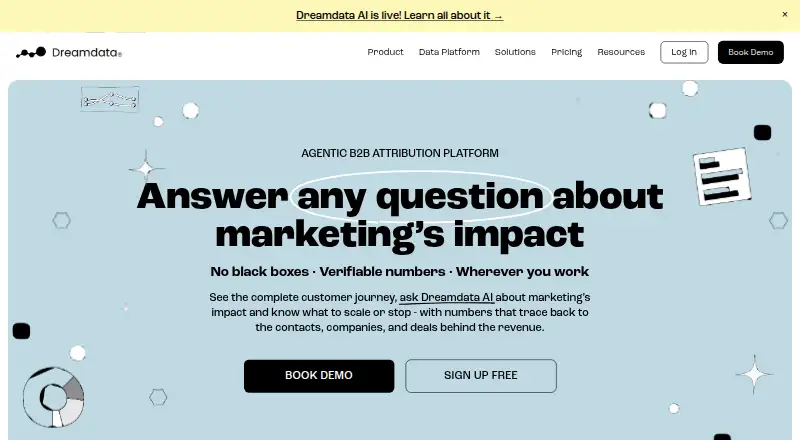
What Dreamdata is
Dreamdata is a B2B activation and attribution platform that maps customer journeys across accounts. It tracks site engagement at the account level, connects activity from contacts within the same account, and links data from ad networks. Its data modeling standardizes UTM parameters into channels and sources. Dreamdata says its IP-to-company resolution engine identifies up to 80% of companies. Analytics Hub provides custom reports and dashboards with figures traceable to their source. Customers can export the account-based go-to-market data model and connect it to business intelligence and machine-learning tools. Listed CRM integrations include HubSpot, Salesforce, Microsoft Dynamics, and Pipedrive, alongside marketing, advertising, warehouse, BI, and reverse-ETL integrations. Tracking APIs include client-side and server-side options, with Node.js and Go SDKs. AI tools include an Analytics Agent for plain-English questions, an MCP Server for preferred LLMs, and a data warehouse foundation for custom agents. Dreamdata offers a free plan at no cost, with five seats and two months of user history; the Attribution & Activation plan has custom pricing.
Good
- Tracks site engagement at the account level.
- Reports trace figures back to their source.
- Exports the account-based GTM data model.
- Free plan includes five seats.
- Provides client-side and server-side tracking APIs.
Watch out
- Free plan includes only two months of user history.
- Attribution & Activation pricing is custom.
Who it suits
It suits B2B marketers who want to map account journeys, build audiences, activate signals, and measure revenue drivers. Teams connecting marketing data to BI or machine-learning tools may also find the export and integration options relevant.
Verdict
Dreamdata links account-level engagement with journey mapping, reporting, and data export. The free plan has defined history and seat limits, while paid Attribution & Activation pricing is custom.
Plans and prices
From Dreamdata's own pricing page, checked 19 Oct 2026.
| Plan | Price | What it gives you |
|---|---|---|
| Free | Free | User history 2 months · 5 seats · 3 stage models · 2 notifications · 1 sync · $0/month |
| Attribution & Activation | Priced on request | Custom limits and volumes · Activation add-on · SCIM available as add-on · Custom pricing |
The facts
Each one read from Dreamdata's own pages, with the date it was checked.
What it does
- AI
- Dreamdata AI provides an Analytics Agent for plain-English questions, an MCP Server for preferred LLMs, and a data warehouse foundation for custom agents.checked 1 Oct 2026
- AI data policy
- Dreamdata says Analytics Agent customer data is not used to train AI models; external MCP or warehouse agents follow the customer’s chosen LLM setup.checked 19 Oct 2026
- AI launch news
- Dreamdata announced Dreamdata AI, including its Analytics Agent and MCP Server, on August 31, 2026.checked 19 Oct 2026
- Analytics Hub
- Analytics Hub provides custom reports and dashboards whose numbers trace back to their source.checked 1 Oct 2026
- API and SDKs
- The tracking API is shared by the website script, single-page-app SDK, Node.js SDK and Go SDK, with Track, Page, Identify, Group and Alias methods.checked 19 Oct 2026
- Chrome extension
- The Chrome extension provides CRM Lite account engagement and signal insights in HubSpot, Salesforce and web browsing, with links to LinkedIn and full Journey views.checked 19 Oct 2026
- Content analytics
- Content Analytics links content consumption to leads, pipeline and revenue, including content outside a company website.checked 19 Oct 2026
- Customer journeys
- Customer Journeys provides interactive account timelines and contact-level journeys from first to last touch.checked 19 Oct 2026
- Data access
- Dreamdata lets customers export its account-based GTM data model and connect it to BI and ML tools, with Hightouch and Census reverse-ETL integrations.checked 1 Oct 2026
- Data collection
- Dreamdata supports JavaScript tracking, a standardized API, user identification and event linking across a technology stack.checked 19 Oct 2026
- Data modeling
- Dreamdata connects contact activity from the same account into an end-to-end customer journey and standardizes UTM parameters into channels and sources.checked 1 Oct 2026
- Data residency
- Dreamdata says customer data is stored in European Union data centers by default and is not sold.checked 19 Oct 2026
- Digital analytics
- Digital Analytics tracks site engagement at the account level and connects data from ad networks.checked 1 Oct 2026
- Documentation
- The documentation includes CRM, marketing automation, custom uploads, attribution models, data warehouses, reverse ETL, BI tools, tracking and troubleshooting sections.checked 19 Oct 2026
- Dreamdata AI
- The Analytics Agent answers questions in plain English, while the MCP Server connects Dreamdata data to external LLMs and warehouse agents.checked 19 Oct 2026
- Encryption
- Dreamdata states that stored data uses at least AES-256 encryption and data in transit uses TLS 1.2 or higher.checked 19 Oct 2026
- Funding news
- On October 14, 2025, Crunchbase News reported a $55 million Series B led by PeakSpan Capital and total funding of $67 million since 2018.checked 19 Oct 2026
- Go requirements
- The Go SDK targets Go 1.17 or newer and supports batching, retries and graceful shutdown.checked 19 Oct 2026
- Hosted API
- Server-side tracking uses Dreamdata’s hosted batch endpoint at api.dreamdata.cloud/v1/batch with API-key authentication.checked 19 Oct 2026
- Integrations
- Official integrations include HubSpot, Salesforce, Microsoft Dynamics, Pipedrive, Marketo, Pardot, Eloqua, LinkedIn Ads, Google Ads, Meta, 6sense, Clearbit, ZoomInfo, Snowflake, BigQuery, Tableau, Looker and more.checked 19 Oct 2026
The company
- Company facts
- LinkedIn lists Dreamdata as privately held, founded in 2018, headquartered in Copenhagen and employing 51–200 people.checked 19 Oct 2026
- Company identification
- Dreamdata says its IP-to-company resolution engine identifies up to 80% of companies.checked 1 Oct 2026
- Company legal name
- Crunchbase lists the legal names Dreamdata.io ApS and Dreamdata Inc.checked 19 Oct 2026
- Headquarters
- Copenhagen, Denmarkchecked 28 Sep 2026
The full review of Dreamdata
Dreamdata is a B2B attribution and activation platform that brings account engagement together into customer journeys. It suits B2B marketing teams that need to connect marketing activity with revenue measurement; its free plan offers a practical entry point, but keeps history and seats tightly capped.
Overview
Dreamdata joins contact activity from the same account into an end-to-end journey and standardizes UTM parameters into channels and sources. That account-level view is more relevant to B2B teams working across long buying journeys than a simple tally of site visits. Its IP-to-company resolution engine says it identifies up to 80% of companies, a useful basis for account analysis, though not a promise of complete coverage.
The platform combines measurement with audience activation, AI signals, reporting, and data access. That breadth can help marketing teams follow activity from engagement through revenue analysis, while teams seeking only basic web analytics may find its account-centered approach more than they need.
Key features
Account journeys and reporting
Digital Analytics tracks site engagement at the account level and connects data from ad networks. Analytics Hub adds custom reports and dashboards with figures traceable to their source, which gives teams a way to inspect how a reported number was formed rather than relying on an opaque summary.
Dreamdata connects CRM activity from HubSpot, Salesforce, Microsoft Dynamics, and Pipedrive, alongside integrations across marketing, advertising, data warehouses, BI, and reverse ETL. Customers can export its account-based GTM data model for BI and ML tools; Hightouch and Census integrations support reverse-ETL workflows. This is a strong fit for organizations that want to use their own analytics stack, though the value depends on having the people and systems to work with exported data.
Tracking, AI, and security
Client-side and server-side tracking APIs, including Node.js and Go SDKs, give technical teams options for collecting events. Dreamdata also supports event tracking, conversion funnels, and ecommerce tracking. Its AI features include an Analytics Agent for plain-English questions, an MCP Server for preferred LLMs, and a data warehouse foundation for custom agents; these complement its reporting and data access rather than replacing the underlying analytics work.
Dreamdata states that it is SOC 2 Type II certified, GDPR compliant, and US Privacy compliant. It encrypts data at rest with at least AES-256 and data in transit with TLS 1.2 or higher. One-on-one demos, onboarding, and ongoing expert product support are available, useful for teams setting up a multi-source measurement workflow.
Pricing
Free: free, billed $0/month. It includes five seats, two months of user history, three stage models, two notifications, and one sync. That makes it a sensible way for a small team to explore account-level measurement, but the short history and low sync and notification allowances constrain sustained reporting and collaboration.
Attribution & Activation: custom pricing, with custom limits and volumes. This is the paid route for organizations whose data scale or usage needs exceed the free plan, but teams should expect to discuss both price and capacity directly rather than rely on a fixed tier.
Dreamdata has a free plan and a free trial. Its stated data retention is unlimited, but the free plan's user history remains capped at two months; retention and the history allowance are distinct limits. No trial length is stated.
Platforms
Dreamdata is available on web and through an API. The API and SDK options suit teams integrating tracking into their own systems, while the web platform serves users working with reports and dashboards. It also supports data export and connections to BI and ML tools.
Who it's for
Dreamdata is best suited to B2B marketers who need to understand engagement by account, connect marketing touchpoints to customer journeys, and measure revenue drivers. It is also relevant to teams with CRM, warehouse, BI, or reverse-ETL workflows that want to export and reuse an account-based data model.
It is a weaker fit for solo users or small teams that need extensive historical analysis at no cost: five seats and two months of user history make the free plan a bounded evaluation tier, not an expansive free analytics setup. Teams that do not need account-level attribution may be better served by a simpler analytics product.
Pros and cons
- Pros: Account-level engagement and connected contact journeys address the complexity of B2B buying paths.
- Pros: Source-traceable reports and data export support scrutiny of results and use in external BI or ML tools.
- Pros: CRM, advertising, warehouse, BI, and reverse-ETL integrations help connect marketing data with a wider analytics stack.
- Pros: Client-side and server-side APIs, plus Node.js and Go SDKs, offer technical teams multiple tracking routes.
- Cons: The free plan limits user history to two months and seats to five, restricting longer-term analysis and broader team use.
- Cons: Paid Attribution & Activation pricing and limits are custom, so buyers cannot assess cost from a fixed published tier.
- Cons: Its account-based focus may be unnecessary for users who only want straightforward site analytics.
Alternatives
Consider Factors.ai if a fixed entry price and explicit tracked-user, company-identification, and seat caps matter more than Dreamdata's custom-priced paid plan: its Basic plan is $6 a year, with up to 10,000 monthly tracked users, up to 3,000 companies identified per month, and five seats.
RevOps may suit teams prioritizing revenue-operations workflows; its Pro plan is $75 a month per user and includes 25 free collaborators, unlimited teams and templates, premium support, and implementation services.
For Salesforce-oriented teams focused on capturing sales activity, RevenueGrid offers Activity Capture 360 at $30 a month per user, with automated activity capture and real-time Salesforce integration.
Choose Gong Forecast when forecasting is the priority and a customized proposal based on per-user licenses and platform fee is acceptable.
Forma.ai is another paid alternative for teams evaluating compensation operations and implementation support.
Aviso AI may be worth considering for buyers seeking tailored use cases, white-glove onboarding and implementation, and free migration under custom pricing.
Revenue.io is aimed at Salesforce teams of 15 or more seats seeking a Salesforce-native dialer, real-time coaching, and recording under custom-quote pricing.
Momentum is a paid revenue-operations alternative with web access and a Business plan priced at $69 a month on annual plans.
Browse Revenue Operations Software, Marketing Attribution Software, Email Marketing Analytics Software, and Web analytics tools for more options by category.
Verdict
Dreamdata is a strong choice for B2B marketing teams that need account-level journeys, revenue attribution, and data they can inspect or export into their own stack. Its free plan gives small teams a way to start, but the two-month history cap and five-seat ceiling quickly matter; choose it for connected B2B measurement, and look elsewhere if you need predictable paid pricing or only basic web analytics.
Getting started
- Visit https://dreamdata.io/.
- Use the Free plan or explore the available free trial.
- Access Dreamdata through the web platform or API.
- Connect relevant CRM, marketing, advertising, warehouse, BI, or reverse-ETL integrations.
Limits worth knowing
The Free plan includes five seats, two months of user history, three stage models, two notifications, and one sync. Attribution & Activation has custom limits and volumes.
Questions
Does Dreamdata have a free plan?
Yes. Free costs nothing.
What does the Free plan include?
It lists five seats, two months of user history, three stage models, two notifications, and one sync.
Is there a free trial?
Yes, a free trial is available.
Which platforms does Dreamdata support?
Dreamdata lists web and API access.
What does the paid plan cost?
Attribution & Activation uses custom pricing.
Which CRM integrations are listed?
Dreamdata lists HubSpot, Salesforce, Microsoft Dynamics, and Pipedrive.
Alternatives to Dreamdata
- 1
Factors.ai
Free planWebAPI7.7From $199 a month - 2
MaxIQ
Free planAndroidiOSWebAPI7.5Free plan - 3

RevenueGrid
AndroidiOSWebExtension7.4From $30 a month - 4
RevOps
Free planWebAPI7.4From $75 a month - 5

Forma.ai
AndroidiOSWeb6.9 - 6

Factors.ai
WebAPI6.8From $199 a month