
Domotz
Domotz is a cloud-based platform for discovering, monitoring, and remotely managing network-connected devices across multiple sites.
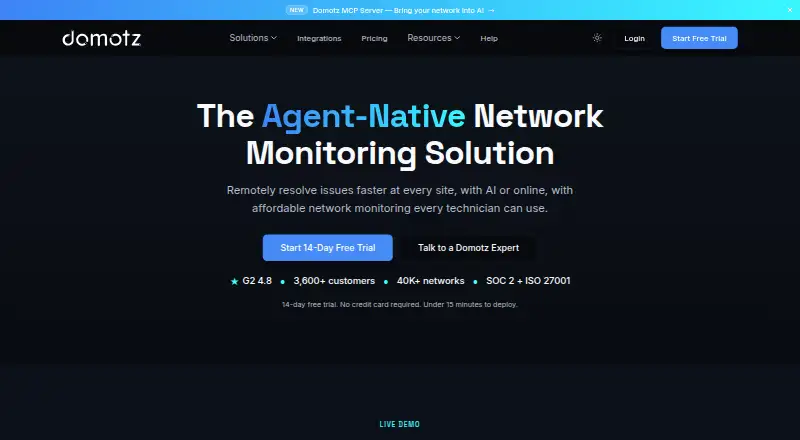
What Domotz is
Domotz is a cloud-based platform for discovering, monitoring, and remotely managing network-connected devices across multiple sites. It creates device inventories and network topology maps, then tracks device health, performance, uptime, SNMP values, and TCP services with configurable alert thresholds. Remote tools include device access and power control, configuration backup and restore, and scripts. Network diagnostics include speed tests, traceroutes, and on-demand VPN access. Domotz lists more than 100 vendor integrations and thousands of device models, with collectors available in 16 deployment options, including virtual machines, Windows, Linux, NAS, Docker, and Raspberry Pi. Its security features include SSO/SAML, two-factor authentication, role-based team management, network sharing, and audit logging. The company says it uses encryption for data in transit and at rest and holds SOC 2 Type II and ISO/IEC 27001:2022 credentials. A free discovery tier is available. The per-device option is $1.50 per managed device per month, billed in bundles of 10; the Collector Plan is $35.00 per month.
Good
- Automatic device discovery and topology mapping
- Monitors health, performance, uptime, SNMP, and TCP services
- Remote access, power control, backup, and restore
- Diagnostics include speed tests and traceroutes
- Supports multiple collector deployment options
Watch out
- Per-device billing is in bundles of 10
- Residential integrator pricing is not listed
- MSP and commercial integrator pricing is not listed
Who it suits
Domotz suits managed service providers, IT departments, system integrators, and security professionals managing devices across sites. Its free discovery tier may suit teams evaluating the platform with real network data.
Verdict
Domotz brings discovery, monitoring, remote management, and diagnostics together for networks spanning multiple sites. Check its bundle-based per-device billing or collector pricing against how you plan to manage devices.
Plans and prices
From Domotz's own pricing page, checked 23 Sep 2026.
| Plan | Price | What it gives you |
|---|---|---|
| Managed Device | $15 a month | 10 devices per minimum bundle · Billed in bundles of 10 devices |
| Per-device option | $1.50 a month | managed devices billed in bundles of 10 · per managed device per month, billed in bundles of 10 |
| Collector Plan | $35 a month | one site or network per collector · unlimited devices · every feature included · per collector per month |
| MSP and commercial integrator pricing | — | one site or network per collector · unlimited devices · per collector per month; volume and annual commitments can lower the rate to €17.50 |
| Residential integrator pricing | — | per home · per home per month; volume and annual commitments can lower the rate to €8 |
The facts
Each one read from Domotz's own pages, with the date it was checked.
What it does
- Access controls
- Listed security features include SSO/SAML, two-factor authentication, role-based team management, secure network sharing, and audit logging.checked 30 Sep 2026
- Audience
- Domotz identifies managed service providers, IT departments, system integrators, and security professionals as users of its platform.checked 30 Sep 2026
- Deployment
- Domotz says its collector has 16 deployment options, including Domotz Box, virtual machines, Windows, Linux, NAS, Docker, and Raspberry Pi.checked 30 Sep 2026
- Diagnostics
- Network diagnostics include speed tests, traceroutes, and VPN access on demand.checked 30 Sep 2026
- Integrations
- Domotz states that it supports 100+ vendor integrations and thousands of device models across software and hardware categories.checked 30 Sep 2026
- Monitoring
- Domotz monitors device health, performance, and uptime, including SNMP values and TCP services, and supports alert thresholds.checked 30 Sep 2026
- Purpose
- Domotz is a cloud-based network monitoring and management platform for discovering, monitoring, and remotely managing network-connected devices across multiple sites.checked 30 Sep 2026
- Remote management
- Features include remote access, power control, configuration backup and restore, and scripts.checked 30 Sep 2026
- Security
- Domotz says it is audited to SOC 2 Type II and certified under ISO/IEC 27001:2022, and uses cryptography for data in transit and at rest.checked 30 Sep 2026
- Support
- Domotz offers customers the option to schedule time with network experts for setup or troubleshooting.checked 30 Sep 2026
Where it runs
- Device discovery
- The platform automatically discovers network devices and provides device inventory and network topology mapping.checked 30 Sep 2026
The company
- Founded
- 2015checked 28 Sep 2026
- Headquarters
- Draper, Utah, United Stateschecked 28 Sep 2026
Money
- Free tier
- The site describes free unlimited device discovery and a free discovery tier for evaluating the platform with real network data.checked 30 Sep 2026
The full review of Domotz
Domotz is a cloud-based platform for finding and managing network-connected devices across sites. It is best suited to MSPs, IT teams, system integrators, and security professionals responsible for networks they need to monitor and support remotely. Its broad monitoring and control toolkit is compelling, but the right pricing option depends on whether you count managed devices, collectors, or homes.
Overview
Domotz brings device inventory and topology maps together with monitoring, remote management, and network diagnostics. That combination can help teams move from spotting a problem to investigating or acting on it without relying on separate tools for every task. The trade-off is a pricing structure that takes some comparison: device-based billing comes in blocks, while collector plans are organized around a site or network.
Founded in 2015 and headquartered in Draper, Utah, Domotz identifies managed service providers, IT departments, system integrators, and security professionals as its audience. Unlimited device discovery is free, so it can provide a practical starting point for evaluating network visibility before committing to paid management.
Key features
- Discovery and topology: Automatic discovery creates an inventory of network devices and maps network topology. Unlimited free discovery is useful when the immediate need is to see what is connected; it does not replace a paid plan when ongoing management is required.
- Monitoring and alerts: Domotz monitors device health, performance, and uptime, including SNMP values and TCP services, with configurable alert thresholds. Synthetic checks and traffic monitoring broaden its monitoring scope, making the platform more useful than a simple inventory for teams that need ongoing operational visibility.
- Remote management: Remote access, power control, configuration backup and restore, and scripts let teams take action as well as observe. These functions suit support and operations work across multiple sites, but users who only need discovery may not need a paid management tier.
- Diagnostics: Speed tests, traceroutes, and on-demand VPN access give teams tools to investigate network issues remotely. This is particularly relevant to providers and IT teams supporting locations they cannot routinely visit.
- Integrations and deployment: Domotz supports more than 100 vendor integrations and thousands of device models. Its collector has 16 deployment options, including a Domotz Box, virtual machines, Windows, Linux, NAS, Docker, and Raspberry Pi, offering flexibility for varied environments.
- Security and support: Domotz says it is audited to SOC 2 Type II and certified to ISO/IEC 27001:2022, and uses cryptography for data in transit and at rest. SSO/SAML, two-factor authentication, role-based team management, secure network sharing, and audit logging support controlled access. Customers can also schedule time with network experts for setup or troubleshooting.
Pricing
Domotz is freemium, with free unlimited device discovery and a 14-day trial. Paid pricing starts at $1.50/mo in the pricing note; the published per-device rate is $1.50 a month. Compare the billing unit and commitment carefully, since these options are not interchangeable.
- Per-device option — $1.50 a month: Billed per managed device per month in bundles of 10. It suits teams with a modest or predictable managed-device count, but the 10-device billing blocks mean the bill is not simply a tally of each individual device.
- Collector Plan — $35 a month: Billed per collector per month, with one site or network per collector, unlimited devices, and every feature included. This is the clearest fit for a network with many devices at one site; additional sites require additional collectors.
- Residential integrator pricing — custom pricing: Billed per home per month. Volume and annual commitments can lower the rate to €8 per home. This structure is aimed at residential integrators handling multiple homes rather than teams pricing individual devices.
- MSP and commercial integrator pricing — custom pricing: Billed per collector per month, with one site or network per collector and unlimited devices. Volume and annual commitments can lower the rate to €17.50 per collector. MSPs and commercial integrators should compare this against the standard collector price based on their volume and term.
The free discovery tier is useful for assessing what the platform finds, while paid plans are for ongoing management. The per-device option's bundles can leave some capacity unused; the collector option avoids device caps but ties cost to each site or network. Residential and integrator rates depend on volume and annual commitments.
Platforms
Domotz supports Android, iOS, Linux, macOS, web, and Windows, as well as an API. Its range of collector deployment options also includes NAS, Docker, virtual machines, and Raspberry Pi, giving teams several ways to place a collector in their environment.
Who it's for
Domotz is a strong fit for MSPs, IT departments, system integrators, and security professionals who need device discovery, monitoring, remote access, and diagnostics across one or more networks. The collector plan favors dense single-site networks, while per-device or home-based billing may better suit other deployment patterns. It is less compelling for someone who needs only basic device discovery or has no need for remote management and monitoring.
Pros and cons
- Pro: Unlimited free discovery lets teams build an inventory and assess the platform using real network data before paying.
- Pro: Monitoring, diagnostics, remote management, and topology mapping in one platform support both visibility and response across sites.
- Pro: Multiple collector deployment options and broad vendor and device support accommodate varied network environments.
- Con: Per-device billing is in bundles of 10, which can mean paying for more managed-device capacity than a smaller deployment needs.
- Con: Collector pricing is per site or network, so organizations managing many sites should account for separate collectors even when each site has few devices.
- Con: Residential and integrator pricing depends on volume or annual commitments, making it less straightforward to compare without knowing the deployment scale and term.
Alternatives
Consider UniFi Network if you want a license-free Site Manager and the option to self-host Network Server or run it on UniFi hardware; its software plan is free.
ManageEngine Network Configuration Manager may suit teams focused on network configuration management that want a free edition limited to 2 devices or a Professional Edition priced at $238 a year.
Arista NG Firewall is another freemium option, with a free tier for basic security and connectivity features with limited capabilities.
MikroTik RouterOS is an alternative to consider for its Free Demo and $45 a month Level 4 WISP plan.
TP-Link Omada SDN is another freemium network-management option.
WhatInStartup is a free Windows utility for listing and managing startup items, rather than a multi-site network management platform.
Synology Router Manager is a free alternative for web, iOS, and Android.
VyOS offers Corporate and Global plans for unlimited deployments, with Global covering multiple subsidiaries and geographic regions.
Explore network management software, network discovery software, and network monitoring for more options in these categories.
Verdict
Choose Domotz if you manage networks professionally and want discovery, monitoring, remote controls, and diagnostics in one platform, especially when unlimited devices per collector suit your site structure. Its free discovery tier makes evaluation low-risk, but the device bundles and per-site collector costs deserve close attention. Look elsewhere if you need only a small discovery tool or want pricing that does not scale by devices, sites, or homes.
Alternatives to Domotz
- 1

ManageEngine OpManager
Free planAndroidiOSWebAPI8.3From $95 a year - 2

Scanopy
Free planOpen sourceWebAPILinuxmacOS8.3Free plan - 3
ManageEngine OpUtils
Free planAndroidiOSWebAPI8.2From $138 a year - 4
NetAI
Free planWebAPILinuxSelf-hosted7.7From $5.99 a month - 5

NetXMS
Free planAndroidWebAPILinux7.2Free plan - 6
WhatsUp Gold
Free planWebAPISelf-hostedWindows7.2From $866 a year