
DocketBird
DocketBird is a web-based repository and monitoring service for federal and state court cases and documents.
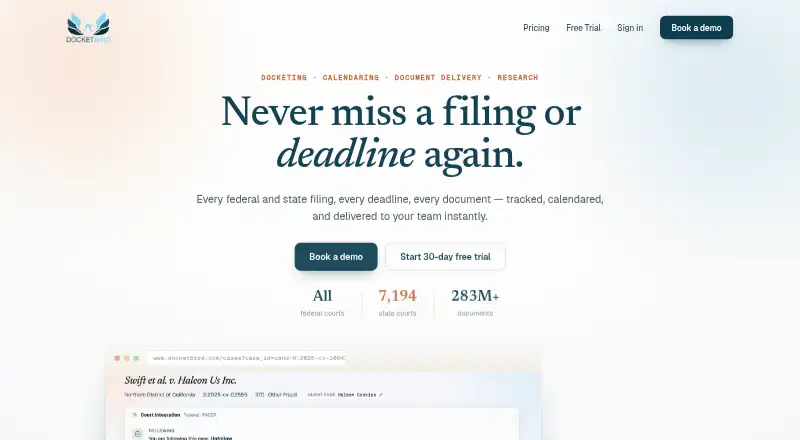
What DocketBird is
DocketBird is a web-based repository and monitoring service for federal and state court cases and documents. It integrates with all U.S. federal courts, including district, bankruptcy, and courts of appeals, as well as thousands of state courts. AutoCalendar AI extracts deadlines and events from filed documents and adds them to case calendars. Calendars can sync through an ICS link with Google Calendar, Apple Calendar, Outlook, Clio, BusyCal, and other calendar applications. DocketBird also connects with document systems including iManage, NetDocs, Clio, Dropbox, Box, Google Drive, Litify, and Filevine. Its Webhook API can send documents to custom systems in real time when filings occur or documents are downloaded. Plans include 20 active cases per seat; a case counts as active if it had a filing in the last 60 days. Each additional active case costs 75 cents. DocketBird shares docket-check costs among users and makes documents downloaded by one user available to others at no charge. Attorneys of record can generally receive federal filings without charge when their court account is integrated. Law-school, university, and public libraries can use it free if they link prominently to DocketBird.
Good
- Integrates with all U.S. federal courts.
- AutoCalendar AI extracts deadlines from filed documents.
- Calendars sync through an ICS link.
- Webhook API can deliver documents in real time.
- Library access is free with a prominent link.
Watch out
- Plans include 20 active cases per seat.
- Each excess active case costs 75 cents.
- Individual plan charges separately for court documents.
Who it suits
DocketBird suits legal professionals who monitor court cases and want filing documents and deadlines organized with calendars. Its free library offering is for law-school, university, and public libraries meeting the linking requirement.
Verdict
DocketBird combines case monitoring, document access, and calendar tools across federal and many state courts. Check active-case limits and court-document costs when choosing a plan.
Plans and prices
From DocketBird's own pricing page, checked 15 Oct 2026.
| Plan | Price | What it gives you |
|---|---|---|
| Library access | Free | Law-school, university and public libraries · prominent DocketBird website link required |
| Individual Plan | $9.99 a month | 1 active case · document downloads charged per filing · monthly |
| Individual | $9.99 a month | Daily tracking of one case · court documents priced separately |
| Research Raven add-on | $10 a month | Full-text repository search · judge, opposing counsel and law-firm analytics · annually |
| AutoCalendar Standalone Plan | $15.79 a month | $2.50 per case · automated deadline calendaring · monthly base fee |
| Starter Sparrow | $35 a month | 20 active cases per user · PACER fees extra · annually ($420/year) |
| Starter Sparrow Plan | $35 a month | 20 active cases per user · core docket tracking · PDF delivery · annually ($420/year) |
| Flow Falcon Plan | $40 a month | 20 active cases per user · Clio, Dropbox, Box, Google Drive, Filevine, iManage and NetDocuments connectors · REST API and webhooks · annually ($480/year) |
| Flow Falcon | $40 a month | 20 active cases per user · PACER fees extra · annually ($480/year) |
The facts
Each one read from DocketBird's own pages, with the date it was checked.
What it does
- Active-case allowance
- Every pricing plan includes 20 active cases per seat, with active cases defined as filings within the previous 60 days.checked 15 Oct 2026
- Active-case limit
- Each pricing plan includes 20 active cases per seat, with active cases defined as cases having a filing within the last 60 days.checked 1 Oct 2026
- AI limitation
- DocketBird acknowledges that AutoCalendar AI can make mistakes and recommends human review of extracted deadlines.checked 15 Oct 2026
- API documentation depth
- The public help center has a dedicated DocketBird APIs category, but the accessible page exposes only a single article rather than a full reference specification.checked 15 Oct 2026
- AutoCalendar AI
- AutoCalendar AI extracts deadlines from docket entries and substantive documents and applies implemented court rules.checked 15 Oct 2026
- Calendar integrations
- ICS links let calendars sync with Google Calendar, Apple Calendar, Outlook, Clio and BusyCal.checked 15 Oct 2026
- Calendar review
- Extracted deadlines can be edited by users, and each law firm receives a separate calendar.checked 15 Oct 2026
- Calendar sync
- Calendars can sync through an ICS link with Google Calendar, Apple Calendar, Outlook, Clio, BusyCal and virtually any calendaring application.checked 1 Oct 2026
- Calendar sync limitation
- The Google Calendar connection is one-way; deadline changes must be made in DocketBird.checked 15 Oct 2026
- Case monitoring
- Users can add cases, follow docket activity and receive alerts when filings occur.checked 15 Oct 2026
- Clio integration behavior
- The Clio listing says DocketBird uploads new court documents using the firm’s filename format and syncs AutoCalendar deadlines to Clio calendars.checked 15 Oct 2026
- Court access fees
- Federal docket checks generally cost about $0.10 and PACER charges can be auto-reloaded through account settings.checked 15 Oct 2026
- Court coverage
- DocketBird integrates with all United States federal courts and thousands of state courts.checked 1 Oct 2026
- Custom DMS control
- iManage and NetDocs connections allow customization of storage location and metadata.checked 15 Oct 2026
- DMS integrations
- Supported document systems include iManage, NetDocs, Clio, Dropbox, Box, Google Drive, Litify and Filevine.checked 15 Oct 2026
- Document integrations
- DocketBird integrates with iManage, NetDocs, Clio, Dropbox, Box, Google Drive, Litify and Filevine.checked 1 Oct 2026
- Document repository
- The product stores downloaded court documents and provides full-text search with Boolean, wildcard and proximity operators.checked 15 Oct 2026
- Dropbox limitation
- Files added manually to the DocketBird Dropbox folder may be deleted during resynchronization, and users are told not to rename or move folders.checked 15 Oct 2026
- Dropbox security scope
- DocketBird says its Dropbox integration can access only the Apps/DocketBird folder.checked 15 Oct 2026
- Federal courts
- Its federal integration covers all United States district, bankruptcy and courts of appeals.checked 1 Oct 2026
- Federal coverage
- The service states that it has deep integrations with every U.S. district, bankruptcy and appellate court.checked 15 Oct 2026
Money
- Clio marketplace price
- Clio’s app directory lists DocketBird as available in the United States starting at $24.99 per month.checked 15 Oct 2026
The company
- Company size
- LinkedIn lists DocketBird as a privately held software-development company with 2–10 employees.checked 15 Oct 2026
- Founded and headquarters
- LinkedIn lists the company as founded in 2014 and headquartered in Las Vegas, Nevada.checked 15 Oct 2026
The full review of DocketBird
DocketBird is a web service for tracking court cases and working with their filings and calendars. It is best suited to legal teams that need broad U.S. court coverage and want case activity to flow into existing calendar and document systems. Its strongest case is connected monitoring; active-case overages and document or PACER charges deserve a close look before committing.
Overview
DocketBird covers every U.S. federal district, bankruptcy and appeals court, along with thousands of state courts. That reach makes it a practical fit for practices following matters across jurisdictions, rather than firms whose needs are limited to a narrow court set. Monitoring, filing alerts and document access sit alongside calendar tools, so it can serve as a workflow hub rather than only a docket lookup service.
The main cost variable is case activity. Plans include 20 active cases per seat, and a case counts as active when it has a filing within the last 60 days. Each active case above that allowance costs $0.75. A stable, focused caseload can fit the included quota; a filing-heavy practice should account for overages when comparing plans.
Key features
Monitoring and calendars
Docket monitoring and filing alerts surface case activity, while AutoCalendar AI extracts deadlines and events from filed documents and publishes them to case calendars. This can reduce manual date entry, though extracted dates still belong in a workflow where staff verify critical deadlines. Calendar synchronization runs through an ICS link and supports Google Calendar, Apple Calendar, Outlook, Clio, BusyCal and virtually any calendaring application.
Document workflows
DocketBird integrates with iManage, NetDocs, Clio, Dropbox, Box, Google Drive, Litify and Filevine. Its Webhook API can push documents to custom-developed systems in real time when documents are filed or downloaded. These connections are useful for firms that already rely on those systems; teams looking for a self-contained practice-management suite should not assume DocketBird replaces one.
PACER docket-check costs are shared among users, and a document downloaded by one user becomes freely available to other users. Attorneys of record can generally receive federal filings through DocketBird without charge when their court account is integrated. DocketBird is compatible with PACER's MFA requirement, which matters for firms maintaining that account security step.
Pricing
The free Library access plan costs free for law-school, university and public libraries, provided they link to DocketBird from a prominent library webpage. It is a meaningful no-cost option for qualifying institutions, not a general free tier for firms.
The Individual plan is $9.99 a month for daily tracking of one case. Court documents are priced separately, so the low monthly entry point is most relevant to someone following a single matter who can budget separately for filings.
Research Raven add-on costs $10 a month, billed annually. It adds full-text repository search and analytics for judges, opposing counsel and law firms. As an add-on, it is for users who need those research functions alongside a plan, not a standalone substitute for case coverage.
Starter Sparrow costs $35 a month, billed annually ($420/year), and includes 20 active cases per user; PACER fees are extra. Flow Falcon costs $40 a month, billed annually ($480/year), with the same stated 20-case allowance and PACER fees extra. Both suit users who need more than one-case tracking, but the shared quota means Flow Falcon's higher price cannot be justified by a larger active-case allowance alone. Compare their other needs against the cost, and include overages above 20 active cases per seat.
Platforms
DocketBird is web-based. Its ICS calendar link and document integrations extend its workflows into connected services, but the product itself is accessed on the web.
Who it's for
DocketBird is a strong fit for attorneys and legal teams that monitor matters across federal and state courts, want filings routed into calendars or document systems, and can manage activity around a 20-case-per-seat allowance. It is less compelling for an individual who only needs occasional document access, since documents are separately priced on the Individual plan, or for a busy docket where overages and PACER charges could erode cost predictability.
Pros and cons
- Pros: Coverage spans all federal district, bankruptcy and appeals courts plus thousands of state courts, useful for multi-jurisdiction practices.
- Pros: Deadline extraction, ICS calendar sync, document integrations and a real-time Webhook API can connect filings with existing workflows.
- Pros: Shared docket-check costs and document reuse can limit duplicate PACER spending among users.
- Cons: The 20 active cases per seat allowance is based on filings in the last 60 days, and each extra active case costs $0.75.
- Cons: Individual charges separately for court documents, while PACER fees are extra on Starter Sparrow and Flow Falcon.
- Cons: The free Library access offer applies only to qualifying libraries that provide a prominent DocketBird link.
Alternatives
For a broader look at this category, browse Legal Docketing Software.
Consider CaseDesk if native access across Android, iOS, Linux, macOS and Windows matters more than DocketBird's web-only platform; its listed options include a free beta and a $290 a year Pro plan.
LitDocket is another option, with a freemium model, a free trial and web, API and self-hosted platform support.
AnchorLex may suit users seeking a web-based freemium option; its Free Plan is free and includes five court orders per month and one sync calendar.
AcclaimIP is worth considering when an annual, prepaid per-seat license with a quote-based price fits better.
Choose CourtDrive if Android or iOS access is important; it is paid, offers a free trial, and its Basic plan is $35 a month.
Deadlines.com may fit teams comparing per-case pricing: its 30+ Cases option is $20 per case per month and includes unlimited users and nationwide coverage.
For trademark protection, Alt Legal offers a paid service with a free trial and an optional Trademark Protection add-on starting at $30 a month for up to 50 matters.
DockItFlo is a web-based alternative with custom pricing per attorney per month and AI calendaring included.
Verdict
Choose DocketBird if your practice needs broad court monitoring and wants filings, dates and documents to connect with established calendar and storage tools. Its coverage and integrations are the central advantages; the key reason to look elsewhere is cost uncertainty when active cases exceed the per-seat allowance or document and PACER charges accumulate.
Getting started
- Open the DocketBird website
- Choose a plan: Library access is free for eligible libraries, Individual is $9.99 a month, Starter Sparrow is $35 a month billed annually, or Flow Falcon is $40 a month billed annually
- For full-text repository search and analytics, add Research Raven for $10 a month billed annually
- Use the web service to monitor cases and documents
Limits worth knowing
Each plan includes 20 active cases per seat, with cases active if they have a filing within the last 60 days. Additional active cases cost 75 cents each. The Individual plan charges separately for court documents.
Questions
Is DocketBird free?
Yes. Law-school, university and public libraries can use it free if they link prominently to DocketBird from a library webpage. Attorneys of record can generally receive federal filings without charge when their court account is integrated.
What does an individual plan cost?
The Individual plan costs $9.99 a month for daily tracking of one case. Court documents are priced separately.
How much do the other listed plans cost?
Starter Sparrow is $35 a month billed annually, and Flow Falcon is $40 a month billed annually. Research Raven is a $10 a month add-on billed annually.
Which courts does it cover?
DocketBird integrates with all United States federal district, bankruptcy and appeals courts, plus thousands of state courts.
Which calendars and document services connect?
Calendars can sync by ICS link with Google Calendar, Apple Calendar, Outlook, Clio, BusyCal and other calendar applications. Document integrations include iManage, NetDocs, Clio, Dropbox, Box, Google Drive, Litify and Filevine.
How are active cases counted?
A case is active if it has had a filing within the last 60 days. Each plan includes 20 active cases per seat; each additional active case costs 75 cents.
Alternatives to DocketBird
- 1
CaseDesk
Free planAndroidiOSAPILinux8.1From $290 a year - 2

Docket Alarm
Free planAndroidiOSWebAPI8.1Free plan - 3
LitDocket
Free planWebAPISelf-hosted7.3From $470 a year - 4

CourtDrive
AndroidiOSWebAPI6.9From $35 a month - 5

Filevine
Free planWebAPI6.8Free plan - 6

AnchorLex
Free planWeb6.6From $49 a month