Diktafon
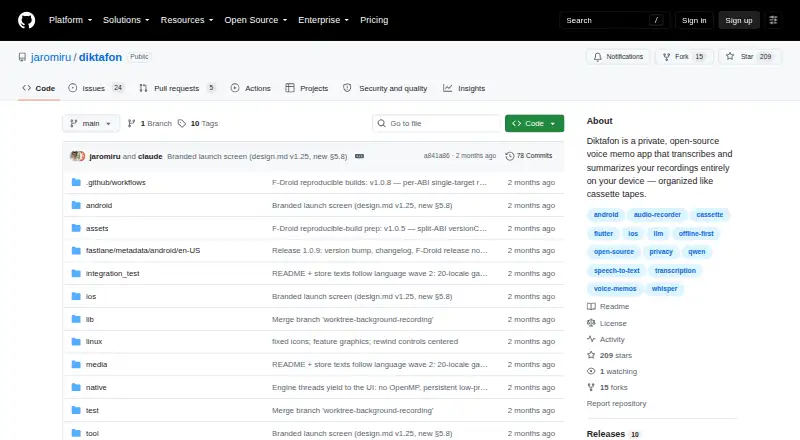
Diktafon is a free voice memo app that transcribes and summarizes recordings on the device, then groups them into topic-based cassettes.
What Diktafon is
Diktafon is a free voice memo app that transcribes and summarizes recordings on the device, then groups them into topic-based cassettes. Whisper handles transcription and Qwen creates summaries; models are downloaded on first run and can be changed in Settings. The app detects the spoken language for each memo, so recordings in different languages can share a cassette. Selecting a word in the transcript moves playback to that point in the recording. Cassettes can be exported as archives containing audio and readable text, while imports add material without replacing existing items. The privacy policy says recordings, transcripts, summaries, labels, and settings remain in private app storage and that the app collects and shares no data. It identifies model downloads over HTTPS from Hugging Face and its CDN, at the user’s request, as the app’s only network activity. The policy also says there are no accounts, analytics, crash reporting, advertising, or third-party service SDKs. Diktafon is free and open source, with Android, iOS, Linux, and macOS support. Android 7.0 or newer is required; 4 GB RAM is recommended for default models.
Good
- Transcribes and summarizes recordings on-device.
- Detects the spoken language for each memo.
- Exports cassettes with audio and readable text.
- No data collection or sharing, according to its policy.
Watch out
- Android 7.0 or newer is required.
- 4 GB RAM is recommended for default models.
- Linux instructions list runtime dependencies.
Who it suits
Diktafon suits people who want on-device transcription and summaries for voice memos, with local organization and export options. It may fit users who prefer an app whose stated data collection and sharing are absent.
Verdict
Diktafon brings transcription, summaries, and cassette organization together while keeping recordings and related content in private app storage, according to its policy. Check the device requirements and Linux dependencies before choosing it.
Plans and prices
From Diktafon's own pricing page, checked 2 Oct 2026.
| Plan | Price | What it gives you |
|---|---|---|
| Free and open-source | Free | No cost · no ads · MIT-licensed |
The facts
Each one read from Diktafon's own pages, with the date it was checked.
What it does
- Accounts and analytics
- The app has no user accounts, analytics, crash reporting, advertising, or third-party service SDKs, according to its privacy policy.checked 2 Oct 2026
- Download verification
- Each release ships a SHA256SUMS file, and the repository says release artifacts include GitHub build-provenance attestations.checked 2 Oct 2026
- Export and import
- Cassettes can be exported as archives containing audio and readable text, and imports add content without overwriting existing items.checked 2 Oct 2026
- Languages
- The spoken language is detected for each memo, so a cassette can contain recordings in multiple languages.checked 2 Oct 2026
- Network use
- The policy says the app’s only network activity is downloading machine-learning models over HTTPS from Hugging Face and its CDN at the user’s request.checked 2 Oct 2026
- Purpose
- Diktafon is a voice memo app that transcribes and summarizes recordings on the device and organizes them into topic-based cassettes.checked 2 Oct 2026
- Support
- The privacy policy lists [email protected] and opening a GitHub issue as contact options.checked 2 Oct 2026
- Transcription and summaries
- The app uses Whisper for transcription and Qwen for summaries, with models downloaded once on first run and switchable in Settings.checked 2 Oct 2026
- Transcript playback
- Tapping a word in a transcript jumps playback to that point in the recording.checked 2 Oct 2026
Where it runs
- Android requirements
- Android 7.0 (API 24) or newer is required, and 4 GB RAM is recommended for the default models.checked 2 Oct 2026
- iOS requirements
- The iOS app requires iOS 13.0 or newer, and the project recommends a recent device for the default models.checked 2 Oct 2026
- Linux requirements
- The Linux instructions list libmpv, parecord, and ffmpeg as runtime dependencies, and say the build uses Ubuntu 24.04 with glibc 2.39.checked 2 Oct 2026
- On-device privacy
- The privacy policy says recordings, transcripts, summaries, labels, and settings stay in the app’s private storage, and the app collects and shares no data.checked 2 Oct 2026
The company
- Headquarters
- Všenory, Czechiachecked 23 Sep 2026
- Maker
- The project says it was designed by Jaromír Janisch.checked 2 Oct 2026
The full review of Diktafon
Overview
Diktafon is a voice memo app for people who want recordings turned into transcripts and summaries without sending them to a cloud service. Its topic-based cassettes suit anyone who needs to keep related recordings together; the trade-off is that model downloads and some platform requirements deserve attention before installation.
It brings recording, transcription, summaries, and archive-based transfer into one free, open-source app, with a privacy policy that says app content stays in private storage and no data is collected or shared.
Key features
- On-device transcription and summaries: Whisper transcribes recordings and Qwen generates summaries. Models download once on first run and can be changed in Settings. This keeps processing on the device, but requires a model download before those capabilities are ready.
- Transcript-linked playback: Tapping a word in the transcript jumps to that point in the audio, making it more direct to revisit a passage than scrubbing through a recording.
- Language detection per memo: Diktafon detects the spoken language separately for each recording, so multilingual users can keep recordings in different languages in the same cassette.
- Cassette archives: Exported archives include audio and readable text. Imports add content without overwriting existing items, a useful safeguard when combining collections.
- Private app storage: The privacy policy says recordings, transcripts, summaries, labels, and settings stay in the app’s private storage. It says the app collects and shares no data and has no accounts, analytics, crash reporting, advertising, or third-party service SDKs. Its only network activity is downloading models over HTTPS from Hugging Face and its CDN at the user’s request.
Pricing
Diktafon is free: its Free and open-source plan costs nothing, with no ads and an MIT license. There is no paid tier or trial to weigh against the free plan. That makes it a straightforward choice for individual use, though the plan information gives no usage quota to compare against other apps’ capped free tiers.
The plan includes transcription, audio export, and text export. The app’s cassette archive combines audio and readable text, so users can move both together. There is no subscription renewal to manage.
Platforms
Diktafon supports Android, iOS, Linux, and macOS. Android requires version 7.0 (API 24) or newer; 4 GB of RAM is recommended for the default models. The iOS app requires iOS 13.0 or newer, and a recent device is recommended for those models.
Linux users should account for libmpv, parecord, and ffmpeg as runtime dependencies. The build uses Ubuntu 24.04 with glibc 2.39, a consideration for systems that do not match that environment. Although Windows appears among the general platform list, the plan’s supported-platform list names Android, iOS, Linux, and macOS.
Each release ships a SHA256SUMS file, and the repository says its release artifacts include GitHub build-provenance attestations. Support is available by email at [email protected] or through a GitHub issue.
Who it's for
Diktafon is best for people who want private, device-side transcription and summaries, especially those organizing related memos by topic or recording in more than one language. Its transcript-to-audio navigation and non-destructive archive imports also suit users who revisit recordings and maintain their own collections.
It is less suited to anyone who needs a cloud workflow or wants to avoid downloading machine-learning models. Linux users should be comfortable with the required runtime dependencies, and users on older phones should consider the memory and device recommendations.
Pros and cons
- Pro: Transcripts, summaries, labels, and settings stay in private app storage according to the policy, which supports a privacy-conscious workflow.
- Pro: Word-level transcript navigation and multilingual cassettes make it practical to review and organize varied recordings.
- Pro: The free, MIT-licensed plan has no ads, and archive imports add items instead of replacing existing content.
- Con: Model downloads are required on first run, so the transcription and summary workflow is not ready without that initial network transfer.
- Con: Android’s 4 GB RAM recommendation and the Linux dependencies may rule it out for some devices or installations.
- Con: The supported-platform list omits Windows, despite Windows appearing in the general platform list, so Windows users should not assume a supported app build.
Alternatives
For a broader category comparison, browse Voice Note Apps.
- Voicenotes is worth considering if you want web and browser-extension access alongside mobile and desktop apps; its Basic plan is free and caps transcription at 100 weekly minutes with 30-day history.
- Whispr Notes may fit better if you want a free plan with 10 hours of monthly transcription and semantic search, or prefer a trial before choosing a paid tier.
- Voice Notebook is an option if web access matters or you want its free web service for transcribing audio files up to 15 minutes.
- AudioPen may suit short recordings when transcription and rewriting are the priority; its free plan limits recordings to 3 minutes.
- Fabric is an alternative if you want a broader cross-platform app with API access and a paid Plus plan that includes 50GB storage and light AI usage.
- Cleft is a narrower Apple-platform option whose free Basic plan includes five-minute recordings, on-device transcription, tags, search, and export.
- Voice Inbox is another iOS and macOS choice, with a free plan centered on an inbox workflow, on-device Whisper transcription, and full-text search.
- Google Recorder is a free Android alternative.
Verdict
Choose Diktafon if you want free, open-source voice memos with on-device transcription, summaries, and topic-based organization, and value keeping recordings and related content in private app storage. Look elsewhere if you need a clearly supported Windows build, want to avoid model downloads, or prefer a service built around web access.
Getting started
- Open the Diktafon project website
- Install the app on Android, iOS, Linux, macOS, or Windows
- Launch it and download the machine-learning models on first run
- Change transcription or summary models in Settings if needed
- Record memos and organize them into topic-based cassettes
Questions
How much does Diktafon cost?
The Free and open-source plan costs nothing, with no ads, under the MIT license.
Which platforms does it support?
The listed platforms are Android, iOS, Linux, macOS, and Windows.
Does Diktafon require an account?
No. Its privacy policy says the app has no user accounts.
Is Diktafon open source?
Yes. The project is offered under the MIT license.
Where does Diktafon send data?
The policy says recordings and related content stay in private storage; network use is model downloading over HTTPS from Hugging Face and its CDN when requested.
Alternatives to Diktafon
- 1
AudioPen
Free planAndroidiOSWebExtension8.2From $99 a year - 2
Voice Notebook
Free planAndroidiOSWebExtension8.1From $16 a year - 3

Voicenotes
Free planAndroidiOSWebAPI8.1From $9 a month - 4

AudioNote
Free planAndroidiOSmacOSWindows7.9$12.99 one-time - 5

Fabric
AndroidiOSWebAPI7.9From $8 a month - 6

Whispr Notes
Free planAndroidiOSWebAPI7.9From $4.17 a month