
Datadog Kubernetes Monitoring
Datadog Kubernetes Monitoring gives teams visibility into the health, performance, and security of Kubernetes environments, from individual pods to multiple …
What Datadog Kubernetes Monitoring is
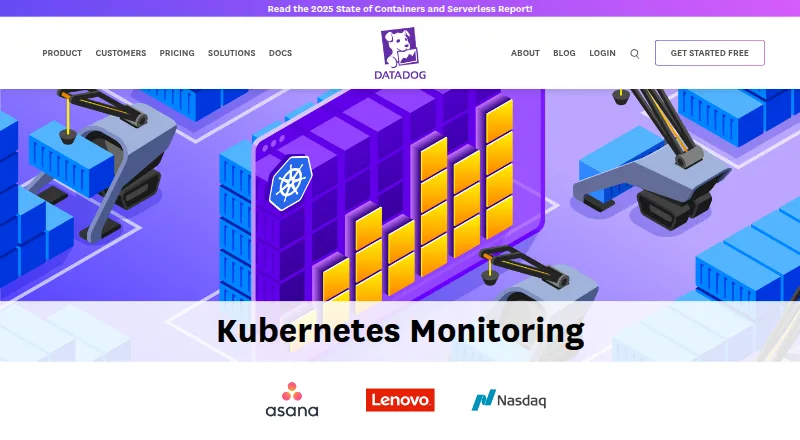
Datadog Kubernetes Monitoring gives teams visibility into the health, performance, and security of Kubernetes environments, from individual pods to multiple clusters. Its Kubernetes Overview correlates component logs, traces, metrics, network traffic, and security signals. Customizable dashboards, forecasting, and anomaly detection help teams examine that telemetry. Datadog says it supports managed Kubernetes platforms and self-hosted Rancher, OpenShift, and Anthos environments; the Kubernetes check is included in the Datadog Agent package. Container Monitoring covers pod health, vulnerabilities, resource use, and deployment status. Other capabilities include threat detection, autoscaling recommendations, and remediation workflows for alerts. Datadog lists support for more than 15 compliance frameworks in Container Monitoring, including PCI DSS, SOC 2, HIPAA, and GDPR. Its Kubernetes solution names Istio, Karpenter, and Vault among more than 1,000 integrations, including major cloud providers. A free plan and 14-day trial are listed. Container Monitoring costs $1 per container per month, billed annually or month-to-month; on-demand billing is $0.002 per container hour. Datadog is headquartered in New York City.
Good
- Correlates logs, traces, metrics, traffic, and security signals.
- Supports managed and named self-hosted Kubernetes environments.
- Container Monitoring shows pod health and resource use.
- Free plan and 14-day trial are listed.
- Offers autoscaling recommendations and alert remediation workflows.
Watch out
- Container Monitoring is priced per container.
- Support live chat is limited to business days, 10:00–19:00 ET.
Who it suits
It suits teams responsible for monitoring Kubernetes workloads across managed platforms or self-hosted environments. Teams seeking visibility into telemetry, security signals, and container resources may find its coverage relevant.
Verdict
Datadog combines Kubernetes telemetry with container monitoring, security, and scaling capabilities. A free plan and trial are available, while Container Monitoring's listed paid price is per container or container hour.
Plans and prices
From Datadog Kubernetes Monitoring's own pricing page, checked 28 Sep 2026.
| Plan | Price | What it gives you |
|---|---|---|
| Container Monitoring (on-demand) | Free | $0.002 per container hour · Per container hour, per hour |
| Container Monitoring | $1 a month | $1 per container per month; on-demand is $0.002 per container hour · Billed annually or month-to-month; per container, per month |
The facts
Each one read from Datadog Kubernetes Monitoring's own pages, with the date it was checked.
What it does
- Autoscaling
- Kubernetes Autoscaling offers workload scaling recommendations and automation, and can scale based on custom Datadog queries or metrics.checked 28 Sep 2026
- Compliance
- Container Monitoring lists out-of-the-box support for more than 15 frameworks, including PCI DSS, SOC 2, HIPAA, and GDPR.checked 28 Sep 2026
- Container visibility
- Container Monitoring provides multidimensional visibility into pod health, vulnerabilities, resource use, and deployment status.checked 28 Sep 2026
- Dashboards and analysis
- Customizable dashboards and machine learning driven forecasting and anomaly detection help teams monitor Kubernetes data.checked 28 Sep 2026
- Integrations
- The Kubernetes solution page names Istio, Karpenter, and Vault and says teams can use data from 1,000+ integrations, including major cloud providers.checked 28 Sep 2026
- Kubernetes setup
- The Kubernetes check is included in the Datadog Agent package, so no additional installation is needed on Kubernetes servers.checked 28 Sep 2026
- Purpose
- Datadog provides visibility into the health, performance, and security of Kubernetes environments, from individual pods to multiple clusters.checked 28 Sep 2026
- Remediation
- Bits AI Kubernetes Remediation can automate workflows from alert to pull request and offers guided playbooks for errors such as CrashLoopBackOff and OOMKilled.checked 28 Sep 2026
- Security
- The product page says Datadog can identify cluster threats in real time using out-of-the-box security rules for suspicious activity.checked 28 Sep 2026
- Support
- Datadog Support offers ticket submission and live chat on business days from 10:00 to 19:00 ET.checked 28 Sep 2026
- Supported environments
- Datadog says it provides Kubernetes visibility on managed platforms and self-hosted Rancher, OpenShift, or Anthos environments.checked 28 Sep 2026
- Telemetry
- Kubernetes component logs, traces, metrics, network traffic, and security signals are correlated in the Kubernetes Overview page.checked 28 Sep 2026
- Trust center
- Datadog's Trust Center lists compliance topics including GDPR, HIPAA, ISO/IEC 27001, PCI DSS, and SOC 2 Type 2, and provides access to security documentation by request.checked 28 Sep 2026
The company
- Company
- Datadog's investor FAQ lists its corporate headquarters as New York City.checked 28 Sep 2026
- Founded
- 2010checked 23 Sep 2026
- Headquarters
- New York City, New York, USAchecked 23 Sep 2026
Money
- Trial
- Datadog advertises a 14-day free trial of its product suite.checked 28 Sep 2026
The full review of Datadog Kubernetes Monitoring
Overview
Datadog Kubernetes Monitoring brings health, performance, and security visibility to Kubernetes workloads, from individual pods through multiple clusters. It suits teams that want telemetry and operational tools in one platform, especially across managed and self-hosted environments. Its breadth is compelling, but per-container pricing can make the cost grow with the fleet.
Key features
Datadog correlates Kubernetes logs, traces, metrics, network traffic, and security signals in a Kubernetes Overview page. Custom dashboards, forecasting, and anomaly detection help teams make sense of those signals; support for control-plane monitoring, distributed tracing, Kubernetes logs, and 450-day data retention rounds out the monitoring coverage.
The Kubernetes check comes with the Datadog Agent package, so Kubernetes servers do not need a separate check installation. Datadog supports managed Kubernetes as well as self-hosted Rancher, OpenShift, and Anthos, and connects to more than 1,000 integrations, including major cloud providers. Named integrations include Istio, Karpenter, and Vault. That range makes it a natural fit for mixed environments, though it also means teams should choose the capabilities they need rather than assume every workload benefits from the full suite.
Container Monitoring adds views of pod health, vulnerabilities, resource use, and deployment status. Datadog also offers real-time cluster threat detection with built-in security rules and out-of-the-box support for more than 15 compliance frameworks, including PCI DSS, SOC 2, HIPAA, and GDPR. Its Trust Center covers GDPR, HIPAA, ISO/IEC 27001, PCI DSS, and SOC 2 Type 2, with security documentation available by request.
For response and capacity work, Bits AI Kubernetes Remediation can automate workflows from alert to pull request and offers guided playbooks for errors such as CrashLoopBackOff and OOMKilled. Kubernetes Autoscaling provides scaling recommendations and automation, including scaling based on custom Datadog queries or metrics. Email, Slack, PagerDuty, Microsoft Teams, and webhooks are supported alerting channels. These tools give teams options beyond detection, but the breadth may be more than a monitoring-only deployment needs.
Pricing
Datadog is freemium, with a free plan and a 14-day free trial of its product suite. Container Monitoring's on-demand option is $0.002 per container hour. The annual or month-to-month Container Monitoring plan is $1 per container per month; on-demand remains $0.002 per container hour. The hourly option suits variable usage, while monthly per-container billing is easier to forecast for steady workloads. In either case, container count is central to the bill, so costs can rise as deployments expand.
The free plan provides a way to start without a subscription, and the trial lets teams evaluate the suite. Container Monitoring is the priced plan described here; teams should match their expected container usage to its per-container or per-hour basis before committing. Datadog Support accepts tickets and offers live chat on business days from 10:00 to 19:00 ET.
Platforms
Datadog supports API, Linux, macOS, self-hosted, web, and Windows environments. Its Kubernetes visibility spans managed services and self-hosted clusters, including Rancher, OpenShift, and Anthos.
Who it's for
Datadog is best suited to teams operating Kubernetes at scale or across varied environments that want monitoring, security, compliance, remediation, and autoscaling capabilities together. It is less compelling for a small cluster needing only basic monitoring, particularly if per-container charges matter more than an integrated toolset.
Pros and cons
- Pros: Correlated logs, traces, metrics, network traffic, and security signals provide a broad view of cluster health.
- Pros: Managed and self-hosted Kubernetes support, plus more than 1,000 integrations, suit varied infrastructure.
- Pros: Remediation workflows and query-based autoscaling extend the product from observation into response and capacity management.
- Cons: Container Monitoring is priced per container or container hour, so usage costs can track cluster growth.
- Cons: Teams seeking only a lightweight monitor may not need its security, compliance, remediation, and scaling breadth.
Alternatives
For a broader comparison, see Kubernetes Monitoring. Coroot is a freemium alternative with a self-hosted Community Edition under the Apache 2.0 license. Site24x7 Kubernetes Monitoring is another option, with free access and per-container pricing plus node-level pricing availability.
groundcover offers a free forever plan with 12-hour data retention, Slack Community support, and BYOC. Radar is an open-source Kubernetes UI. Pixie offers a free hosted version of its open-source project, while Prometheus is a free, Apache 2.0-licensed monitoring and alerting toolkit. VictoriaMetrics has open-source single-node and cluster versions. Botkube is worth considering when a self-hosted plan capped at five nodes in one cluster fits the need.
Verdict
Choose Datadog Kubernetes Monitoring if your team needs Kubernetes telemetry alongside security, compliance, remediation, and scaling tools across a varied environment. Its main advantage is that operational signals and follow-up actions sit within one broad platform; its main drawback is container-based pricing, which makes simpler or smaller monitoring needs a case for a lighter alternative.
Alternatives to Datadog Kubernetes Monitoring
- 1
Checkmk
Free planOpen sourceAndroidiOSWebAPI8.8From $275 a month - 2
Netdata
Free planOpen sourceAndroidiOSWebAPI8.7From $4.50 a month - 3
Grafana Cloud Application Observability
Free planAndroidiOSWebAPI8.4From $0.03 a month - 4
Coroot
Free planOpen sourceWebAPILinuxSelf-hosted8.2From $1 a month - 5

Middleware
Free planAndroidiOSWebAPI8.2$0.30 usage-based - 6

SigNoz
Free planAndroidiOSWebAPI7.6From $19 a month