
Comprehensive
Comprehensive is a web-based platform for planning, communicating, and benchmarking employee compensation.
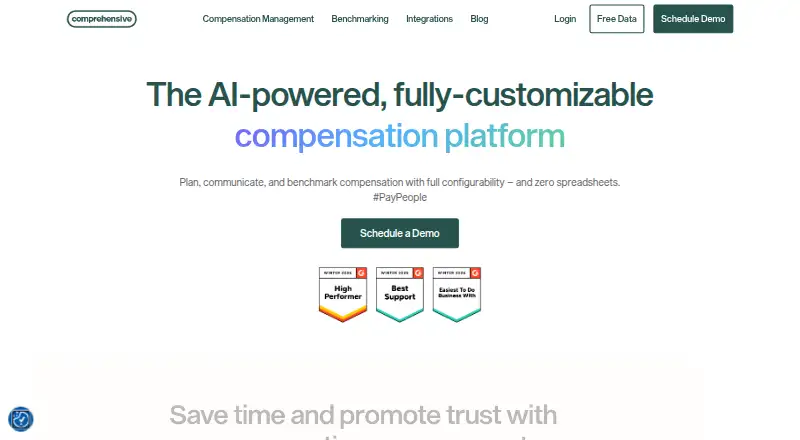
What Comprehensive is
Comprehensive is a web-based platform for planning, communicating, and benchmarking employee compensation. Teams can configure cycles for promotions, salary changes, bonuses, and equity grants, with salary review and approval workflows, budget controls, compensation bands, and an audit trail. Employee dashboards can bring together salary, bonuses, variable compensation, equity, benefits, and other employer-provided rewards when the necessary data is available. Pay ranges are managed centrally and can be shared selectively according to permissions; formal ranges are optional for compensation cycles.
Analytics include pay equity reporting, demographic segmentation, promotion rate analysis, and market-position distributions. AI capabilities provide compensation data insights, match jobs across data sources, and offer personalized coaching for managers. Listed integrations include Rippling, BambooHR, Paylocity, Paycor, ADP Marketplace, 15Five, Klaar, Culture Amp, Salary.com, Mercer, Carta, and Shareworks. HRIS integrations typically sync daily, and syncing can be paused or run on demand; available fields depend on the HRIS. Comprehensive says it complies with SOC 2, GDPR, and CCPA, and supports SAML-based single sign-on. It serves teams from one person to larger organizations.
Good
- Configurable cycles cover promotions, salary changes, bonuses, and equity grants.
- Includes salary review, approval, budget, band, and audit-trail capabilities.
- Dashboards can show multiple forms of employee rewards.
- Analytics cover pay equity, promotion rates, and market-position distributions.
- HRIS syncing can be paused or run on demand.
Watch out
- Compensation management pricing is calculated per employee, with no public dollar amount.
- Benchmark coverage varies by role and dataset.
- Niche or hybrid roles may need blended benchmarks or internal calibration.
Who it suits
Comprehensive suits teams that need structured compensation cycles, salary review and approval workflows, or a way to combine employee rewards information. It may also help teams seeking pay equity analytics, manager coaching, and HRIS connections.
Verdict
Choose Comprehensive if you need compensation-cycle workflows alongside reward dashboards, analytics, and manager support. Teams with highly niche or hybrid roles should account for the possibility of blended benchmarks or internal calibration. The compensation management price is provided on request.
Plans and prices
From Comprehensive's own pricing page, checked 7 Oct 2026.
| Plan | Price | What it gives you |
|---|---|---|
| Startup compensation benchmarking data | Free | Free access to the full anonymized dataset after contributing compensation data through the survey |
| Startup Compensation Data | Free | VC-backed technology companies · contribute compensation data · survey takes about 15 minutes · Free after survey participation |
| Compensation management | — | Pricing based on total employee count · headcount changes are prorated · implementation fee may apply and can often be waived · Annually; price is calculated per employee per month, with no public dollar amount stated. |
| Compensation Platform | Priced on request | Annual agreement · headcount-based pricing · implementation fee may apply · Calculated per employee per month and billed annually |
The facts
Each one read from Comprehensive's own pages, with the date it was checked.
What it does
- AI analytics
- The product provides AI-generated insights from compensation data and demographic pay-equity analysis.checked 14 Oct 2026
- AI features
- AI features include compensation data insights, job matching across data sources, and personalized manager coaching.checked 7 Oct 2026
- Analytics
- Analytics include pay equity reporting, demographic segmentation, promotion rate analysis, and market-position distributions.checked 7 Oct 2026
- Benchmark filters
- Users can search by title, location, industry and level, compare levels and view base, short-term and long-term incentives.checked 14 Oct 2026
- Benchmarking data
- Benchmarking combines daily-refreshed ranges from more than 6,000 U.S. technology companies, Mercer data, Salary.com data and a startup dataset from more than 550 VC-backed companies.checked 14 Oct 2026
- Compensation cycles
- Its workflows support promotions, salary changes, bonus targets and payouts, equity grants, eligibility rules, budgets and approvals.checked 14 Oct 2026
- Custom feeds
- Tools not listed can be connected through SFTP file feeds or custom integrations.checked 14 Oct 2026
- Data synchronization
- HRIS connections sync employee identity, job, salary, manager and organizational data, generally on a daily cadence with some initial syncs completing within minutes.checked 14 Oct 2026
- Data syncing
- HRIS integrations typically sync daily and can be paused or run on demand; available fields depend on the HRIS.checked 7 Oct 2026
- Evaluation environment
- Customers can evaluate with scrubbed sample data, guided demos or a sandbox environment.checked 14 Oct 2026
- Implementation
- The company says compensation experts can make customers operational in under two weeks, while its FAQ describes typical setup as two to four weeks.checked 14 Oct 2026
- Independent limit: OTE data
- Gappsy notes that bonus, commission and OTE information may need manual maintenance when reliable HRIS synchronization is unavailable.checked 14 Oct 2026
- Independent review summary
- Gappsy describes the product as a unified platform with configurable workflows, AI benchmarking and strong HRIS connections, while noting that pricing is quote-based and headcount-sensitive.checked 14 Oct 2026
- Integrations
- Listed connectors include Rippling, BambooHR, Paylocity, Paycor, ADP Marketplace, 15Five, Klaar, Culture Amp, Salary.com, Mercer, Carta and Shareworks.checked 14 Oct 2026
- Intended users
- The platform is described as serving teams ranging from one person to larger organizations, with help for bandwidth, visibility, automation, and process.checked 7 Oct 2026
- Limit: candidate workflows
- Candidate-facing Total Rewards and offer-letter experiences are listed as roadmap items.checked 14 Oct 2026
- Limit: integrations and setup
- G2 reviewers report that some integrations feel clunky, broader HRIS coverage is wanted and initial uploads can be confusing because a template is not provided.checked 14 Oct 2026
- Limit: job-profile automation
- New-hire job-profile assignment is usually manual, with automation available only in some HRIS cases.checked 14 Oct 2026
- Limit: manual data
- Benefits data unavailable through an integration API and some bonus or commission fields may require manual uploads or maintenance.checked 14 Oct 2026
- Limit: niche benchmarks
- The FAQ warns that market coverage can be thin for highly niche roles and may require human judgment.checked 14 Oct 2026
The company
- Company
- Comprehensive is listed as headquartered in San Francisco, California, and founded in 2021.checked 7 Oct 2026
- Company dataset
- A LinkedIn company update says its executive benchmark dataset covers 4,272 executives across more than 550 VC-backed companies.checked 14 Oct 2026
- Company identity
- LinkedIn lists Comprehensive as a privately held technology, information and internet company headquartered in San Francisco, founded in 2021, with 11–50 employees.checked 14 Oct 2026
Money
- G2 implementation and cost
- G2 user averages show one month to implement and a perceived cost level of five dollar signs.checked 14 Oct 2026
The full review of Comprehensive
Comprehensive is a web-based compensation platform for teams that need to plan pay decisions, analyze outcomes, and communicate rewards. It is most compelling when compensation cycles and employee reward dashboards need to sit alongside benchmarking and manager support. Its main caveat is that niche or hybrid roles may not map cleanly to available benchmarks.
Overview
Comprehensive brings compensation planning and reward communication into one system. Teams can configure cycles for promotions, salary changes, bonuses, and equity grants, while employee dashboards can show salary, variable pay, equity, benefits, and other employer-provided rewards when the relevant data is available. That can make the full package easier to understand, but the dashboard is only as complete as the underlying records.
Pay ranges can be managed centrally and shared selectively using permissions. Formal ranges are optional for compensation cycles, which gives teams flexibility if they have not yet established bands. For organizations that want every decision tied to formal ranges, that flexibility means the framework still needs to be defined internally.
Key features
Cycles, controls, and analytics
Salary review and approval workflows, budget controls, compensation bands, and an audit trail support a more governed review process. These tools are useful for coordinating recommendations and retaining a record of decisions; their practical value is greatest when multiple managers participate in a cycle.
Analytics cover pay equity, demographic segmentation, promotion rates, and market-position distributions. That breadth helps teams examine patterns across compensation and advancement rather than focusing only on individual salary changes. AI adds compensation-data insights, job matching across data sources, and personalized manager coaching, giving managers guidance as well as a view of the numbers.
Integrations and implementation
Integrations include Rippling, BambooHR, Paylocity, Paycor, ADP Marketplace, 15Five, Klaar, Culture Amp, Salary.com, Mercer, Carta, and Shareworks. HRIS data typically syncs daily, with options to pause syncing or run it on demand; the fields available depend on the HRIS. Teams should confirm that their essential data is supported before relying on automated updates.
Most implementations take two to four weeks, although some customers go live in a few days. A standard implementation fee may apply but can often be waived. Annual agreements typically come with high-touch support and direct access to implementation and support teams, a strong fit for buyers who want guided setup rather than a self-service-only relationship. Comprehensive says it complies with SOC 2, GDPR, and CCPA and supports SAML-based single sign-on.
Pricing
The free Startup compensation benchmarking data plan costs nothing. It provides access to the full anonymized dataset after a company contributes compensation data through the survey. It is a useful entry point for benchmarking, but it is not the compensation-management plan with cycles and workflows.
Compensation management has custom pricing, billed annually and calculated per employee per month. Pricing is based on total employee count, headcount changes are prorated, and an implementation fee may apply, though it can often be waived. The free data plan avoids a subscription price but requires survey participation; teams seeking planning workflows should expect an annual paid agreement and a quote based on headcount.
Platforms
Comprehensive is available on the web. No mobile platform is specified, so teams should plan to use a browser-based workflow.
Who it's for
The product is designed for teams from a single compensation practitioner to larger organizations, particularly those looking to combine structured reviews, reward visibility, analytics, and manager coaching. It can also suit organizations that are still formalizing pay ranges because ranges are not required for cycles. Companies with highly specialized or hybrid roles should allow for blended benchmarks or internal calibration, since coverage varies by role and dataset.
Pros and cons
- Pro: Configurable cycles cover promotions, salary changes, bonuses, and equity grants, supporting a broad range of compensation decisions in one process.
- Pro: Pay equity, demographic, promotion-rate, and market-position analytics offer several lenses for reviewing outcomes.
- Pro: Selective range sharing and optional formal bands let teams control access without requiring a finished range structure before starting cycles.
- Con: Benchmark coverage can be weaker for niche and hybrid roles, which may require blended data or internal calibration.
- Con: Reward dashboards depend on available data, so missing or disconnected records can leave employees with an incomplete view.
- Con: Compensation management has custom annual pricing, and implementation may add a fee; buyers need a quote to assess total cost.
Alternatives
Compensation Management Software and Pay Transparency Software are useful starting points for comparing products across those categories.
- OpenComp is worth considering for teams that want a free trial and a comp-cycle plan that includes global comp data, benchmarking, pay equity, ranges, headcount planning, total rewards statements, merit increases, and intelligent offers.
- Pave Market Data may suit a startup with 1–200 employees seeking free benchmarks for the overall U.S. and one additional market; its Market Data Pro plan adds global benchmarks.
- Compose by Decusoft is an alternative available on Android, iOS, and web, with pricing by demo request.
- CompUp is another paid option available through web and API.
- Heyquity offers a paid yearly subscription by custom quote and has no free trial.
- Qommet is another paid web-based option.
- beqom PaySuite is a paid web and API option with pricing by demo request.
- CompAccelerator is a paid web-based option with pricing by demo request.
Verdict
Choose Comprehensive when your team needs compensation-cycle workflows alongside reward dashboards, analytics, and manager support. Its range of review controls and outcome analysis makes it a strong fit for teams bringing more structure to pay decisions. Look elsewhere if benchmark coverage for specialized roles is central to your decision, or if you need publicly priced compensation-management software.
Getting started
- Visit https://www.comprehensive.io/.
- Use the free access to the anonymized dataset by contributing compensation data through the survey.
- For compensation management, request pricing; the plan is billed annually and priced per employee per month.
- Plan for implementation, which the site says often takes two to four weeks; a standard fee may apply and can often be waived.
Limits worth knowing
The free benchmarking plan provides access to the anonymized dataset after contributing compensation data through the survey. Compensation management is billed annually, priced per employee per month, and may have an implementation fee; the fee can often be waived.
Questions
Is there a free plan?
Yes. The startup compensation benchmarking data plan is free and provides access to the full anonymized dataset after compensation data is contributed through the survey.
How much does compensation management cost?
Pricing is on request. The plan is billed annually and calculated per employee per month based on total employee count; headcount changes are prorated.
What platforms does Comprehensive support?
The listed platform is web.
Which integrations are listed?
Integrations include Rippling, BambooHR, Paylocity, Paycor, ADP Marketplace, 15Five, Klaar, Culture Amp, Salary.com, Mercer, Carta, and Shareworks.
What does the compensation management plan include?
It includes salary review workflows, approval workflows, budget controls, compensation bands, and an audit trail.
Where is Comprehensive based, and when was it founded?
Comprehensive is listed as headquartered in San Francisco, California, and founded in 2021.