ChurchFinance
ChurchFinance is cloud-based financial management software for churches and religious organizations.
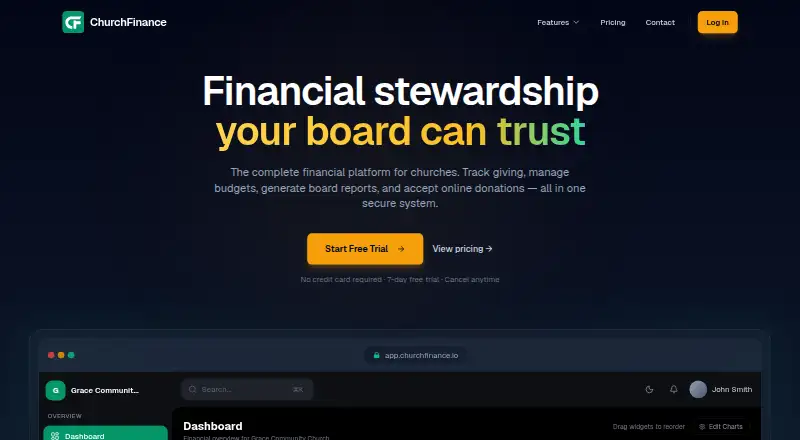
What ChurchFinance is
ChurchFinance is cloud-based financial management software for churches and religious organizations. It records income and expenses with categories, funds, recurring entries, bank rules, CSV imports, and an audit trail. Planning features include annual budgets, fund accounting, ministry-scoped plans, and budget-versus-actual tracking. Reports cover income, funds, cash flow, reconciliations, giving, and board packets. Online giving supports cards, ACH bank transfers, and Apple Pay through Stripe, with one-time or recurring gifts and no ChurchFinance platform fees. A free Starter plan covers one team member; Growth costs $71 a month, billed annually at $853, and Ministry costs $134 a month, billed annually at $1,609. ChurchFinance says it uses HTTPS/TLS, encrypts sensitive credentials at rest, hashes passwords, and takes daily backups. It also says it has not pursued SOC 2 or HIPAA certification. Data can be exported as JSON or CSV, and the auditor portal offers scoped, read-only, time-limited access.
Good
- Tracks income and expenses with funds and an audit trail
- Supports annual budgets and budget-versus-actual tracking
- Accepts card, ACH, and Apple Pay giving
- Exports donor, transaction, and fund data as JSON or CSV
- Provides scoped, read-only auditor access
Watch out
- Starter is limited to one team member
- ChurchFinance has not pursued SOC 2 or HIPAA certification
Who it suits
ChurchFinance is suited to churches and religious organizations that need to track funds, budgets, expenses, and giving. Its auditor portal and board reports may also suit organizations that need structured financial oversight.
Verdict
ChurchFinance brings transaction tracking, budgeting, giving, and reporting into one church-focused service. Review the plan limits and its stated certification status when deciding whether it fits your organization.
Plans and prices
From ChurchFinance's own pricing page, checked 30 Sep 2026.
| Plan | Price | What it gives you |
|---|---|---|
| Starter | Free | 1 team member · Transaction tracking · Categories & Funds management |
| Growth | $71 a month | Up to 5 team members · Budget management · Recurring transactions · Bank reconciliation · Financial reports · Unlimited donors · Online giving portal · Campaigns & pledges · Giving statements · Audit log · Billed $853 annually |
| Ministry | $134 a month | Unlimited team members · Everything in Growth · Board Packet · Multi-campus/location support · Ministry financial management · Advanced analytics & forecasting · Custom report builder · Giving page customization & embed · Customizable dashboard widgets · AI-Powered Financial Assistant · Billed $1609 annually |
The facts
Each one read from ChurchFinance's own pages, with the date it was checked.
What it does
- AI assistant
- The AI Assistant answers questions using the church's data, is read-only, records AI queries in the audit log, and does not use church data for model training.checked 30 Sep 2026
- Auditor access
- An auditor portal provides scoped, read-only accounts with time-bound access and visibility into the audit log.checked 30 Sep 2026
- Budgeting
- Planning features provide annual budgets, fund accounting, categories, ministry-scoped plans, and budget-versus-actual tracking.checked 30 Sep 2026
- Compliance disclosure
- ChurchFinance states that it has not pursued SOC 2 or HIPAA certification.checked 30 Sep 2026
- Data portability
- Users can export their data at any time, and security documentation specifies JSON or CSV exports of donors, transactions, and funds.checked 30 Sep 2026
- Online giving
- ChurchFinance accepts cards, ACH bank transfers, and Apple Pay through Stripe, with one-time or recurring gifts and zero ChurchFinance platform fees.checked 30 Sep 2026
- Product purpose
- ChurchFinance is cloud-based financial management software designed for churches and religious organizations.checked 30 Sep 2026
- Reports
- The reporting system generates income statements, budget-versus-actual reports, fund summaries, cash-flow reports, reconciliation reports, giving statements, and board packets.checked 30 Sep 2026
- Security controls
- ChurchFinance states that traffic uses HTTPS/TLS, sensitive credentials are encrypted at rest with AES-256-GCM, passwords are hashed, and daily backups are taken.checked 30 Sep 2026
- Stripe integration
- Stripe processes ChurchFinance card, ACH, and Apple Pay payments, and Stripe is PCI DSS Level 1.checked 30 Sep 2026
- Support
- The contact page says the team will respond to messages within 24 hours and offers sales, product-demo, and partnership assistance.checked 30 Sep 2026
- Transaction tracking
- The software records income and expenses with categories, funds, recurring entries, bank rules, CSV imports, and an audit trail.checked 30 Sep 2026
The full review of ChurchFinance
Overview
ChurchFinance is web-based financial software for churches and religious organizations that want accounting, budgeting, giving and reporting in one service. It is strongest for churches ready to manage those workflows together; the free plan is a limited starting point, while Growth is the first tier with a fuller finance toolkit.
Transaction tracking, fund accounting, budget management and online giving sit alongside oversight tools such as an audit trail and a read-only auditor portal. ChurchFinance says it has not pursued SOC 2 or HIPAA certification, a material consideration for organizations whose procurement or compliance requirements call for either.
Key features
Transactions, funds and budgeting
Income and expenses can be organized by category and fund, with recurring entries, bank rules and CSV imports supporting routine recordkeeping. The audit trail adds a record of activity. Annual budgets, ministry-scoped plans and budget-versus-actual tracking let finance teams compare plans with actual performance across ministries and funds. Bank reconciliation is included in Growth, so Starter is better for basic tracking than for a complete accounting process.
Giving and reports
ChurchFinance accepts one-time or recurring gifts by card, ACH bank transfer and Apple Pay through Stripe, and says it charges no platform fees for giving. Stripe processes those payments and is PCI DSS Level 1. The report set includes income statements, budget-versus-actual reports, fund summaries, cash-flow and reconciliation reports, giving statements and board packets. That range serves both finance teams and board reporting, though the Board Packet is a Ministry-plan feature.
Oversight, AI and data handling
The auditor portal gives scoped, read-only access for a limited period and exposes the audit log, a practical way to grant review access without handing over broader account control. The read-only AI Assistant answers questions using church data, logs its queries and does not use church data for model training.
ChurchFinance states that connections use HTTPS/TLS, sensitive credentials are encrypted at rest with AES-256-GCM, passwords are hashed and backups are taken daily. Users can export donor, transaction and fund data in JSON or CSV at any time. Those controls and portability help with operational oversight, but they do not replace SOC 2 or HIPAA certification where an organization requires formal certification.
Pricing
ChurchFinance uses a freemium model, with a 7-day trial and paid plans from $71 a month. Starter is free and allows one team member, transaction tracking, and category and fund management. That makes it a no-cost way for a solo administrator to organize basic records, but it omits the budgeting, reconciliation and reporting features that make the service a fuller finance system.
Growth costs $71 a month, billed $853 annually, and supports up to five team members. It adds budget management, recurring transactions, bank reconciliation, financial reports, unlimited donors, the online giving portal, campaigns and pledges, giving statements and an audit log. This is the sensible tier for a small finance team that needs a working budget and reporting workflow as well as giving; the five-seat cap may be restrictive for larger teams.
Ministry costs $134 a month, billed $1609 annually, with unlimited team members and everything in Growth. It adds a Board Packet, multi-campus and location support, ministry financial management, advanced analytics and forecasting, a custom report builder, giving-page customization and embedding, and a customizable dashboard. It fits churches with multiple locations or more demanding reporting needs; smaller organizations may not benefit enough from those additions to justify the higher price.
Platforms
ChurchFinance runs on the web, so it suits organizations managing finances through a browser rather than seeking a dedicated mobile or desktop app.
Who it's for
Churches that want fund-based transaction records, budgets, reconciliation, reports and online giving in one service are the clearest fit. Growth suits a team of up to five that needs the core accounting workflow; Ministry is more appropriate when unlimited seats, multiple locations or advanced reporting matter. A solo user needing only categories, funds and transaction tracking can begin on Starter, but should expect to move up for budgeting and reconciliation.
Organizations that require SOC 2 or HIPAA certification should look elsewhere. Churches that need an app beyond the web platform should also consider their platform requirements before choosing it.
Pros and cons
- Pros: The feature set spans transaction tracking, fund accounting, budgets, reconciliation, giving and detailed financial reports, reducing the need to split these workflows across separate tools.
- Pros: Growth includes unlimited donors and online giving with no ChurchFinance platform fees, while Stripe processes card, ACH and Apple Pay payments.
- Pros: Scoped auditor access, a logged read-only AI Assistant and JSON or CSV exports support oversight and data portability.
- Cons: Starter is limited to one team member and basic tracking and fund management; budgeting, reconciliation and reports require a paid plan.
- Cons: Growth is capped at five team members, and unlimited seats require the more expensive Ministry plan.
- Cons: ChurchFinance has not pursued SOC 2 or HIPAA certification, which rules it out for some compliance requirements.
Alternatives
Compare church accounting software if you want to weigh ChurchFinance against the category more broadly.
- CDM+ is worth considering if you prefer paid software with broad platform support; CDM+ Essentials is $25 a month, billed monthly by ACH, for one program and one user.
- ChurchTrac is an option for churches that prefer pricing by people-count, with plans from $29 a month for 75 people.
- Grain Ledger suits a church seeking a web-based freemium alternative: its free Starter supports up to $20k in monthly expenses, one bank connection, three users, unlimited funds and one active budget.
- Vestrybooks is another web-based freemium choice; its free plan covers recording money in and out, fund tracking, a donor list and online giving with no platform cut where available.
- Churchsoft Assist may suit buyers seeking a paid suite with broad platform support; its Assist 2022 plan is $40 a month.
- FellowshipOne is another paid alternative with custom pricing.
- IconCMO may appeal if you want paid membership and donation software, with its Basic plan at $50 a month.
- One Church Software is worth comparing if you want accounting as an add-on to a church-management plan; its Accounting add-on is $36 a month.
Verdict
Choose ChurchFinance if your church wants one web service for fund accounting, budgeting, giving and reporting, and Growth's five-seat limit fits the team. Ministry is the stronger match for multiple locations or advanced reporting. Look elsewhere if certification is mandatory, your team needs more than five seats without Ministry's added cost, or the narrow free tier cannot support your accounting workflow.
Getting started
- Visit churchfinance.io to begin with the cloud-based service.
- Start with the free Starter plan for one team member and transaction tracking.
- Use the 7-day trial if you want to evaluate a paid plan.
- Choose Growth at $71 a month, billed annually at $853, or Ministry at $134 a month, billed annually at $1,609.
- Import transactions by CSV or configure bank rules and recurring entries.
- Connect Stripe for card, ACH bank transfer, or Apple Pay giving.
Limits worth knowing
Starter includes one team member, transaction tracking, and categories and funds management. Growth costs $71 a month billed annually at $853 and permits up to five team members; Ministry costs $134 a month billed annually at $1,609 and includes unlimited team members. The service says it has not pursued SOC 2 or HIPAA certification.
Questions
How much does ChurchFinance cost?
Starter is free. Growth is $71 a month, billed annually at $853; Ministry is $134 a month, billed annually at $1,609.
Is there a free trial?
Yes. The pricing note lists a 7-day trial.
What does the free plan include?
Starter includes one team member, transaction tracking, and categories and funds management.
Can churches accept online gifts?
Yes. Through Stripe, ChurchFinance accepts cards, ACH bank transfers, and Apple Pay for one-time or recurring gifts. ChurchFinance charges zero platform fees.
What platforms does it support?
The listed platform is web.
Does ChurchFinance have SOC 2 or HIPAA certification?
ChurchFinance states that it has not pursued SOC 2 or HIPAA certification.
Alternatives to ChurchFinance
- 1

ChurchSoftware Accounting
Free planAndroidiOSWeb8.1Free plan - 2

ChurchTrac
AndroidiOSWebmacOS8.0From $7 a month - 3

CDM+
AndroidiOSWebAPI7.9From $25 a month - 4

Grain Ledger
Free planAndroidWebAPI7.8From $50 a month - 5

ParishSOFT
AndroidiOSWebAPI7.6$250 one-time - 6
Churchsoft Assist
AndroidiOSWebmacOS7.5From $40 a month