
Chargeflow
Chargeflow is a platform for chargeback management, prevention, alerts, and analytics.
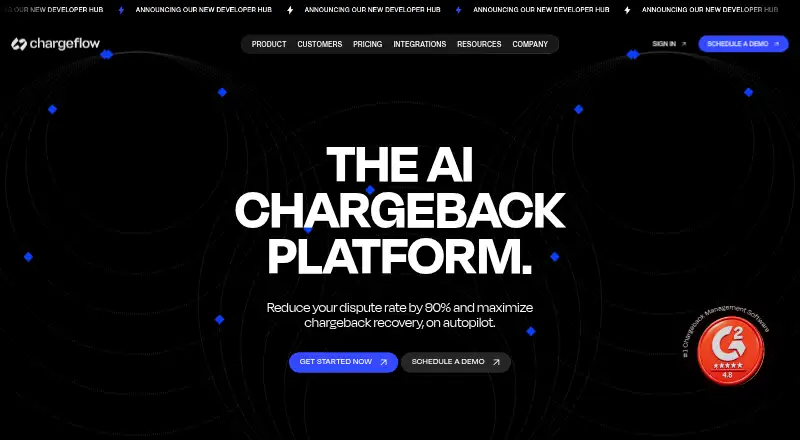
What Chargeflow is
Chargeflow is a platform for chargeback management, prevention, alerts, and analytics. Its automation gathers dispute data, builds evidence, and submits responses. Prevent scans transactions after checkout and before fulfillment, then can approve, verify, or cancel them according to risk scores and merchant rules. Insights brings processor chargeback information into a dashboard with win-rate trends and processor-level analytics. Chargeflow lists more than 100 integrations, including Shopify, Stripe, PayPal, Zapier, and WooCommerce. Chargeflow Connect lets platforms embed or white-label its services, or access them through an API. Insights is free. Prevent starts at $0.40 per scanned transaction, with the first 1,000 scans free and a stated rate as low as $0.20 at scale. Automation charges 25% of recovered amounts, excluding the dispute fee; Alerts costs $29 per successfully prevented chargeback. Standard usage-based pricing has no contract or minimum commitment, while enterprise volumes may have custom terms. Chargeflow says it uses encryption, OAuth 2.0 integrations, and multi-factor authentication for accounts with access to sensitive information.
Good
- Free Insights analytics plan
- Automates evidence building and dispute responses
- Prevent includes 1,000 free transaction scans
- Lists more than 100 integrations
- Offers API, embedding, and white-label options
Watch out
- Prevent starts at $0.40 per scanned transaction
- Automation takes 25% of recovered amounts
- Alerts costs $29 per deflected chargeback
- Enterprise pricing terms are custom
Who it suits
Chargeflow suits eCommerce, SaaS, enterprise, and airline businesses managing disputes or seeking chargeback prevention and analytics. Its free Insights plan may suit teams that need processor-level chargeback reporting.
Verdict
Chargeflow combines dispute response automation with transaction prevention and chargeback analytics. Review the transaction, recovery, and deflection charges to see which pricing model fits your use.
Plans and prices
From Chargeflow's own pricing page, checked 15 Oct 2001.
| Plan | Price | What it gives you |
|---|---|---|
| Insights | Free | Unified analytics · win-rate trends · repeat-disputer flags · processor-level analytics · weekly summaries · Free forever; no credit card required |
| Prevent | $0.10, paid once | First 1,000 scanned transactions free for new customers · Shopify currently supported · Per scanned transaction; effective October 15, 2026 |
| Prevent | $0.40, paid once | First 1,000 scanned transactions are free · $0.4 starting price · as low as $0.2 at scale · Per Scanned Transaction; price drops to $0.2 at scale |
| Automation | $25, paid once | Automated evidence collection and submission · 4x ROI guarantee · 100+ integrations · PayPal, Klarna and Afterpay inquiries · 25% per recovered chargeback; no payment until recovery |
| Alerts | $29, paid once | Real-time Verifi and Ethoca alerts · automatic refunds · zero-duplication guarantee · configurable filters · Per deflected chargeback; better pricing above 50 alerts monthly |
| Connect | Priced on request | White-label, co-branded or Evidence-as-a-Service delivery · portfolio reporting · platform SLAs · Schedule a demo |
| Enterprise | Priced on request | Dedicated customer success manager · EU hosting options · SSO and provisioning · DPA and terms redlines · Custom terms, SLAs and annual agreements available |
The facts
Each one read from Chargeflow's own pages, with the date it was checked.
What it does
- Alerts feature
- Alerts uses Verifi and Ethoca network notifications to trigger automatic refunds before complaints become chargebacks.checked 15 Oct 2001
- Analytics
- Insights provides a unified dashboard for chargeback data across payment processors, with win-rate trends and processor-level analytics.checked 29 Sep 2001
- API changelog
- The April 1, 2025 API release added alerts, customer communication, platform accounts, Evidence-as-a-Service and platform disputes endpoints.checked 15 Oct 2001
- API versioning
- The current API version is 2025-04-01 and the earlier 2024-03-18 version remains served as legacy.checked 15 Oct 2001
- Audience
- Chargeflow describes its intended customers as eCommerce merchants, SaaS companies, enterprise companies, and airline businesses.checked 29 Sep 2001
- Automation
- Automation gathers dispute data, builds evidence, and submits chargeback responses end to end.checked 29 Sep 2001
- Automation feature
- Automation gathers transaction and customer data, creates tailored AI evidence and submits the complete dispute response.checked 15 Oct 2001
- Compliance
- Chargeflow states that it is SOC 2 Type 2 and GDPR compliant and stores data in US data centers.checked 29 Sep 2001
- Connect feature
- Connect lets payment platforms embed Chargeflow capabilities under a white-label, co-branded or Evidence-as-a-Service model.checked 15 Oct 2001
- Developer tooling
- OpenAPI specifications and an agent integration skill are available, while the official Postman collection, MCP server, API explorer, linter and seeded scenarios are still planned.checked 15 Oct 2001
- Documentation
- The documentation is organized into concepts, API fundamentals, integrations, tools, error codes, security, FAQ, support, status and changelog sections.checked 15 Oct 2001
- Funding news
- On November 18, 2025, Chargeflow announced a $35 million Series A including a $10 million debt facility and said total funding reached $49 million.checked 15 Oct 2001
- Insights feature
- Insights provides a free cross-processor dashboard with dispute ratios, win-rate trends, revenue impact and repeat-disputer signals.checked 15 Oct 2001
- Integration limits
- Magento, BigCommerce, Wix, Amazon, eBay, Walmart, Salesforce and several other commerce connectors are marked coming soon.checked 15 Oct 2001
- Integrations
- The documented catalog includes Stripe, Shopify Payments, PayPal, Braintree, Adyen, Checkout.com, WooPayments, Klarna, Affirm, Afterpay, Recharge, Chargebee, Recurly, Gmail, Gorgias, Zendesk and Zapier.checked 15 Oct 2001
- Licence
- Chargeflow is proprietary commercial software; its terms grant service access and the site states all rights reserved rather than publishing an open-source licence.checked 15 Oct 2001
- Limit: pricing and reporting
- A G2 reviewer says usage pricing can be steep at low volumes and requests more granular accounting-oriented reporting.checked 15 Oct 2001
- Limit: Shopify evidence quality
- A Shopify reviewer reports roughly a 10% success rate and says winning submissions often contained only basic invoice and IP information.checked 15 Oct 2001
- Payment terms
- The company says there is no contract or minimum commitment for standard usage-based pricing, while enterprise volumes may use custom terms, SLAs, and annual agreements.checked 29 Sep 2001
The company
- Company headquarters and size
- LinkedIn lists New York, New York headquarters, 201–500 employees and a 2020 founding year.checked 15 Oct 2001
- Company legal name
- Crunchbase identifies the legal entity as Chargeflow, Inc., founded by Ariel Chen and Avia Chen.checked 15 Oct 2001
- Headquarters
- 251 Little Falls Dr, Wilmington, DE 19808, United Stateschecked 23 Sep 2001
Money
- Limit: Shopify billing complaints
- A Shopify reviewer alleges alerts were billed at $39 instead of the advertised $29 and says correction requests were delayed.checked 15 Oct 2001
- Limit: Trustpilot billing concerns
- Trustpilot complaints include unexpected per-transaction charges and allegations of thousands of dollars in unanticipated fees after connecting stores.checked 15 Oct 2001
The full review of Chargeflow
Overview
Chargeflow is a chargeback platform for merchants and other businesses that need to manage disputes across payment processors. It suits teams looking to automate evidence submission while also monitoring or preventing chargebacks. Its breadth is a strength, but its transaction- and outcome-based charges make the right mix of services important.
Key features
Dispute automation and alerts
Automation gathers dispute data, builds evidence, and submits responses, with representment automation and an evidence builder included. This is most useful to teams facing recurring disputes that want to reduce manual response work. The trade-off is a 25% fee on recovered amounts, excluding the dispute fee; payment is due only when a chargeback is recovered. Alerts are charged per successfully deflected chargeback, making the cost depend on results rather than a flat subscription.
Transaction prevention and analytics
Prevent scans transactions after checkout and before fulfillment, then supports approval, verification, or cancellation based on risk scores and merchant rules. That makes it relevant to businesses that can act on risk signals before fulfillment, though the per-scan charge means costs rise with transaction volume. The first 1,000 scans are free.
Insights brings chargeback data from stores and processors into one dashboard, including win-rate trends and processor-level analytics. Its free price makes it a low-commitment way to compare performance, but analytics alone does not automate disputes.
Integrations and security
Chargeflow says it supports more than 100 integrations, including Shopify, Stripe, PayPal, Zapier, and WooCommerce. Its listed processor connections also include Braintree, Adyen, Klarna, Affirm, and AfterPay, among others. Chargeflow Connect lets platforms embed, white-label, or connect services through an API.
Chargeflow says it uses AES-256 encryption at rest, TLS in transit, OAuth 2.0 integrations, and multi-factor authentication for accounts with access to sensitive information. It states that it is SOC 2 Type 2 and GDPR compliant, stores data in US data centers, and hosts its infrastructure on AWS; enterprise customers can request EU hosting options.
Pricing
Chargeflow uses a freemium model, with paid services billed by use rather than one standard subscription. The free Insights plan is free, billed Free Forever, and provides unified analytics across stores and processors without a credit card. It is the clearest fit for teams that want visibility before paying for automation, but it does not include dispute handling.
Prevent starts at $0.40, paid once, billed per scanned transaction, with the first 1,000 scans free and prices as low as $0.20 at scale. This is a practical entry point for merchants who want to screen transactions before fulfillment; at scale, the per-scan model still needs to be weighed against volume.
Automation costs $25, paid once, billed per recovered chargeback, with a 25% fee on recovered amounts and no payment until recovery. The percentage excludes the dispute fee, so teams should account for both when assessing recovery economics. Alerts costs $29, paid once, billed per deflected chargeback; the offer says businesses with over 50 alerts per month can get a better price. It is suited to teams willing to pay for successful prevention rather than a fixed monthly allowance.
Enterprise has custom pricing and terms for enterprise volumes. It includes a dedicated customer success manager, EU hosting options, SSO and user provisioning, and DPA and TOS redlines. Chargeflow says standard usage-based pricing has no contract or minimum commitment; enterprise volumes may use custom terms, SLAs, and annual agreements. The pricing page also lists 24/7 live chat and email support, dedicated success managers, and private Slack channels for teams.
Platforms
Chargeflow is available on web and through an API. Its broad processor connections make it relevant to businesses operating across payment providers, while platform customers can integrate through embedding, white-labeling, or an API.
Who it's for
Chargeflow is aimed at eCommerce merchants, SaaS companies, enterprise companies, and airline businesses. It is strongest for teams that need dispute response and prevention across multiple processors, or want to start with free cross-processor analytics. Businesses seeking only a fixed-price service may find its per-scan and outcome-based fees harder to forecast.
Pros and cons
- Pros: End-to-end evidence building and submission can reduce manual representment work.
- Pros: Free Forever analytics and 1,000 free Prevent scans let teams begin without an upfront commitment.
- Pros: More than 100 integrations and cross-processor analytics suit businesses working across payment providers.
- Cons: Automation takes 25% of recovered amounts, excluding the dispute fee, which can materially affect recovery economics.
- Cons: Prevent and Alerts are usage-priced, so spend depends on scanned transactions or successfully deflected chargebacks.
- Cons: The free Insights plan provides analytics but not dispute automation.
Alternatives
Chargeback Management Software is the category listing for comparing options across the category.
Redo is worth considering when email and SMS recovery tools are the priority: its free Email & SMS plan includes add-to-cart email capability, an AI email and SMS builder, monthly AI personas, and real-time analytics, with a free trial and API, iOS, and web platforms.
DisputeDash may suit teams that want free analytics without automation: its free plan includes unlimited processors, brands, and team users, while its $149 a month Starter plan covers up to 100 disputes per month.
FIS Data Integrity Manager is a paid web alternative.
Mastercard Decision Intelligence is a paid web option with custom pricing.
Chargeback Gurus Platform is a paid API and web alternative with custom pricing.
Chargebacks911 offers paid API and web solutions customized to company needs, with performance-based pricing.
Chargebackhit is a paid API and web alternative with no free plan; its Prevent plan costs $17, paid once per prevented chargeback and includes Visa CE 3.0, Mastercard First-Party Trust, Order Insight, and Consumer Clarity at no extra cost.
ChargebackStop is a paid API and web option with per-contact pricing, including Digital Receipts (Order Insight) at $0.20 per contact and Verifi RDR from from $19 (priced on request).
Verdict
Chargeflow is a strong fit for merchants and service businesses that need automated dispute responses alongside transaction prevention and cross-processor analytics. Its free analytics and scan allowance make it approachable, while the main reason to look elsewhere is the variable cost: recovery fees, scan charges, and deflection-based billing may be less suitable for teams that need predictable flat pricing.
Getting started
- Open the Chargeflow website
- Choose the free Insights plan or a usage-based service
- Connect a supported payment processor or listed integration
- Configure transaction risk rules for Prevent
- Use Automation to gather evidence and submit responses
- Enable alerts or analytics as needed
Limits worth knowing
Insights is free forever. Prevent includes the first 1,000 scanned transactions free, then starts at $0.40 per scan and can fall to $0.20 at scale; Automation takes 25% of recovered amounts, and Alerts charges $29 per successfully prevented chargeback.
Questions
Is there a free Chargeflow plan?
Yes. Insights is free forever, with no credit card needed, and provides unified analytics across stores and processors.
How much does Prevent cost?
Prevent starts at $0.40 per scanned transaction. The first 1,000 scanned transactions are free, and the stated price can drop to $0.20 at scale.
How is Automation billed?
Automation charges 25% of recovered chargeback amounts, excluding the dispute fee, with no payment until a chargeback is recovered.
Which platforms and integrations are supported?
Chargeflow supports API and web platforms and supports over 100 integrations, including Shopify, Stripe, PayPal, Zapier, WooCommerce, and numerous payment processors.
Does Chargeflow offer enterprise terms?
Yes. Enterprise volumes can use custom terms, SLAs, annual agreements, EU hosting options, SSO, user provisioning, and dedicated customer success.
Alternatives to Chargeflow
- 1

Redo
Free planiOSWebAPI7.0From $0.06 a month - 2

DisputeDash
Free planWebAPI6.6From $149 a month - 3

Disputifier
WebAPI6.3$0.05, paid once - 4
Ethoca
AndroidiOSWebAPI6.3 - 5

SecureShieldPay
WebAPI6.3From $239 a month - 66.2