Cathar
Cathar is a free audio restoration toolkit for Linux and macOS that cleans, enhances, and levels recordings.
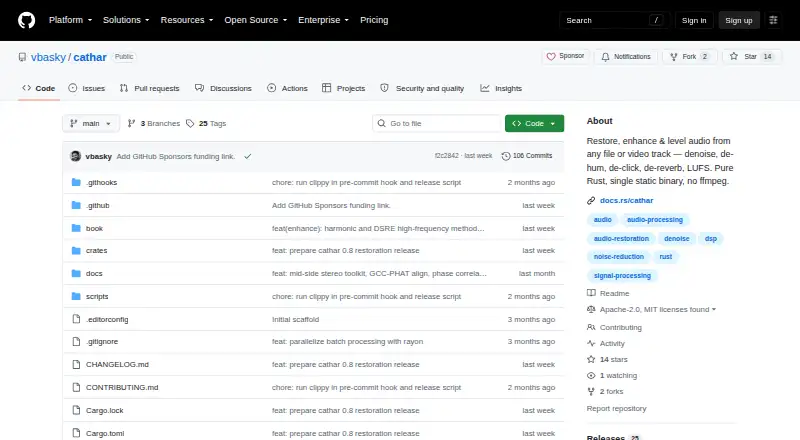
What Cathar is
Cathar is a free audio restoration toolkit for Linux and macOS that cleans, enhances, and levels recordings. It accepts WAV, MP3, FLAC, OGG, and M4A files, as well as audio tracks in MP4 and MKV video, and writes WAV, FLAC, or AIFF output. Its restoration tools cover noise, hum, wind, clicks, clipping, reverb, plosives, rustle, and spectral repair. Enhancement options include de-essing, breath removal, voice isolation, and bandwidth extension; loudness and peak normalization help prepare output levels. Written in Rust, Cathar uses inspectable and tunable DSP stages rather than opaque neural models. Users can integrate effects through the Rust crate or run Cathar as a command-line stage in a media pipeline. An optional machine-learning feature adds a deterministic GRU denoiser that uses safetensors weights. Optional terminal tools provide an audio player and interactive spectrogram viewer; Linux playback requires ALSA headers. The toolkit is licensed under Apache 2.0 or MIT, and the project describes its 0.8.x series as being before 1.0.
Good
- Accepts audio files and tracks inside MP4 and MKV video.
- Includes spectral repair and noise reduction tools.
- Effects can run through the Rust crate or CLI.
- Licensed under Apache 2.0 or MIT.
Watch out
- Available platforms are Linux and macOS.
- Linux terminal playback requires ALSA headers.
- The project describes its 0.8.x series as before 1.0.
Who it suits
Cathar suits audio workflows on Linux or macOS that need restoration tools and command-line or in-process pipeline integration. It may also interest Rust developers who want inspectable DSP stages.
Verdict
Cathar combines restoration, enhancement, and leveling tools with options for Rust-based pipeline use. Note its Linux and macOS platform list and that the project is still before 1.0.
The facts
Each one read from Cathar's own pages, with the date it was checked.
What it does
- Current release
- The GitHub releases page lists cathar v0.8.0 as the latest release.checked 30 Sep 2026
- Documentation
- The project includes an illustrated Cleaning Up Sound book explaining its concepts and comparing it with tools such as iZotope RX, Audition, Audacity, SoX and FFmpeg.checked 30 Sep 2026
- enhancement
- Its enhancement functions include de-essing, breath removal, voice isolation, and bandwidth extension.checked 2 Oct 2026
- Enhancement
- Enhancement tools include de-essing, breath removal, voice isolation and bandwidth extension.checked 30 Sep 2026
- formats
- It reads WAV, MP3, FLAC, OGG, M4A, MP4, and MKV inputs and writes WAV, FLAC, or AIFF.checked 2 Oct 2026
- implementation
- Cathar is implemented in pure Rust with no ffmpeg, C/C++, or system-library dependencies.checked 2 Oct 2026
- Implementation
- The toolkit is written in pure Rust and uses no ffmpeg, C or C++ code, or system libraries.checked 30 Sep 2026
- Input formats
- It accepts WAV, MP3, FLAC, OGG and M4A files, plus audio tracks inside MP4 and MKV video.checked 30 Sep 2026
- Installation
- The command-line binary can be installed with cargo install cathar-cli from crates.io.checked 30 Sep 2026
- integration
- The toolkit can be called in-process through the cathar Rust crate or invoked as a command-line stage in a media pipeline.checked 2 Oct 2026
- latest_release
- The GitHub releases page lists cathar v0.8.0 as the latest release.checked 2 Oct 2026
- leveling
- Cathar supports LUFS and peak normalization for delivery.checked 2 Oct 2026
- Leveling
- Cathar provides LUFS loudness normalization and peak normalization for delivery.checked 30 Sep 2026
- license
- The project is licensed under either Apache License 2.0 or MIT.checked 2 Oct 2026
- License
- Cathar is licensed under either the Apache License 2.0 or the MIT License.checked 30 Sep 2026
- ml_denoise
- An optional ml feature provides a deterministic GRU-based denoiser that loads safetensors checkpoints.checked 2 Oct 2026
- Output formats
- It writes WAV, FLAC or AIFF output selected by the output filename extension.checked 30 Sep 2026
- Pipeline integration
- Effects are plain functions over audio sample slices and can run in-process through the cathar crate or as a cathar command between pipeline steps.checked 30 Sep 2026
- purpose
- Cathar is an audio restoration toolkit for noisy recordings and video audio tracks.checked 2 Oct 2026
- Purpose
- Cathar is an audio restoration toolkit for cleaning, enhancing and leveling recordings.checked 30 Sep 2026
- restoration
- Its restoration functions include denoise, de-hum, de-wind, de-click, de-clip, de-reverb, spectral repair, de-plosive, and de-rustle.checked 2 Oct 2026
Where it runs
- DSP approach
- Its processing stages are inspectable and tunable DSP rather than opaque neural models.checked 30 Sep 2026
- Machine-learning denoise
- An optional ml feature adds a GRU-based denoiser whose open safetensors weights and deterministic inference are implemented in Rust.checked 30 Sep 2026
The company
- maker
- The repository owner is Vikram Bhaskaran, whose profile describes him as a technologist and lists Sydney.checked 2 Oct 2026
The full review of Cathar
Cathar is a free audio-restoration toolkit for Linux and macOS, best suited to developers and audio teams who want repair tools they can tune or fold into a pipeline. Its broad cleanup and enhancement set is the draw; its pre-1.0 status is a reason to be cautious about production-critical use.
Overview
Cathar handles both restoration and delivery preparation: it can address recording problems, enhance voice material, and normalize loudness. Batch processing makes it relevant to collections of recordings as well as individual files. It is a standalone toolkit rather than a finished desktop editing suite, so it fits best when a workflow can accommodate command-line tools or Rust integration.
The project is written in pure Rust and avoids ffmpeg, C and C++ code, and system libraries. Its processing stages use inspectable, tunable DSP rather than opaque neural models, which suits users who want control over how cleanup is applied. That approach does not make it a graphical editing environment, and users who need one should look elsewhere.
Key features
Repair and enhancement
Restoration covers denoise, de-hum, de-wind, de-click, de-clip, de-reverb, spectral repair, de-plosive, and de-rustle. De-essing, breath removal, voice isolation, and bandwidth extension extend the toolkit to voice enhancement. The range is useful for varied recording problems, though the project’s pre-1.0 status may make it a less settled choice for workflows that cannot tolerate change.
Formats and delivery
Cathar accepts WAV, MP3, FLAC, OGG, and M4A, plus audio tracks in MP4 and MKV. It writes WAV, FLAC, or AIFF, with the output filename extension determining the format. LUFS loudness normalization and peak normalization help prepare processed audio for delivery.
Rust and optional tools
Effects are plain functions over audio sample slices: Rust projects can call them in-process through the cathar crate, or run the cathar command as a pipeline stage. Optional machine-learning denoise adds a GRU-based model with open safetensors weights and deterministic Rust inference; it complements rather than replaces the inspectable DSP approach. Optional terminal tools provide an audio player and interactive spectrogram viewer, but Linux playback requires ALSA headers.
The command-line binary installs with cargo install cathar-cli from crates.io. An illustrated book, Cleaning Up Sound, explains the project’s concepts and compares it with tools including iZotope RX, Audition, Audacity, SoX, and FFmpeg. Cathar is licensed under either Apache License 2.0 or MIT; the latest release is v0.8.0, in the 0.8.x series before 1.0.
Pricing
Cathar is free, with no free-trial period to weigh against a paid plan. The free offering covers the toolkit rather than a limited introductory tier; the project’s license is Apache 2.0 or MIT. That makes it an appealing option for users comfortable assembling their own workflow, but it does not remove the setup and integration work that comes with a toolkit.
Platforms
Cathar supports Linux and macOS. That makes it a candidate for Rust-based pipelines on those systems, but not for a Windows workflow. Linux users who want the optional terminal player also need ALSA headers for playback.
Who it's for
Cathar is a strong fit for Rust developers, audio teams, and technically comfortable users building repeatable cleanup pipelines, especially when tunable processing and batch work matter. It is less suitable for users looking for a conventional desktop editor, a Windows option, or a mature pre-1.0-free workflow.
Pros and cons
Pros
- Broad repair coverage, including spectral repair, declipping, de-hum, de-wind, and de-reverb, for tackling different recording defects with one toolkit.
- Voice enhancement and both LUFS and peak normalization extend its use from cleanup through delivery preparation.
- Rust crate and command-line pipeline options support both in-process integration and staged media workflows.
- Free and dual-licensed under Apache 2.0 or MIT, with no plan fee to budget for.
Cons
- Linux and macOS only, leaving Windows users out.
- It is a toolkit, not a desktop editing suite, so it asks users to bring a suitable workflow.
- The project is still before 1.0, a meaningful caveat for production-critical adoption.
- Linux playback in the optional terminal tools requires ALSA headers.
Alternatives
Choose CEDAR Cambridge if you want a paid modular hardware and software system on macOS or Windows, with configuration-dependent options. Consider iZotope RX instead for its paid macOS and Windows repair suite, which includes common audio repair tools and Repair Assistant in RX 12 Elements and a larger pro restoration set in RX 12 Standard. Neiro is another free option for Linux and macOS, and also supports self-hosted, web, and Windows use.
Pick SpectraLayers Pro if AI-assisted spectral audio editing and restoration are priorities and a paid macOS or Windows product with a free trial suits you. VinylRest is another free option for Linux and macOS, with web availability as well. Diamond Cut Audio Restoration Tools 11.09 is a paid Windows alternative with a free trial and a stated one-time price of 59.00 USD. Accentize dxRevive is a paid macOS and Windows choice for noise removal, reverb suppression, absent-frequency restoration, and codec artifact elimination. PD Cleaner is another free option for Windows.
For more options, browse Audio Restoration Software or AI Audio Restoration Software.
Verdict
Choose Cathar if you want a free, tunable restoration toolkit that can run inside a Rust application or as a command-line pipeline stage, and Linux or macOS meets your needs. Its breadth, batch support, and integration options are persuasive. Look elsewhere if you need Windows, a conventional desktop editor, or a project that has passed its pre-1.0 stage.
Alternatives to Cathar
- 1
Avidemux
Free planOpen sourceWebLinuxmacOSWindows7.3Free plan - 2

@audio/denoise
Free planOpen sourceWeb7.1Free plan - 3
VinylRest
Free planWebAPILinuxmacOS7.1Free plan - 4
PD Cleaner
Free planOpen sourceWindows7.0Free plan - 5

LANDR ReHance
WebmacOSWindows6.5From $11.99 a month - 6
Wave Arts Master Restoration Suite 6
macOSWindows6.5$99 one-time