CEDAR Cambridge
CEDAR Cambridge is a 64-bit platform for speech enhancement and audio restoration on Windows and macOS.
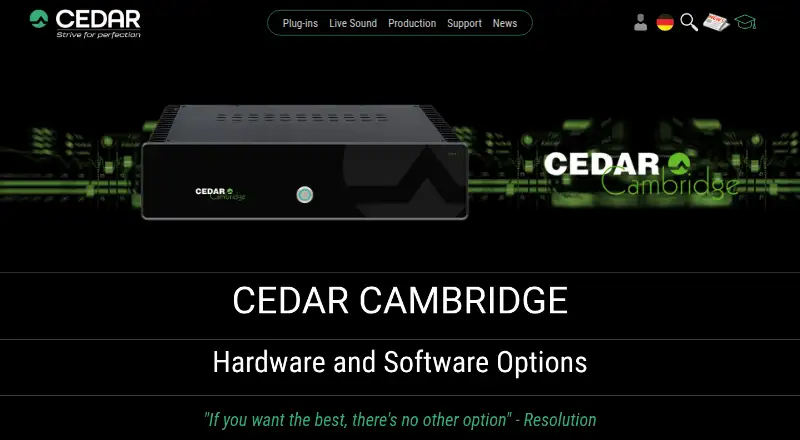
What CEDAR Cambridge is
CEDAR Cambridge is a 64-bit platform for speech enhancement and audio restoration on Windows and macOS. Its modular processing system can be automated and is intended for uses including audio forensics and security, archives and libraries, broadcast, and mastering. Tools include voice extraction processes such as DNS, DNS Two, FNR, and VoicEX, as well as noise reduction and forensic options for reducing impulse noise and improving speech intelligibility. Retouch provides spectral editing, while dynamics, loudness control, and equalisation modules cover tasks such as compression, limiting, and normalisation.
Depending on hardware, Cambridge can process audio at up to 100 times faster than real time. It can connect with media asset management systems and add track reports and metadata to databases. Its Report Generator records processing details and outputs PDF, HTML, or XML reports. Silent 1 is configured for individual users; Series V targets batch processing in archives, libraries, and forensic labs, and can support multiple users with optional components. Pricing is listed from £349 with a 14-day trial; buyers are directed to contact CEDAR for hardware and system details.
Good
- Modular processing can be automated.
- Includes spectral editing and forensic tools.
- Reports export to PDF, HTML, or XML.
- Can process up to 100 times faster than real time, hardware dependent.
Watch out
- Available for Windows and macOS only.
- No free plan.
- Hardware and system configuration details require contacting CEDAR.
Who it suits
Cambridge is aimed at audio restoration and speech-enhancement work in areas such as forensics, broadcast, archives, and mastering. Its Silent 1 and Series V configurations address individual users and batch-processing settings respectively.
Verdict
CEDAR Cambridge brings restoration, speech, spectral, and reporting tools into a configurable system. Prospective buyers should confirm the hardware and system configuration directly with CEDAR.
Plans and prices
From CEDAR Cambridge's own pricing page, checked 3 Oct 2026.
| Plan | Price | What it gives you |
|---|---|---|
| CEDAR Cambridge | Priced on request | Modular hardware and software system; options and configuration vary; contact CEDAR Audio for information |
The facts
Each one read from CEDAR Cambridge's own pages, with the date it was checked.
What it does
- Audio I/O
- The listed audio I/O options are an internal RME card for digital I/O and an Apogee desktop interface for analogue I/O, and both can be installed together.checked 3 Oct 2026
- Automation
- The modular system can be fully automated when desired and can generate a report for every processed track.checked 3 Oct 2026
- Dynamics and EQ
- CEDAR Cambridge offers dynamics, loudness control, and equalisation modules, including normalisation, compression, expansion, limiting, and EQ.checked 3 Oct 2026
- Forensic tools
- Forensic options include impulse noise reduction, adaptive filters, and Trinity Enhance tools for suppressing background noise and improving speech intelligibility.checked 2 Oct 2026
- Hardware configurations
- The Silent 1 is described as a compact, silent host for individual users, while Series V is aimed at batch processing in archives, libraries, and forensic audio laboratories.checked 3 Oct 2026
- Hardware options
- The Silent 1 is aimed at individual users, while the Series V host is aimed at batch processing in archives, libraries, and forensic laboratories.checked 2 Oct 2026
- MAM integration
- CEDAR Cambridge can integrate with media asset management systems and pass processed audio and associated metadata into users’ databases.checked 3 Oct 2026
- Modular processing
- The system is modular and can be fully automated when desired.checked 2 Oct 2026
- Multiple users
- The Series V host can support multiple users when equipped with the optional Server Pack and XML Extension.checked 3 Oct 2026
- Noise reduction
- The NR and Auto Dehiss processes are designed to reduce artefacts, dullness, and compression while reducing noise.checked 2 Oct 2026
- Pricing
- The maker directs prospective buyers of hardware or systems products to contact sales for more information.checked 2 Oct 2026
- Processing speed
- The system can process up to 100 times faster than real time or more, depending on the hardware.checked 3 Oct 2026
- Purpose
- CEDAR Cambridge is a 64-bit, high-resolution platform for speech enhancement and audio restoration, including forensic, archival, broadcast, and mastering work.checked 3 Oct 2026
- Report compliance
- The maker says PDF reports include improved graphic handling and page numbering in response to ISO/IEC 17025 requirements.checked 2 Oct 2026
- Reports
- The Report Generator records processing details and can output reports in PDF, HTML, and XML formats.checked 2 Oct 2026
- Source separation
- Source separation identifies and separates individual audio sources in a live stream or recording obtained using a suitable microphone array.checked 3 Oct 2026
- Spectral editing
- CEDAR describes Retouch as a spectral editor for identifying and manipulating individual sounds.checked 3 Oct 2026
- Support
- For support issues unresolved by the search or support pages, CEDAR directs users to create an account and message its support team.checked 2 Oct 2026
- Support and training
- CEDAR says it places a premium on customer support, and its Cambridge v12 announcement offered training courses covering host systems, processing modes, batch processing, and system modules.checked 3 Oct 2026
- Use cases
- The maker describes uses in audio forensics and security, archives and libraries, broadcast, and mastering.checked 2 Oct 2026
- Voice extraction
- Its voice extraction processes include DNS, DNS Two, FNR, and VoicEX for removing noise from contaminated audio.checked 2 Oct 2026
The company
- Headquarters
- Fulbourn, Cambridge, CB21 5BS, United Kingdomchecked 28 Sep 2026
Money
- Price availability
- The product page directs prospective buyers to contact CEDAR Audio for information about its hardware and systems products.checked 3 Oct 2026
The full review of CEDAR Cambridge
CEDAR Cambridge is a modular 64-bit system for speech enhancement and high-resolution audio restoration, built for work ranging from forensic audio to broadcast and mastering. It suits teams and specialists who need configurable processing, automation and track-level reporting. Its breadth is compelling, but the hardware-led configuration and custom pricing make it a considered purchase rather than a straightforward software download.
Overview
Cambridge combines restoration and speech tools in a system that can be configured around the work. Modules can be automated, and the system can process audio at up to 100 times real time, depending on hardware. That speed and automation can matter for large collections or repeatable workflows, but actual throughput depends on the chosen setup.
It can integrate with media asset management systems, adding track reports and associated metadata to a user’s database. For workflows where processed audio must remain traceable, the Report Generator can create a record for every track in PDF, HTML or XML. PDF reports include graphic-handling and page-numbering improvements made in response to ISO/IEC 17025 requirements; that is a targeted reporting feature, not a claim of general certification.
Key features
Speech cleanup is a core strength. DNS, DNS Two, FNR and VoicEX target noise in contaminated audio, while NR and Auto Dehiss are designed to reduce noise alongside artefacts, dullness and compression. Forensic options add impulse-noise reduction, adaptive filters and Trinity Enhance tools intended to suppress background noise and improve speech intelligibility.
Cambridge also covers spectral editing and broader restoration. Retouch lets users identify and manipulate individual sounds; dynamics, loudness and EQ modules include normalisation, compression, expansion, limiting and equalisation. Click and crackle removal, hum removal, declipping and batch processing extend its reach beyond speech work. Source separation can identify and separate sources in a live stream or recording, but it requires a suitable microphone array.
The system’s hardware choices shape who it fits. Silent 1 is a compact, silent host for an individual user; Series V is intended for batch processing in archives, libraries and forensic laboratories. Series V can support multiple users with the optional Server Pack and XML Extension. Audio I/O can use an internal RME card for digital I/O, an Apogee desktop interface for analogue I/O, or both together.
Pricing
CEDAR Cambridge is paid, with pricing from £349 and a 14-day trial. The Cambridge system itself has custom pricing: it is a modular hardware-and-software system whose options and configuration vary, and prospective buyers are directed to contact CEDAR Audio for a quote. The entry figure does not establish the cost of a complete system or a particular configuration.
There is no free plan. Buyers should clarify the hardware, modules and any optional Series V components needed for their workload before comparing total cost. The trial provides a limited evaluation window of 14 days; the available pricing terms do not state renewal conditions or seat limits.
Platforms
Cambridge supports macOS and Windows. Its standalone workflow and dedicated host options make it a system-level choice rather than a plug-in-only restoration purchase.
Who it's for
Cambridge is best suited to audio-forensics and security specialists, archives and libraries, broadcasters, and mastering professionals who need more than a single-purpose cleanup tool. Its automated processing, batch capability and per-track reports are especially relevant when work must be repeated or documented. Individual users can look to Silent 1, while organisations handling larger batch workloads can consider Series V; multi-user use on Series V requires the optional Server Pack and XML Extension.
It is less suited to someone seeking a low-cost, simple app for occasional repairs. The modular system and hardware configuration require more purchasing decisions, and the system price is custom rather than a fixed checkout price. CEDAR offers support through an account-based support team, and its Cambridge v12 announcement described training on host systems, processing modes, batch processing and modules.
Pros and cons
- Pros: Broad speech, forensic, spectral and restoration tools make one configurable system relevant across several demanding audio workflows.
- Pros: Automation, batch processing and reports for every processed track support repeatable, documented work.
- Pros: Series V can serve multiple users with the optional Server Pack and XML Extension, and both listed audio I/O options can be installed together.
- Cons: Custom system pricing and variable configurations make it harder to establish the full cost before speaking with sales.
- Cons: The 14-day trial is brief for evaluating a complex system, and there is no free plan.
- Cons: Source separation depends on a suitable microphone array, so it is not a self-contained option for every recording setup.
Alternatives
For a wider comparison, start with Audio Restoration Software or AI Audio Restoration Software.
- VinylRest is a free option on Linux, macOS and the web; its public-beta Live plan requires a license for processing and allows up to three active Mac installations.
- Neiro is a free alternative available on Linux, macOS, Windows, web and self-hosted setups.
- Cathar is a free Linux and macOS alternative, with no free trial.
- Wave Arts Master Restoration Suite 6 costs $99, paid once for five restoration plug-ins and suits buyers who want plug-ins, provided they have a compatible audio plug-in host.
- SpectraLayers Pro is a paid macOS and Windows option focused on spectral editing, audio repair and restoration, with AI-assisted processing.
- LANDR ReHance is a paid macOS, web and Windows option at $11.99 a month on annual billing; it requires a LANDR Studio subscription.
- Acoustica is a paid macOS and Windows option with Standard and Premium editions for different channel counts.
- Diamond Cut Audio Restoration Tools 11.09 is a Windows-only alternative at $59, paid once, with one year of free support.
Verdict
Choose CEDAR Cambridge if you need configurable speech and restoration processing paired with automation, batch workflows and detailed track reports. Its main advantage is the range of specialised tools within one system; its main drawback is the custom-priced hardware configuration, which demands a larger buying decision than a fixed-price app. For occasional cleanup or a tighter budget, a free alternative or a focused plug-in suite is a more proportionate place to start.
Alternatives to CEDAR Cambridge
- 1
Avidemux
Free planOpen sourceWebLinuxmacOSWindows7.3Free plan - 2

@audio/denoise
Free planOpen sourceWeb7.1Free plan - 3
VinylRest
Free planWebAPILinuxmacOS7.1Free plan - 4
PD Cleaner
Free planOpen sourceWindows7.0Free plan - 5

LANDR ReHance
WebmacOSWindows6.5From $11.99 a month - 6
Wave Arts Master Restoration Suite 6
macOSWindows6.5$99 one-time