Cabot
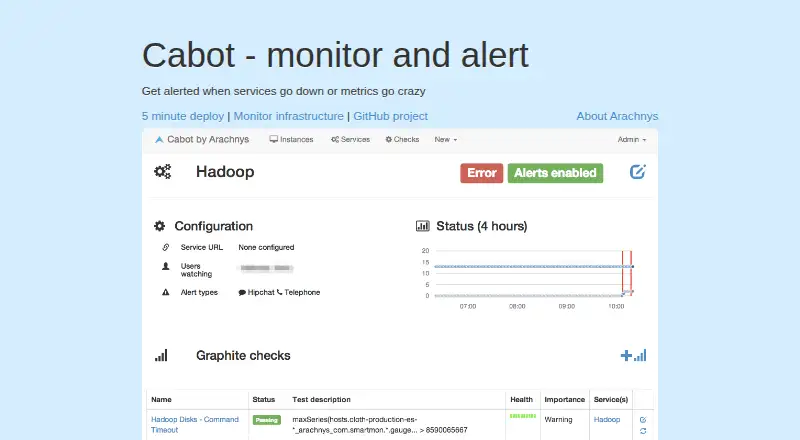
The facts below are what the maker publishes about Cabot, checked and dated. Our editors have not written about it yet.
The facts
Each one read from Cabot's own pages, with the date it was checked.
What it does
- Alert channels
- The alerting documentation lists email, Hipchat, Slack, SMS, and telephone as supported out of the box, with other channels available through plugins.checked 11 Oct 2026
- Alert severity
- Service statuses include Passing, Warning, Error and Critical, with alert frequency depending on status.checked 11 Oct 2026
- API
- Cabot documents a browsable API with HTTP Basic or session authentication and Django permission checks for write methods.checked 11 Oct 2026
- API access
- The API supports HTTP basic authentication and session authentication, with Django permissions controlling access to write methods.checked 11 Oct 2026
- Built-in checks
- The homepage lists Graphite metrics, Jenkins jobs, and web endpoints as things Cabot can monitor.checked 11 Oct 2026
- Deployment
- The quickstart recommends Docker Compose and supports running Cabot behind Caddy or a separately configured reverse proxy.checked 11 Oct 2026
- Graphite thresholds
- Graphite checks support equality and greater-than or less-than comparisons against a chosen metric threshold.checked 11 Oct 2026
- Keyword monitoring
- Yeschecked 20 Sep 2026
- Logical service monitoring
- Cabot monitors logical services across one or many machines and combines related checks into service statuses.checked 11 Oct 2026
- Maintenance
- The repository says Cabot is stable and used in production but is not actively maintained, and that maintainers are wanted.checked 11 Oct 2026
- Monitoring
- It can monitor Graphite metrics, Jenkins jobs and web endpoints.checked 11 Oct 2026
- On-call rota
- Cabot can sync an on-duty rota from a shared calendar with an iCalendar feed; syncing runs every 30 minutes.checked 11 Oct 2026
- Plugins
- Plugins can add alerting and check functionality, but the documentation says listed plugins may not have been validated and should be tested at the user's own risk.checked 11 Oct 2026
- Project status
- The project README says Cabot is stable and used in production but is not actively maintained, and seeks maintainers.checked 11 Oct 2026
- Purpose
- Cabot is a self-hosted watchdog for websites and infrastructure that alerts when services go down or metrics exceed thresholds.checked 11 Oct 2026
- Rota limitation
- Cabot does not support several support layers, alert escalation or shift swaps through its rota feature.checked 11 Oct 2026
- Server monitoring
- Yeschecked 20 Sep 2026
- Service monitoring
- Cabot groups checks into logical services, which can run across multiple machines.checked 11 Oct 2026
- Severity levels
- Services have Passing, Warning, Error, and Critical statuses, and telephone alerts are limited to Critical status when the listed service and duty-officer conditions are met.checked 11 Oct 2026
- SSL expiry alerts
- Yeschecked 20 Sep 2026
- Support and limitations
- The services documentation says a formal alert acknowledgement and escalation procedure may suit larger organizations, and invites suggestions and pull requests.checked 11 Oct 2026
Money
- Free plan
- Yeschecked 20 Sep 2026
- License and cost
- The project describes Cabot as free and open source, and its repository identifies an MIT license.checked 11 Oct 2026
Alternatives to Cabot
- 1

Dotcom-Monitor
Free planAndroidiOSWebAPI8.3From $13.33 a month - 2

Pingdom
AndroidiOSWebAPI7.8From $16.50 a month - 3

UptimeRobot
Free planAndroidiOS7.8From $9 a month - 4

openstatus
Free planWebAPILinuxmacOS7.6From $30 a month - 5
HetrixTools
Free planLinuxmacOSWindows7.5From $9.95 a month - 6

Montastic
Free planWebAPI7.5From $5 a month