BOUML
BOUML is a free UML 2 toolbox for specifying systems and generating code.
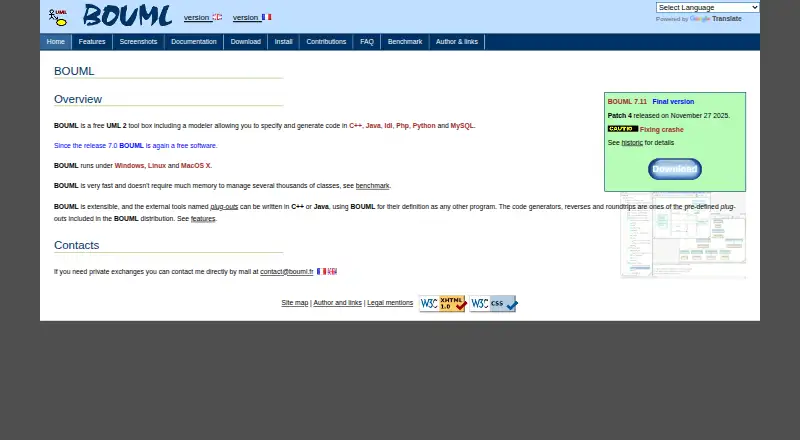
What BOUML is
BOUML is a free UML 2 toolbox for specifying systems and generating code. It runs on Linux, macOS, and Windows and supports use case, sequence, communication, class, composite class, activity, state, object, composite object, component, and deployment diagrams. Built-in generators cover C++, C, Java, PHP, Python, IDL, and MySQL; reverse-engineering tools are listed for C++, Java, PHP, and MySQL, while round-trip tools cover C++, Java, and PHP. Plug-outs can generate XMI 1.2 and 2.1, import XMI 2.1 and Rational Rose models, and be developed in C++ or Java to run outside BOUML. An HTML documentation generator can produce diagram images as PNG or SVG. Project control and synchronization tools support shared project work. The maker says it can manage several thousand classes while using little memory. Version 7.11 is identified as the final release, with patch 4 listed for some distributions. Releases since version 7.0 are free to use; the software is distributed without warranty.
Good
- Free to use since version 7.0
- Supports Windows, Linux, and macOS
- Generates code in seven listed languages
- Exports diagrams as PNG or SVG
- Includes project control and synchronization tools
Watch out
- Version 7.11 is identified as the final release
- Distributed without warranty
Who it suits
BOUML suits people who need UML modeling and code-generation tools on Linux, macOS, or Windows. Its project controls may also suit teams working on shared models.
Verdict
BOUML combines UML modeling, code generation, and import/export tools in a free desktop package. Its final-release status and lack of warranty are important considerations.
Plans and prices
From BOUML's own pricing page, checked 30 Sep 2026.
| Plan | Price | What it gives you |
|---|---|---|
| BOUML | Free | Free to use; no price listed |
The facts
Each one read from BOUML's own pages, with the date it was checked.
What it does
- Code generation
- Built-in plug-outs include generators for C++, C, Java, PHP, Python, IDL, and MySQL.checked 30 Sep 2026
- Collaboration tools
- Project control and project synchronization tools are listed for working on a project with several people.checked 30 Sep 2026
- Documentation output
- An HTML documentation generator can produce diagrams as PNG or SVG images.checked 30 Sep 2026
- Extensibility
- External plug-outs can be developed in C++ or Java and run outside BOUML.checked 30 Sep 2026
- Interchange
- Plug-outs provide XMI 1.2 and 2.1 generation, XMI 2.1 import, and Rational Rose model import.checked 30 Sep 2026
- License and warranty
- Releases since version 7.0 are free to use; the maker states the software is distributed without warranty.checked 30 Sep 2026
- Purpose
- BOUML is a free UML 2 toolbox with a modeler for specifying systems and generating code.checked 30 Sep 2026
- Release status
- The download page identifies version 7.11 as the current and final release and lists patch 4 for some distributions.checked 30 Sep 2026
- Reverse engineering
- Built-in reverse tools are listed for C++, Java, PHP, and MySQL.checked 30 Sep 2026
- Round trips
- Built-in round-trip tools are listed for C++, Java, and PHP.checked 30 Sep 2026
- Scale
- The maker says BOUML can manage several thousand classes while using little memory.checked 30 Sep 2026
- Supported languages
- BOUML supports programming in C++, Java, PHP, Python, IDL, and MySQL.checked 30 Sep 2026
Where it runs
- Platforms
- The maker says BOUML runs on Windows, Linux, and MacOS X.checked 30 Sep 2026
The full review of BOUML
BOUML is a desktop UML 2 modeling toolbox that connects system design with code generation and model exchange. It suits developers and teams that want broad language support, reverse engineering, and project coordination without a subscription. Its strongest case is a capable, low-cost modeling workflow; its final release makes it a less reassuring choice for projects that need continuing development.
Overview
BOUML combines UML modeling, implementation-oriented generators, reverse-engineering utilities, documentation output, and collaboration controls in one desktop application. It supports Linux, macOS, and Windows, so a team can use the same general tool across the three major desktop platforms.
The maker says it can handle several thousand classes while using little memory. That makes it a plausible fit for substantial models rather than only classroom diagrams, although capacity alone does not guarantee that its workflow or interchange behavior will suit every large project.
Key features
- Broad UML coverage: Use case, sequence, communication, class, composite class, activity, state, object, composite object, component, and deployment diagrams cover both behavioral and structural views. Teams documenting an entire system get more than a single diagram style.
- Code generation: Built-in plug-outs generate C++, C, Java, PHP, Python, IDL, and MySQL. This is especially useful when a model is expected to feed implementation work rather than remain purely descriptive.
- Reverse engineering and round trips: Reverse tools are provided for C++, Java, PHP, and MySQL. Round-trip tools are listed for C++, Java, and PHP, so MySQL has a narrower workflow than those three programming languages.
- Extensibility: External plug-outs can be written in C++ or Java and run outside BOUML. That gives technically capable teams a way to extend the toolbox without limiting additions to built-in features.
- Interchange: Plug-outs generate XMI 1.2 and 2.1, import XMI 2.1, and import Rational Rose models. These options help when models must move between compatible tools, though format support should still be matched to the receiving application.
- Documentation: An HTML documentation generator can include diagrams as PNG or SVG images, making model material easier to publish or circulate.
- Team projects: Project control and synchronization tools are listed for work involving several people. This is a practical advantage over a diagram-only utility when a shared project model is part of the process.
Pricing
BOUML is free to use. The BOUML plan costs free, with no paid tier or subscription term described. It is therefore suitable for individuals, students, and teams that need the full stated feature set without allocating a software budget.
The trade-off is not a cheaper restricted edition versus a premium upgrade; there is simply no paid path identified for additional support or future development. Releases since version 7.0 are free to use, and the software is distributed without warranty.
Platforms
BOUML is desktop software for Windows, Linux, and macOS. It is a good match for organizations that standardize on those operating systems, but it is not presented as a browser-first service or a hosted collaborative workspace.
Who it's for
Choose BOUML if you are a developer, architect, or small-to-large modeling team that wants UML diagrams tied directly to generators, reverse engineering, and documentation. Its language range is valuable for mixed technology environments, while external plug-outs suit teams able to work in C++ or Java.
Look elsewhere if ongoing vendor updates, warranty coverage, or a web-based workflow is central to your procurement decision. The final release reduces uncertainty about what you are downloading, but it also signals that future changes should not be expected.
Pros and cons
Pros
- Free full package: Modeling, generators, import/export, documentation, and project tools are included without a listed price.
- Unusually broad language coverage: C++, C, Java, PHP, Python, IDL, and MySQL generation support can serve varied development stacks.
- Large-model ambition: The stated ability to manage several thousand classes with little memory favors sizeable projects.
- Cross-platform desktop support: Windows, Linux, and macOS availability eases mixed-OS adoption.
Cons
- Final release: Version 7.11 is identified as the current and final release, which is a concern for long-lived projects needing active evolution.
- No warranty: The maker distributes the software without warranty, increasing the responsibility on teams using it for important work.
- Uneven round-trip coverage: MySQL has listed reverse tools but is not among the languages with listed round-trip tools.
Alternatives
Sparx Enterprise Architect is the better choice when you want a freemium product with a free trial, multi-user projects, and a listed Professional standard-license option rather than an entirely free final release.
BESSER suits readers seeking free, open-source modeling across desktop, web, self-hosted, and API environments.
kUML is an alternative for those who prefer Apache 2.0 open-source software with desktop, web, self-hosted, and API availability.
UMLet is worth choosing when you want a free open-source tool available as a standalone desktop app, Eclipse plugin, web app, and VS Code extension.
ArgoUML offers a free/open-source UML option for Windows, macOS, and Linux under the Eclipse Public License 1.0.
BridgePoint is a free Apache 2.0 project centered on an editor, verifier, and model compilers.
Eclipse Papyrus is a free open-source modeling environment spanning desktop, web, self-hosted, and API use.
Gaphor is a free, fully open-source Apache 2 licensed option for Windows, macOS, and Linux.
For a wider comparison, see UML Modeling Software.
Verdict
BOUML is a strong fit for developers and modeling teams that want extensive UML coverage, code generation, reverse engineering, and project tools at no cost. Choose it for a self-contained desktop workflow and broad language reach; look elsewhere if active releases, warranty protection, or hosted collaboration matter more than its substantial free feature set.
Alternatives to BOUML
- 1

Sparx Enterprise Architect
Free planWebAPILinuxmacOS7.9$245 one-time - 2
BESSER
Free planOpen sourceWebAPILinuxmacOS7.6Free plan - 3
Visual Paradigm
Free planWeb7.3From $4 a month - 4
UMLet
Free planWebExtensionLinuxmacOS6.9Free plan - 5
StarUML
ExtensionLinuxmacOSWindows6.7$129 one-time - 6
Horusec
Free planWebAPIExtensionLinux6.6Free plan