
Sparx Enterprise Architect
Sparx Enterprise Architect is a multi-user visual modeling tool for business and IT systems, software and systems engineering, and real-time and embedded dev…
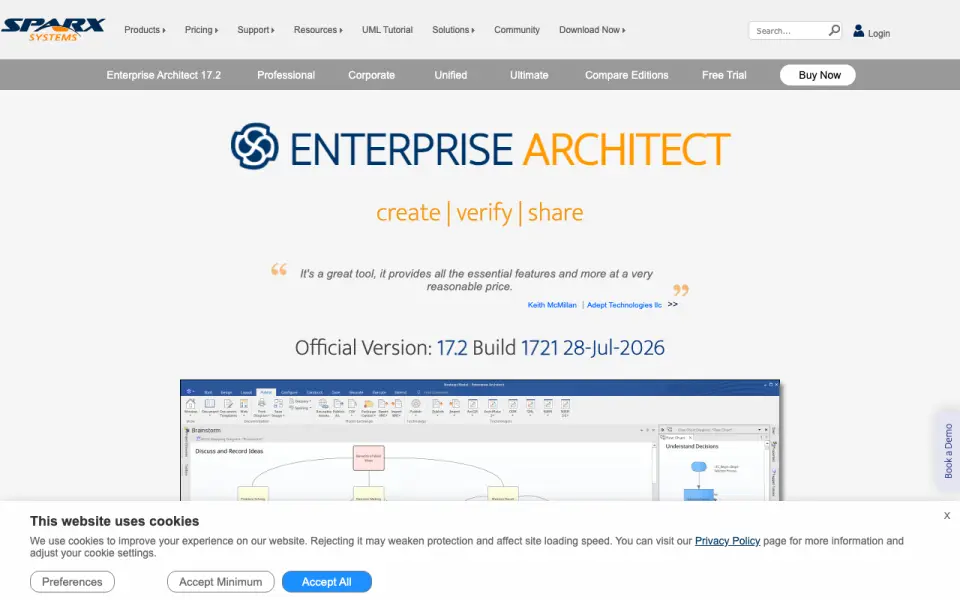
What Sparx Enterprise Architect is
Sparx Enterprise Architect is a multi-user visual modeling tool for business and IT systems, software and systems engineering, and real-time and embedded development. It supports UML, SysML, BPMN, and other open standards, linking specifications with analysis, design, implementation, testing, and maintenance models. Diagram options include UML use case, activity, state, sequence, class, component, and deployment, among others. Built-in requirements management lets teams organize hierarchical requirements, trace them to model elements, generate reports, and assess impact. Behavioral models can be simulated using triggers, guards, effects, and JavaScript. Enterprise Architect can generate and reverse engineer code in languages including C++, C#, Java, PHP, and Python. Collaboration features include version control and deployable cloud-based servers for shared projects. It also includes role-based model security; Pro Cloud Server Visibility Levels can add row-level controls with up to 20 security levels. A free plan and a 30-day trial are listed. During the trial, any edition can be used with personal data, though printed documents carry a watermark.
Good
- Supports UML, SysML, BPMN, and other open standards.
- Requirements can be traced to model elements.
- Simulates behavioral models, including JavaScript.
- Generates and reverse engineers several programming languages.
- Includes version control and cloud-based collaboration servers.
Watch out
- Trial-printed documents show a watermark.
- Third-party API use requires a commercial license.
- WebEA viewing does not allow model creation or diagram editing.
Who it suits
It suits analysts, designers, architects, developers, testers, project managers, and maintenance staff working on shared models. Teams needing requirements traceability, model simulation, or code engineering may find its toolset relevant.
Verdict
Enterprise Architect combines modeling, requirements, simulation, and code engineering in a multi-user environment. Its free plan and trial offer a way to start, while some web access and API uses have specific licensing limits.
Plans and prices
From Sparx Enterprise Architect's own pricing page, checked 10 Oct 2026.
| Plan | Price | What it gives you |
|---|---|---|
| Lite Edition | Free | Read-only edition |
| Enterprise Architect Lite | Free | Read-only model viewing · 32-bit and 64-bit installers · no editing or document generation |
| Professional Standard | $245, paid once | UML modeling · workgroups · code engineering · multi-user projects · per license |
| Professional — Standard License | $245, paid once | UML modeling · multi-user projects · code engineering |
| Corporate — Standard License | $320, paid once | Professional features · shared DBMS model repositories · role-based security · auditing · baseline merge |
| Corporate Standard | $320, paid once | DBMS repositories · role-based security · auditing · baseline merge · per license |
| Professional Floating | $320, paid once | Floating license · Professional feature set · per license |
| Professional — Floating License | $320, paid once | UML modeling · multi-user projects · code engineering |
| Corporate Floating | $425, paid once | Floating license · Corporate feature set · per license |
| Corporate — Floating License | $425, paid once | Professional features · shared DBMS model repositories · role-based security · auditing · baseline merge |
| Unified Standard | $535, paid once | UML · SysML · DDS · DMN · BPSim · systems engineering · per license |
| Unified — Standard License | $535, paid once | UML · SysML · DDS · DMN · BPSim tools |
| Unified Floating | $699, paid once | Floating license · Unified feature set · per license |
| Unified — Floating License | $699, paid once | UML · SysML · DDS · DMN · BPSim tools |
| Ultimate Standard | $750, paid once | Complete Enterprise Architect feature set · Data Bridge · MDG Office · DOORS link · per license |
| Ultimate — Standard License | $750, paid once | All features and bundled software of the other editions |
| Ultimate Floating | $965, paid once | Floating license · Ultimate feature set · per license |
| Ultimate — Floating License | $965, paid once | All features and bundled software of the other editions |
The facts
Each one read from Sparx Enterprise Architect's own pages, with the date it was checked.
What it does
- API
- Pro Cloud Server provides an OSLC-based REST API for exchanging repository information, and a commercial license is required for third-party use.checked 10 Oct 2026
- Audience
- The maker says its software is intended for analysts, designers, architects, developers, testers, project managers and maintenance staff.checked 10 Oct 2026
- Automation API
- A detailed automation interface exposes most element properties, supports writable automation, XMI import/export and plug-in windows, and works with VB, C#, C++ and Delphi clients.checked 14 Oct 2026
- Azure DevOps integration
- The Azure DevOps connector synchronizes work items and Enterprise Architect elements bi-directionally, including tasks, requirements, use cases and issues.checked 14 Oct 2026
- Business process modeling
- The tool supports BPMN modeling, BPEL generation and validation of BPMN models.checked 14 Oct 2026
- Code engineering
- Enterprise Architect generates and reverse engineers code for languages including C++, C#, Java, Delphi, PHP, Python, VHDL and Verilog.checked 14 Oct 2026
- Collaboration
- Built-in version control and deployable cloud-based servers support collaboration by globally distributed teams on shared projects.checked 10 Oct 2026
- Current release
- Version 17.2 Build 1721 was released on 28 July 2026.checked 14 Oct 2026
- Diagram types
- UML Use Case,Activity,State,Interaction Overview,Sequence,Communication,Package,Class,Object,Composite,Component,Deployment; BPMN; SysMLchecked 22 Sep 2026
- Documentation
- A WYSIWYG template engine creates filtered RTF reports with tables of contents, images, headers, footers and reusable templates.checked 14 Oct 2026
- Documentation depth
- Sparx says its online User Guide contains more than 1,000 help pages plus subject-focused PDF guidebooks.checked 14 Oct 2026
- Extensibility
- The product supports scripting, plug-ins, UML profiles, MDG technologies and model-validation extensions.checked 14 Oct 2026
- Integrations
- External-data integration covers Jira, Confluence, Polarion, Azure DevOps/TFS, Wrike, ServiceNow, Autodesk, Bugzilla, Salesforce, SharePoint and Dropbox.checked 14 Oct 2026
- License model
- Enterprise Architect is proprietary software licensed under an EULA with fixed and floating license options; copyright remains with Sparx Systems.checked 14 Oct 2026
- Limit: data modeling and publishing
- Critical Gartner feedback cites weak data-modeling support, folder-heavy navigation, rudimentary PDF-based publishing and missing lifecycle management.checked 14 Oct 2026
- Limit: learning curve
- G2 and Gartner reviewers report that the large feature set creates a steep learning curve for new users.checked 14 Oct 2026
The company
- Company founding
- Sparx Systems says it was established in 1996 by Geoffrey Sparks.checked 14 Oct 2026
- Company headquarters
- Sparx Systems is based in Creswick, Victoria, Australia.checked 14 Oct 2026
- Company legal name
- The EULA identifies the owner as Sparx Systems Pty Ltd.checked 14 Oct 2026
- Company scale
- Sparx reports more than one million effective Enterprise Architect licenses worldwide.checked 14 Oct 2026
- Company size
- LinkedIn lists Sparx Systems as a privately held company with 11–50 employees.checked 14 Oct 2026
- Founded
- 1996checked 23 Sep 2026
- Headquarters
- Creswick, Victoria, Australiachecked 23 Sep 2026
Money
- Free plan
- Yeschecked 22 Sep 2026
The full review of Sparx Enterprise Architect
Sparx Enterprise Architect is a visual modeling environment for business and IT systems, software and systems engineering, and embedded development. It suits teams that need requirements, architecture, simulation and code engineering to work together. Its broad project scope is a strength for traceable engineering, but can be more than a team seeking a simple diagram editor needs.
Overview
Enterprise Architect supports UML, SysML, BPMN and other open standards across specification, analysis, design, implementation, testing and maintenance. This makes it useful when models need to remain connected throughout a project rather than serve as standalone diagrams. It also combines desktop modeling with multi-user collaboration, version control and deployable cloud-based servers.
The breadth comes with licensing distinctions: shared DBMS repositories, role-based security and auditing are Corporate features, while some integrations require both a premium Pro Cloud Server edition and Enterprise Architect Corporate or above. Teams should weigh those edition requirements against the value of consolidating their modeling and engineering work.
Key features
Diagram coverage spans UML use case, activity, state, sequence, class, component, deployment and other types, plus BPMN and SysML. Built-in requirements management supports hierarchical requirements, links them to model elements, and provides reporting and impact analysis. That combination is valuable where teams must track how requirements map to a design and what changes may affect.
Behavioral models can be simulated using triggers, guards and effects, including JavaScript. Code generation and reverse engineering cover languages including C++, C#, Java, PHP and Python, connecting design work with source code. Import formats include XMI, JAR, .NET assemblies, XML Schema and WSDL; export formats include XMI, PDF, HTML, RTF, XSD and DDL.
Role-based model security is built in. Pro Cloud Server Visibility Levels can add row-level access controls with up to 20 security levels. Its integration plugins cover Jira, Confluence, Azure DevOps, ServiceNow, Salesforce, SharePoint, Jama and Polarion, but are included in premium Pro Cloud Server editions and accessed with Enterprise Architect Corporate or above.
WebEA enables browser-based model viewing and feedback, not license-free model creation or diagram editing: those still require a valid Enterprise Architect license. Pro Cloud Server also offers an OSLC-based REST API for repository information exchange, but third-party use requires a commercial license. These boundaries matter for organizations planning browser-based or external integrations.
Pricing
Enterprise Architect has a free plan and a 30-day trial. The trial permits unlimited use of any edition with personal data, though printed documents carry a watermark. That makes it a substantial evaluation route, but not a clean-print option for formal deliverables.
Professional Standard includes a UML modeling environment, multi-user projects and code import, export and synchronization. Professional Floating adds floating licensing; its listed price is $320.00 per license. These tiers suit UML-focused teams, with the floating option for license sharing, but do not include the Corporate repository, security, auditing and baseline merge capabilities.
Corporate Standard adds shared DBMS repositories, role-based security, auditing and baseline merge tools. Corporate Floating includes the same features and floating licensing, at $425.00 per license. These are the more relevant choices for teams needing centralized repositories and governance controls.
Unified Standard includes business, software and systems development tools, with UML, SysML, DDS, DMN and BPSim support. Unified Floating adds floating licensing. Both Unified plans have custom pricing. Standard plan prices are also custom pricing. Sparx Systems offers a user forum, online manual, bug reporting, feature requests and email support.
Platforms
Enterprise Architect supports Windows, macOS, Linux, self-hosted deployment and API access. A desktop app is available, and version history is supported. The range is useful for mixed-platform and hosted environments, while browser access through WebEA remains limited to viewing and feedback unless users hold a valid license to create or edit.
Who it's for
Enterprise Architect is aimed at analysts, designers, architects, developers, testers, project managers and maintenance staff. It is strongest for cross-functional teams working on complex systems that benefit from traceable requirements, behavioral simulation, code engineering and controlled collaboration. It is less compelling for individuals or teams who need only lightweight diagrams and would not use its engineering or repository features.
Pros and cons
- Pros: Requirements traceability, impact analysis, simulation and code engineering sit in one modeling environment, supporting work that spans design and implementation.
- Pros: Real-time collaboration, version control, deployable servers and role-based security support shared projects and distributed teams.
- Pros: A free plan and unlimited-use 30-day trial provide a way to evaluate the product before committing to a paid edition.
- Cons: Integration plugins require premium Pro Cloud Server editions and Enterprise Architect Corporate or above, restricting access for teams on lower tiers.
- Cons: WebEA does not remove the license requirement for model creation and diagram editing, and third-party API use requires a commercial license.
- Cons: Printed trial documents carry a watermark, which limits the trial's usefulness for polished external deliverables.
Alternatives
For a free, open-source option across desktop, web and self-hosted platforms, consider BESSER.
Choose UMLet for a free, open-source UML tool available as a standalone desktop app, Eclipse plugin, web app and VS Code extension. ArgoUML is a free, open-source option licensed under EPL 1.0 and requiring Java 5 or later. BOUML is free to use.
BridgePoint offers a free, Apache 2.0-licensed open-source package with an editor, verifier and model compilers. Eclipse Papyrus is a free open-source modeling environment with no usage limits stated. Gaphor is a free, Apache 2-licensed open-source option.
Browse UML Modeling Software, Diagram Software or Diagramming Software for more choices.
Verdict
Choose Enterprise Architect if your team needs requirements, system models, simulation and code engineering connected in a shared, governed project. Its breadth is the main reason to choose it; the edition and licensing boundaries around integrations, browser editing and third-party API use are the main reasons to look elsewhere. For lightweight diagramming or a free open-source workflow, one of the alternatives is a better fit.
Getting started
- Visit the Sparx Systems Enterprise Architect website.
- Choose the free plan or start the 30-day trial, which permits unlimited use of any edition with personal data.
- Install the desktop app on Windows, Linux, or macOS.
- Select a Professional, Corporate, or Unified license option if its listed capabilities fit your work.
- Use WebEA for browser-based model viewing and feedback; a valid Enterprise Architect license is required to create models and edit diagrams.
Limits worth knowing
The free 30-day trial permits unlimited use of any edition and personal data, but printed documents show a watermark. WebEA supports browser-based model viewing and feedback, while model creation and diagram editing require a valid Enterprise Architect license.
Questions
Is Sparx Enterprise Architect free?
A free plan is available, and the pricing model is freemium. A free 30-day trial also allows unlimited use of any edition with personal data.
What platforms does it support?
The listed platforms are Windows, Linux, macOS, self-hosted, and API.
What modeling standards and diagram types does it support?
It supports UML, SysML, BPMN, and other open standards. Listed diagram types include UML use case, activity, state, interaction overview, sequence, communication, package, class, object, composite, component, and deployment.
What license plans are available?
Professional, Corporate, and Unified each have Standard and Floating License options. Prices are listed for Professional Floating at $320.00 per license and Corporate Floating at $425.00 per license.
Which tools can it integrate with?
Pro Cloud Server integration plugins support Jira, Confluence, Azure DevOps, ServiceNow, Salesforce, SharePoint, Jama, and Polarion. The plugins are included in premium Pro Cloud Server editions and accessed with Enterprise Architect Corporate or above.
Who makes Enterprise Architect?
The maker is Sparx Enterprise Architect, founded in 1996 and headquartered in Creswick, Victoria, Australia.
Alternatives to Sparx Enterprise Architect
- 1
BESSER
Free planOpen sourceWebAPILinuxmacOS7.6Free plan - 2
Visual Paradigm
Free planWeb7.3From $4 a month - 3
UMLet
Free planWebExtensionLinuxmacOS6.9Free plan - 4
StarUML
ExtensionLinuxmacOSWindows6.7$129 one-time - 5
Horusec
Free planWebAPIExtensionLinux6.6Free plan - 6
objectiF RPM
WebAPISelf-hostedWindows6.6