ArgoUML
ArgoUML is a free, open-source UML modeling tool for standard UML 1.4 diagrams, with support for all nine diagram types in that standard.
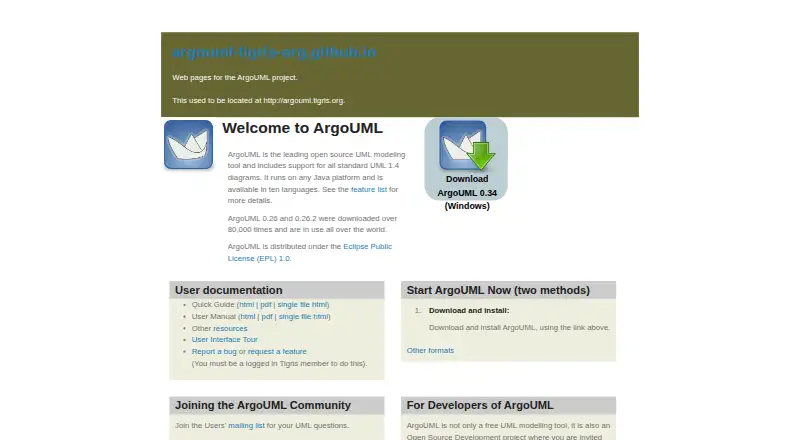
What ArgoUML is
ArgoUML is a free, open-source UML modeling tool for standard UML 1.4 diagrams, with support for all nine diagram types in that standard. It is written in Java and intended to run on systems with Java 5 or Java 6; the project provides installation through Java Web Start. The tool follows the OMG UML 1.4 standard and uses a JMI-based model repository. It saves models using XMI, can import XMI 1.1 and 1.2, and writes XMI 1.2. Diagram output can be saved as GIF, PNG, PostScript, Encapsulated PostScript, PGML, or SVG. ArgoUML supports code generation for Java, C++, C#, PHP4, and PHP5, as well as reverse engineering from Java source, JAR files, and class files. It also offers UML profiles and OCL constraint modeling with syntax and type checking. Background design critics can place suggestions in a to-do list. The application is available for Windows, macOS, and Linux via a Java runtime, and is distributed under the Eclipse Public License 1.0.
Good
- Covers all nine UML 1.4 diagram types
- Imports XMI 1.1 and 1.2
- Generates code for five listed languages
- Exports diagrams in six listed formats
- Includes background design suggestions
Watch out
- Intended for Java 5 or Java 6
- Java Web Start is the provided installation method
- Code generation lists PHP4 and PHP5
Who it suits
ArgoUML suits users who need UML 1.4 modeling, XMI exchange, or code generation from UML models. It may also fit those working with Java source and class files who want reverse-engineering support.
Verdict
ArgoUML provides a broad UML 1.4 feature set, including XMI, code generation, and reverse engineering. Its Java runtime requirements are an important fit consideration.
Plans and prices
From ArgoUML's own pricing page, checked 1 Oct 2026.
| Plan | Price | What it gives you |
|---|---|---|
| Free/Open source | Free | Eclipse Public License (EPL) 1.0 · Java 5+ |
The facts
Each one read from ArgoUML's own pages, with the date it was checked.
What it does
- Code generation
- Code generation is provided for Java, C++, C#, PHP4, and PHP5.checked 1 Oct 2026
- Cognitive assistance
- Design critics analyze designs in the background and post suggestions to a to-do list without interrupting the designer.checked 1 Oct 2026
- Diagram coverage
- The feature list states that ArgoUML supports all nine UML 1.4 diagram types.checked 1 Oct 2026
- Diagram exports
- Diagrams can be saved as GIF, PNG, PostScript, Encapsulated PostScript, PGML, and SVG.checked 1 Oct 2026
- Installation
- The project provides installation through Java Web Start.checked 1 Oct 2026
- Internationalization
- ArgoUML is available in American English, British English, French, German, Italian, Portuguese, Spanish, Russian, Norwegian Bokmål, and Chinese.checked 1 Oct 2026
- License
- ArgoUML is distributed under the Eclipse Public License (EPL) 1.0.checked 1 Oct 2026
- OCL
- ArgoUML provides OCL constraint modeling with syntax and type checking through the Dresden OCL toolkit.checked 1 Oct 2026
- Profiles
- The product supports creating and distributing UML profiles and includes Java, C++, and UML 1.4 profiles.checked 1 Oct 2026
- Purpose
- ArgoUML is an open source UML modeling tool supporting standard UML 1.4 diagrams.checked 1 Oct 2026
- Reverse engineering
- The reverse engineering framework includes Java source support plus modules for Java JAR and class-file imports.checked 1 Oct 2026
- Support
- The project directs users to a mailing list for UML questions and an IRC channel at Freenode.checked 1 Oct 2026
- UML compliance
- ArgoUML is compliant with the OMG UML 1.4 standard and uses a JMI-based model repository.checked 1 Oct 2026
- XMI integration
- ArgoUML uses XMI as its standard saving mechanism, imports XMI 1.1 and 1.2, and writes XMI 1.2.checked 1 Oct 2026
Where it runs
- Java platform
- ArgoUML is written entirely in Java and is intended to run on virtually any platform with Java 5 or Java 6.checked 1 Oct 2026
The full review of ArgoUML
ArgoUML is a free, open-source desktop modeler for teams and individuals working with UML 1.4. It is strongest when diagrams need to connect to source code, model interchange, or formal constraints; users who require a newer UML standard or want to avoid a Java runtime should consider other tools.
Overview
ArgoUML follows the OMG UML 1.4 specification and stores models in a JMI-based repository. That focused compliance is useful for projects tied to UML 1.4, but it is a constraint for teams whose process depends on another UML version.
XMI is the normal save format. The application imports XMI 1.1 and 1.2 and writes XMI 1.2, providing a practical interchange route for compatible tools. Diagram output covers GIF, PNG, PostScript, Encapsulated PostScript, PGML, and SVG, so users can produce both raster images and scalable or print-oriented files.
Key features
Modeling and guidance
The tool covers all nine UML 1.4 diagram categories, with class, statechart, activity, use case, collaboration, deployment, and sequence diagrams among the documented types. That breadth suits a project that needs a complete UML 1.4 model rather than a single diagram style.
Background design critics review the model and place suggestions in a to-do list instead of interrupting the drawing workflow. This is useful for a designer who wants ongoing prompts, although it remains advisory rather than a replacement for formal review. ArgoUML also supports creating and distributing UML profiles, and includes Java, C++, and UML 1.4 profiles for teams standardizing modeling conventions.
Code, constraints, and exchange
Code generation targets Java, C++, C#, PHP4, and PHP5. Reverse engineering supports Java source plus Java JAR and class-file imports, making the product more relevant to existing codebases than a diagram-only editor. The combination is a clear advantage for developers who want a model-to-code or code-to-model workflow.
OCL constraint modeling includes syntax and type checking through the Dresden OCL toolkit. It therefore fits requirements or designs where constraints must be expressed and checked, not merely drawn. Internationalization covers American and British English, French, German, Italian, Portuguese, Spanish, Russian, Norwegian Bokmål, and Chinese.
Pricing
Free/Open source — free. The plan is distributed under the Eclipse Public License (EPL) 1.0 and requires Java 5+. There are no paid tiers or seat quotas in the supplied plan information, so it is the natural fit for individuals, classrooms, and teams seeking an open-source UML 1.4 tool without a purchase. The trade-off is environmental: users must provide a compatible Java runtime, and the product's UML 1.4 focus may not match newer modeling requirements.
Platforms
ArgoUML is a desktop application for Windows, macOS, and Linux through a Java runtime. The project provides installation through Java Web Start. Because it is written entirely in Java and targets Java 5 or Java 6, platform choice is broad but runtime compatibility is a material part of deployment planning.
Who it's for
Choose ArgoUML for UML 1.4 projects that need comprehensive diagram coverage, XMI interchange, code generation, or Java reverse engineering at no software cost. It also suits teams that value distributable UML profiles and OCL checking. It is a weaker fit when a project requires a different UML standard, a browser-first workflow, or an environment where maintaining the required Java runtime is undesirable.
Pros and cons
- Pro: All nine UML 1.4 diagram types support broad specification-based modeling.
- Pro: Generation for five languages and Java reverse engineering connect models with implementation work.
- Pro: XMI import/export and six diagram formats make sharing and publishing flexible.
- Pro: OCL syntax and type checking add useful constraint validation.
- Con: Compliance is specifically with UML 1.4, limiting projects built around another standard.
- Con: Java 5+ is required, so runtime provisioning is part of installation and support.
Alternatives
Browse UML Modeling Software for a wider category comparison.
- Sparx Enterprise Architect is the alternative to consider when you want a freemium product with a free trial and multi-user projects.
- BESSER suits users wanting free, open-source modeling across desktop, web, and API environments with no hidden fees.
- kUML is another free, open-source option with desktop, web, self-hosted, and API availability.
- UMLet is a free open-source choice offering standalone desktop apps plus an Eclipse plugin, web app, and VS Code extension.
- BOUML is a free UML tool for Windows, macOS, and Linux.
- BridgePoint provides free open-source editor, verifier, and model compilers.
- Eclipse Papyrus is a free open-source modeling environment with desktop, web, and self-hosted availability.
- Gaphor is a free, Apache 2 licensed open-source alternative for Windows, macOS, and Linux.
Verdict
ArgoUML is a strong match for developers and modelers who specifically need a free UML 1.4 desktop environment with code generation, reverse engineering, XMI, and OCL support. Look elsewhere if your project depends on a newer UML standard or if the Java runtime requirement makes deployment a poor fit.
Alternatives to ArgoUML
- 1

Sparx Enterprise Architect
Free planWebAPILinuxmacOS7.9$245 one-time - 2
BESSER
Free planOpen sourceWebAPILinuxmacOS7.6Free plan - 3
Visual Paradigm
Free planWeb7.3From $4 a month - 4
UMLet
Free planWebExtensionLinuxmacOS6.9Free plan - 5
StarUML
ExtensionLinuxmacOSWindows6.7$129 one-time - 6
Horusec
Free planWebAPIExtensionLinux6.6Free plan