
Basis Theory
Basis Theory is a payment-data platform that centralizes sensitive information, governs access and routes tokens to payment service providers or other servic…
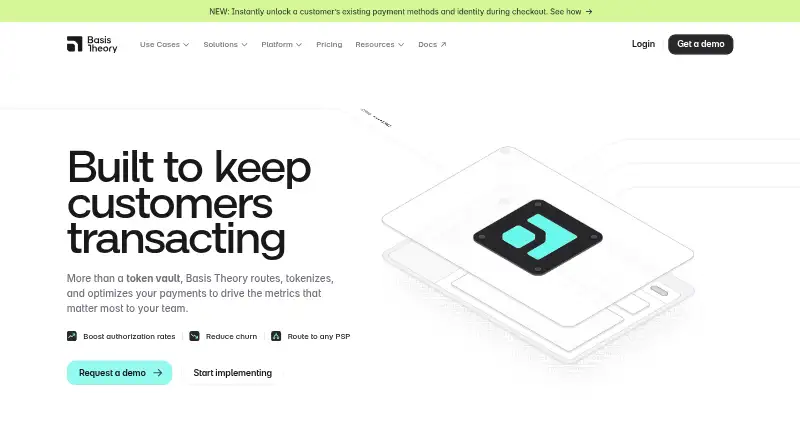
What Basis Theory is
Basis Theory is a payment-data platform that centralizes sensitive information, governs access and routes tokens to payment service providers or other services. It tokenizes card data when collected so raw primary account numbers do not touch customers’ systems. Its tools include Proxy, Reactors, Elements and Token Intents for routing, server-side logic, collecting sensitive data and validating it before tokenization. Vault capabilities include Account Updater, BIN Details, Network Tokens and 3DS. The company says its API can connect with existing payment service providers, naming Stripe, Adyen, Worldpay, Chase, Braintree, Nuvei, Amazon Pay and ACI as examples. SDKs are listed for programming languages and frameworks as well as iOS and Android. Basis Theory states that it is PCI Level 1 compliant, SOC 2 Type II certified, ISO 27001 certified and HIPAA compliant. The Standard platform costs $995 a month and includes 20,000 tokens, with each additional token costing $0.05. Tokens added and deleted within the same calendar month still count toward that month’s token total.
Good
- Tokenizes card data at the point of collection.
- API can connect with existing payment service providers.
- SDKs cover Android, iOS and several languages.
- Standard includes 20,000 tokens per month.
Watch out
- Standard platform costs $995 a month.
- Additional tokens cost $0.05 each.
- Deleted tokens still count toward the month’s total.
- Standard plan is limited to a US environment.
Who it suits
Basis Theory suits payment businesses that need to tokenize card data and control access to sensitive information. Listed use cases include e-commerce, fintech, digital health, gaming and subscription platforms.
Verdict
Basis Theory combines tokenization, payment routing and vault capabilities, with compliance and integration options listed by the company. The monthly token-counting rule and Standard plan’s US-only environment are important limits to consider.
Plans and prices
From Basis Theory's own pricing page, checked 29 Sep 2026.
| Plan | Price | What it gives you |
|---|---|---|
| Standard platform | $995 a month | 20,000 tokens included · $0.05 per additional token · 1MB payload limit · 24 hours of logs · US environment only · $995/month; platform fee charged at the beginning of the month |
| Enterprise | Priced on request | Additional PII and PHI compliance options · Unlimited monthly interactions per token · Custom log access and payload size · Uptime guarantees · Enterprise support options · SSO/SAML · Get in touch |
The facts
Each one read from Basis Theory's own pages, with the date it was checked.
What it does
- Card features
- Vault capabilities include Account Updater, BIN Details, Network Tokens, and 3DS.checked 29 Sep 2026
- Data protection
- The maker says data is encrypted at rest and in transit with tenant-specific keys and communication uses TLS 1.2+.checked 29 Sep 2026
- Integrations
- The maker says its API connects with any existing payment service provider and displays Stripe, Adyen, Worldpay, Chase, Braintree, Nuvei, Amazon Pay, and ACI as examples.checked 29 Sep 2026
- Intended users
- The maker lists creator economy, digital health, e-commerce, fintech, gaming, subscription platforms, and vertical SaaS as use cases.checked 29 Sep 2026
- Payment tools
- Its platform includes Proxy, Reactors, Elements, and Token Intents for routing, server-side logic, collecting sensitive data, and validating data before tokenization.checked 29 Sep 2026
- Product
- Basis Theory centralizes sensitive payment data, governs access, and routes tokens to any PSP or service.checked 29 Sep 2026
- SDKs
- Documented SDKs cover .NET, Java, Go, NodeJS, Python, Terraform, React, JavaScript, iOS, Android, and React Native.checked 29 Sep 2026
- Security
- Basis Theory states that it is PCI Level 1 compliant, SOC 2 Type II certified, ISO 27001 certified, and HIPAA compliant.checked 29 Sep 2026
- Support
- Implementation, bug, and issue support is available by email, with private Slack or Microsoft Teams channels offered through Sales.checked 29 Sep 2026
- Tokenization
- It tokenizes card data at the point of collection so raw primary account numbers do not touch customers’ systems.checked 29 Sep 2026
The company
- Company
- The site identifies the company as Basis Theory Inc.checked 29 Sep 2026
- Headquarters
- San Francisco, California, United Stateschecked 28 Sep 2026
Money
- Token billing limit
- Tokens added and then deleted during a calendar month still count toward that month’s token total.checked 29 Sep 2026
The full review of Basis Theory
Basis Theory is a cloud payment-data platform for businesses that need to keep card data out of their systems while working with multiple payment providers. It is a stronger fit for established payment teams than small operators: the Standard plan starts at $995 per month, before additional-token charges.
Overview
Basis Theory tokenizes card data as it is collected, keeping raw primary account numbers from touching customer systems. It centralizes sensitive payment data, governs access, and routes tokens to payment providers and other services. The vendor hosts the vault, and a detokenization API is available.
The API is designed to connect with existing PSPs, including Stripe, Adyen, Worldpay, Chase, Braintree, Nuvei, Amazon Pay, and ACI. That flexibility matters to teams managing more than one provider, but the Standard plan’s US-only environment is a poor fit for deployments that require another environment.
Key features
Proxy supports routing, Reactors provide server-side logic, Elements handle sensitive-data collection, and Token Intents validate data before tokenization. Together, these tools cover more of the payment-data workflow than a vault alone. Vault capabilities also include Account Updater, BIN Details, Network Tokens, and 3DS, with credit cards, bank accounts, Apple Pay, and Google Pay among the supported payment methods.
Documented SDKs span .NET, Java, Go, NodeJS, Python, Terraform, React, JavaScript, iOS, Android, and React Native. That range gives teams options across backend, web, and mobile projects. Basis Theory states that it is PCI Level 1 compliant, SOC 2 Type II and ISO 27001 certified, and HIPAA compliant; it also says data is encrypted at rest and in transit with tenant-specific keys, and communications use TLS 1.2 or later.
Pricing
Standard platform: $995 a month, billed monthly, with the platform fee charged at the beginning of the month. It includes 20,000 tokens, then charges $0.05 per additional token. The plan also sets a 1MB payload limit, retains logs for 24 hours, and is limited to a US environment. Tokens added and deleted within the same calendar month still count toward that month’s total, so frequent token turnover can increase charges. This plan suits teams whose expected volume, payloads, and deployment region fit those boundaries.
Enterprise: custom pricing. It adds options for additional PII and PHI compliance, unlimited monthly interactions per token, custom log access and payload size, uptime guarantees, enterprise support, and SSO/SAML. It is the more appropriate tier for organizations that need those controls or service terms; the tradeoff is a sales-led purchase rather than a published price.
Platforms
Basis Theory supports Android, iOS, web, and API access. Its cloud deployment and vendor-hosted vault avoid a self-hosting requirement, while the Standard plan’s US-only environment remains a significant regional restriction.
Who it's for
The company identifies creator economy, digital health, e-commerce, fintech, gaming, subscription platforms, and vertical SaaS as use cases. The common case is a business that handles sensitive payment data and wants to route tokens across existing providers. Implementation, bug, and issue support is available by email; private Slack or Microsoft Teams channels are offered through Sales.
Pros and cons
- Broad payment workflow: collection, validation, routing, server-side logic, and vault features sit in one platform.
- Provider and SDK coverage: the API targets existing PSPs, and documented SDKs cover major backend, web, and mobile options.
- Security controls: the company states multiple compliance credentials and encryption protections, relevant to teams handling sensitive payment data.
- High entry cost and metered usage: Standard starts at $995 per month, includes 20,000 tokens, and charges for additional tokens; deleted tokens still count for the month.
- Limited Standard environment and logs: US-only deployment and 24-hour log retention may not suit teams with other regional or operational needs.
Alternatives
Payment Tokenization Software is the category directory for comparing options. Choose American Express Token Service if a free plan and no stated deployment or use fees matter more; availability varies by market. Hyperswitch Card Vault is worth considering for teams seeking a free, self-hosted community edition with 90+ payment integrations, provided they are prepared to manage compliance themselves. DeloPay may suit teams that prefer transaction-based pricing and a free trial, though its Power plan charges 2.25% per transaction at the stated volume tier.
Cashfree Token Vault, FIS Data Integrity Manager, Very Good Security, Worldpay eProtect, and Mastercard Decision Intelligence are also alternatives to compare.
Verdict
Basis Theory is best for payment teams that need tokenization, access governance, and routing across providers, and can justify a $995 monthly starting commitment. Its broad toolset and integrations are compelling; look elsewhere if you need a non-US Standard environment, lower fixed costs, or a token model that does not count same-month deletions.
Getting started
- Visit the Basis Theory website
- Choose the Standard platform or contact Sales about Enterprise
- Integrate the API or a documented SDK for your stack
- Collect and tokenize payment data with Elements and Token Intents
- Route tokens through Proxy or Reactors to your payment services
Limits worth knowing
The Standard platform costs $995 a month and includes 20,000 tokens, with each additional token priced at $0.05. It has a 1MB payload limit, 24 hours of logs, and US-environment hosting; tokens added and deleted within the same calendar month still count toward the token total.
Questions
What does Basis Theory cost?
The Standard platform costs $995 a month and includes 20,000 tokens. Additional tokens cost $0.05 each; Enterprise pricing requires contacting the company.
Which payment providers can it connect to?
The API is described as connecting with any existing payment service provider. Examples shown include Stripe, Adyen, Worldpay, Chase, Braintree, Nuvei, Amazon Pay, and ACI.
Which platforms and SDKs are supported?
Platforms listed are Android, API, iOS, and web. SDKs cover .NET, Java, Go, NodeJS, Python, Terraform, React, JavaScript, iOS, Android, and React Native.
Does it tokenize payment data?
Yes. Card data is tokenized at collection so raw primary account numbers do not touch customer systems.
What security and compliance standards are stated?
Basis Theory states PCI Level 1 compliance, SOC 2 Type II certification, ISO 27001 certification, and HIPAA compliance. It also states that data is encrypted at rest and in transit, with TLS 1.2 or newer communications.
Alternatives to Basis Theory
- 1

DeloPay
AndroidiOSWebAPI7.7From $2.25 a month - 2

IXOPAY
AndroidiOSWebAPI7.6From $1,000 a month - 3
American Express Token Service
AndroidiOSWebAPI7.3 - 4

PayU
AndroidiOSWebAPI6.6 - 5
Hyperswitch Card Vault
Free planAPILinuxSelf-hosted6.4Free plan - 6
Very Good Security
AndroidiOSWebAPI6.4From $1,000 a month