Hyperswitch Card Vault
Hyperswitch Card Vault is a service for keeping payment credentials away from a merchant’s main application server.
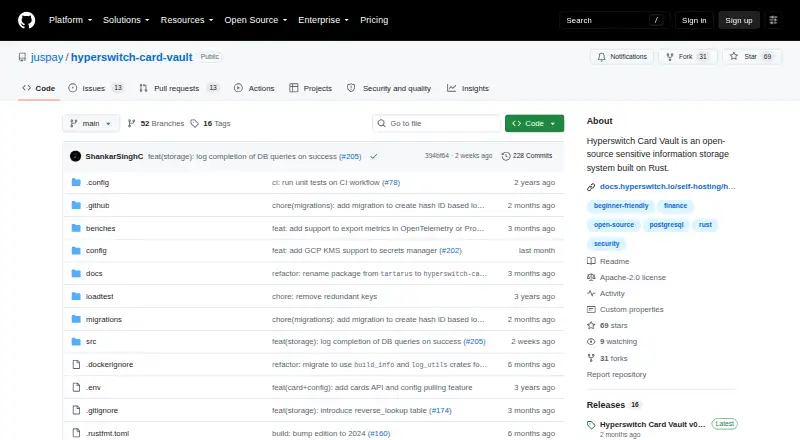
What Hyperswitch Card Vault is
Hyperswitch Card Vault is a service for keeping payment credentials away from a merchant’s main application server. It can store card details, bank account details, bank credentials, wallet credentials, and network or processor tokens. Its Vault and Forward API can tokenize data and route it to supported processors or endpoints. A proxy payment service can substitute vault tokens with card data and send payment requests through existing PSP connections, without requiring PSP reintegration. Keeping raw card data in the vault is described as a way to reduce PCI DSS scope.
The vault can run as a standalone service without Hyperswitch payment solutions. Merchants can connect through an SDK or directly server to server, and deploy it on-premises, in the cloud, or use Juspay-managed hosting. Security measures described include JWE encryption and JWS signing for communications, optional two-key custodian protection, AWS KMS support, AES re-encryption for storage, and database encryption at rest. Hyperswitch lists tokenization through 50+ processors and network tokens across Visa, Mastercard, and Amex. The self-host setup uses Docker or a Cargo executable and requires a database and configuration. The Community Edition is open source and free.
Good
- Standalone vault does not require Hyperswitch payment solutions.
- Supports cards, bank details, and wallet credentials.
- Offers SDK and server-to-server integration options.
- Can be deployed on-premises, in the cloud, or managed.
- Lists tokenization through 50+ processors.
- Community Edition includes public Slack and GitHub discussion support.
Watch out
- Self-hosting requires a database and configuration.
- Community Edition users manage compliance end to end.
Who it suits
It suits teams that need to store or tokenize payment credentials separately from their application and operate a vault service themselves. Merchants that prefer managed hosting can consider Hyperswitch Cloud, while PCI-compliant merchants can integrate directly server to server.
Verdict
Choose the free, open-source Community Edition if your team wants to run its own payment credential vault and manage compliance. Look at Hyperswitch Cloud instead if you want managed hosting, or Enterprise if you need SLA-driven support; neither plan has a listed price.
Plans and prices
From Hyperswitch Card Vault's own pricing page, checked 4 Oct 2026.
| Plan | Price | What it gives you |
|---|---|---|
| Self-Host Community Edition | Free | Self-hosted; manage compliance end to end; 90+ payment integrations; community support |
| Integrate Hyperswitch Cloud | Priced on request | Managed hosting; 210+ payment integrations; SLA-driven support; dedicated account manager |
| Self-Host Enterprise Edition | Priced on request | Self-hosted; 90+ payment integrations; SLA-driven support; dedicated account manager |
The facts
Each one read from Hyperswitch Card Vault's own pages, with the date it was checked.
What it does
- AWS KMS
- The setup guide describes an AWS-specific KMS feature that adds encryption for keys and sensitive data passed to the vault during startup.checked 4 Oct 2026
- Communication security
- The setup guide describes JWE encryption and JWS signing middleware for communications between tenant applications and the vault.checked 4 Oct 2026
- Community support
- The pricing page lists free support through the public Slack channel and GitHub discussions for the Community Edition.checked 4 Oct 2026
- Data protection
- Hyperswitch documents signing card data before transmission, encrypting it to the vault, re-encrypting it with AES for storage, and encrypting the database at rest.checked 3 Oct 2026
- Deployment
- The vault page says it can be deployed by customers on-premises or in the cloud, or used as a managed service hosted by Juspay.checked 3 Oct 2026
- Deployment and audience
- The setup guide documents running the vault in Docker or running the executable with Cargo, for teams configuring and operating their own service.checked 4 Oct 2026
- Duplicate prevention
- The repository overview says internal hashing checks are used to avoid data duplication.checked 4 Oct 2026
- Encryption at rest
- Hyperswitch documentation says card data is re-encrypted internally with AES and the database is encrypted at rest.checked 4 Oct 2026
- Flexible data
- The vault is designed to store different types of sensitive information and supports APIs on the /data and /cards endpoints.checked 4 Oct 2026
- Integration options
- The vault can be integrated through an SDK for merchants that are not PCI compliant or directly server to server for PCI-compliant merchants.checked 3 Oct 2026
- Key custody
- The optional key custodian feature requires two keys to decrypt the master key before vault functions can run.checked 4 Oct 2026
- PCI scope
- The proxy payment flow is described as reducing PCI DSS scope by keeping raw card data within the vault.checked 4 Oct 2026
- Performance claims
- The product page lists 99.999% uptime, response time under 50 ms, and throughput of 20k+ transactions per second.checked 3 Oct 2026
- Processor connections
- Proxy payments are described as working with existing PSP connections without requiring PSP reintegration.checked 4 Oct 2026
- Processor coverage
- The product page states that tokenization is available through 50+ processors and references network tokens across Visa, Mastercard, and Amex.checked 3 Oct 2026
- Purpose
- Hyperswitch Card Vault is an open-source Rust service for securely storing sensitive information such as payment card and bank account details.checked 4 Oct 2026
- Security features
- The setup guide describes optional key custodian protection, JWE and JWS encryption middleware, and AWS KMS encryption for keys and sensitive data passed during startup.checked 3 Oct 2026
- Self-hosting setup
- The setup guide documents running the locker in Docker or directly as a Cargo executable, with a database and configuration required.checked 3 Oct 2026
- Standalone service
- Hyperswitch describes its Vault Service as a standalone service for tokenizing and securing customer card data without requiring its payment solutions.checked 3 Oct 2026
- Storage association
- The repository overview says cards are stored against the combination of merchant and customer identifiers.checked 4 Oct 2026
- Tokenization
- The product page describes storing network and processor tokens, raw card details, bank credentials, and wallet credentials.checked 3 Oct 2026
- Tokenized proxy payments
- Its proxy payment service can replace vault tokens with card data and forward payment requests to a PSP.checked 4 Oct 2026
- Vaulting and forwarding
- The Vault and Forward API can tokenize and store card details, then route that data to supported processors or endpoints.checked 3 Oct 2026
The company
- Maker headquarters
- Juspay says it is headquartered in Bangalore.checked 3 Oct 2026
The full review of Hyperswitch Card Vault
Overview
Hyperswitch Card Vault is a service for tokenizing and storing payment credentials separately from a merchant’s main application. It suits payment teams that want control of their vault or need a managed option alongside existing processor connections. Its breadth of credential handling and deployment choices is appealing, but running it yourself also means owning setup and compliance.
Key features
The Vault and Forward API stores card details as tokens and routes them to supported processors or endpoints. It supports raw card details, network and processor tokens, bank credentials, wallet credentials, and other sensitive data through its flexible data APIs. Cards are associated with merchant and customer identifiers, and internal hashing checks help avoid duplication. That range is useful for teams managing several credential types, but it also calls for careful configuration and governance.
Proxy payments can substitute a vault token with card data and forward a payment request through an existing PSP connection, without requiring PSP reintegration. Keeping raw card data inside the vault can reduce PCI DSS scope; it does not remove the operator’s compliance responsibilities. The product page cites tokenization through 50+ processors and network tokens across Visa, Mastercard, and Amex, which is relevant for merchants working across providers.
Integration options reflect different compliance situations: merchants that are not PCI compliant can use an SDK, while PCI-compliant merchants can connect server to server. Data is signed before transmission, encrypted to the vault, re-encrypted with AES for storage, and held in a database encrypted at rest. Optional protections include JWE encryption and JWS signing middleware, key-custodian protection that requires two keys to decrypt the master key, and AWS KMS encryption for keys and sensitive data passed during startup. These controls offer useful layers, but the team operating a self-hosted vault must configure and maintain them.
Hyperswitch cites 99.999% uptime, response times under 50 ms, and throughput above 20,000 transactions per second. Those figures make ambitious performance claims; teams should weigh them alongside the operational demands of their chosen deployment.
Pricing
| Plan | Price | What it includes | Best suited to |
|---|---|---|---|
| Self-Host Community Edition | free | Self-hosted service, 90+ payment integrations, and community support; the team manages compliance end to end. | Teams able to operate their own vault and handle compliance. |
| Integrate Hyperswitch Cloud | Custom pricing | Managed hosting, 210+ payment integrations, SLA-driven support, and a dedicated account manager. | Teams that want hosting and operational support handled for them. |
| Self-Host Enterprise Edition | Custom pricing | Self-hosted service, 90+ payment integrations, SLA-driven support, and a dedicated account manager. | Teams that need enterprise support but want to run the service themselves. |
The Community Edition keeps software costs at zero, but not the work of managing compliance or the service itself; support is through public Slack and GitHub discussions. The paid plans add SLA-driven support and a dedicated account manager. Cloud also shifts hosting to Hyperswitch and includes 210+ integrations rather than the 90+ offered by the self-hosted editions.
Platforms
Hyperswitch Card Vault is an API service for Linux and self-hosted deployment. Teams can run the locker in Docker or as a Cargo executable, with a database and configuration required. The vault can be deployed on-premises or in the cloud, or used as a managed service hosted by Juspay. This flexibility fits teams with infrastructure capacity; it is less attractive to those seeking a turnkey local app.
Who it's for
This is a strong fit for payment teams that need to keep credentials outside their main application, use tokenized payments with existing PSP connections, or manage several types of sensitive payment data. It is also suited to organizations that want to self-host and take responsibility for compliance, or are willing to use Hyperswitch Cloud for managed hosting. Teams without the capacity to operate a vault or oversee compliance should look elsewhere or choose the managed plan.
Pros and cons
- Pros: Free, open-source self-hosting gives teams control over deployment and compliance choices.
- Pros: Vault and Forward supports a broad range of credentials and can work through existing PSP connections without reintegration.
- Pros: Documented encryption, signing, key-custodian, and AWS KMS options provide multiple ways to protect data and keys.
- Cons: Community users must operate the service and manage compliance end to end; support is community-based.
- Cons: Self-hosting requires a database, configuration, and operational setup, making it a poor fit for teams seeking a hands-off vault.
Alternatives
Payment Tokenization Software is a broader category to compare if you want to weigh vaults and tokenization tools side by side.
American Express Token Service is worth considering for teams seeking an Amex-focused option with no deployment or use fees stated and availability that varies by market.
DeloPay may suit teams that prefer a transaction-priced service: its Power plan is $2.25 a month, billed at 2.25% per transaction for monthly volume from $100,000 to $500,000.
Basis Theory is a paid alternative for teams considering a platform with a stated monthly fee: Standard platform costs $995 a month and includes 20,000 tokens, with additional tokens charged at $0.05 each.
Cashfree Token Vault is another paid vault option for readers comparing alternatives.
FIS Data Integrity Manager is a paid, web-based alternative.
Very Good Security is a paid alternative with a Starter Package at $1,000 a month and a free starting option.
Worldpay eProtect is another paid option for readers comparing payment-data services.
Mastercard Decision Intelligence is a paid alternative with custom pricing for its Decision Intelligence Pro plan.
Verdict
Choose Hyperswitch Card Vault if your payment team wants an open-source vault, broad credential support, and control over deployment, and can take on the setup and compliance work. Its strongest case is tokenized forwarding through existing PSP connections without reintegration. Look elsewhere if you need a fully managed service or do not have the capacity to run a security-sensitive vault.
Getting started
- Open the Hyperswitch Card Vault website on GitHub.
- Choose the Self-Host Community Edition, Hyperswitch Cloud, or Self-Host Enterprise Edition route.
- For self-hosting, run the locker in Docker or as a Cargo executable.
- Provide the required database and configuration.
- Connect using an SDK or directly server to server, according to your PCI compliance.
Limits worth knowing
The Self-Host Community Edition is self-hosted and requires customers to manage compliance end to end.
Questions
Is Hyperswitch Card Vault free?
The Self-Host Community Edition is free and open source. Hyperswitch also lists Cloud and Enterprise plans without prices.
Can it be hosted by Juspay?
Yes. Hyperswitch lists managed hosting through Hyperswitch Cloud, as well as self-hosted deployment on-premises or in the cloud.
What payment data can it store?
It supports card and bank account details, as well as bank and wallet credentials and network or processor tokens.
How can a merchant integrate it?
Merchants can use an SDK or connect directly server to server. The stated options depend on PCI compliance.
What is required for self-hosting?
The setup guide documents running the locker in Docker or as a Cargo executable, with a database and configuration.
Who makes Hyperswitch Card Vault?
It is made by Juspay, which says it is headquartered in Bangalore.
Alternatives to Hyperswitch Card Vault
- 1

DeloPay
AndroidiOSWebAPI7.7From $2.25 a month - 2

IXOPAY
AndroidiOSWebAPI7.6From $1,000 a month - 3
American Express Token Service
AndroidiOSWebAPI7.3 - 4

PayU
AndroidiOSWebAPI6.6 - 5

Basis Theory
AndroidiOSWebAPI6.4From $995 a month - 6
Very Good Security
AndroidiOSWebAPI6.4From $1,000 a month