
Cashfree Token Vault
Cashfree Token Vault replaces sensitive card information with cryptographically generated tokens, allowing merchants to process saved-card payments without k…
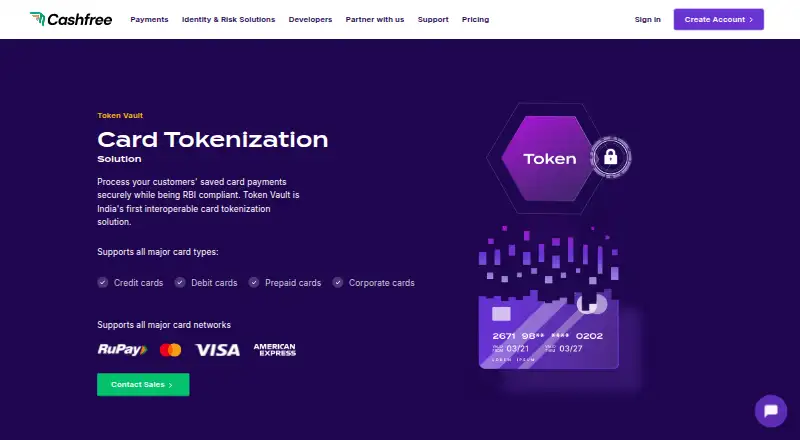
What Cashfree Token Vault is
Cashfree Token Vault replaces sensitive card information with cryptographically generated tokens, allowing merchants to process saved-card payments without keeping card numbers on their own platforms. Cashfree describes it as one integration for processing cards across payment gateways or networks. It supports credit, debit, prepaid and corporate cards, with Visa and Mastercard credit and debit tokenization specifically described. Saved-card tokenization is enabled automatically for Standard Checkout; merchants using Seamless Pro need to integrate or update APIs. Customers can choose a saved card and enter its CVV to pay. Token provisioning requires explicit customer consent and cannot proceed if two-factor authentication fails. Merchants cannot retrieve the card number from a token and may retain only the last four digits, scheme and issuing bank name. A token reference created through Cashfree stays with Cashfree, though merchants can fetch the network token for another payment aggregator. Pricing is available on request, and no free trial is stated.
Good
- Supports credit, debit, prepaid and corporate cards
- Standard Checkout enables saved-card tokenization automatically
- Customer consent and two-factor authentication guard token provisioning
- Merchants cannot retrieve card numbers from tokens
Watch out
- Seamless Pro requires API integration or updates
- Token references created through Cashfree remain with Cashfree
- No free trial is stated
- Pricing is available on request
Who it suits
It suits merchants that want to support saved-card payments without storing card numbers on their platforms. It may fit businesses using Standard Checkout or willing to integrate the Token Vault API with Seamless Pro.
Verdict
Token Vault supports saved-card payments while limiting the card data merchants can retain. Consider its Seamless Pro setup requirement and the Cashfree-bound token reference when planning payment integrations.
The facts
Each one read from Cashfree Token Vault's own pages, with the date it was checked.
What it does
- Bulk tokenization
- The page says RBI rules do not allow bulk tokenization of cards already saved by PCI/DSS-compliant merchants, who must delete those saved cards.checked 30 Sep 2026
- Cards supported
- The page lists credit, debit, prepaid, and corporate cards, and specifically describes Visa and Mastercard credit and debit tokenization.checked 30 Sep 2026
- Checkout
- For merchants using Standard Checkout, saved cards are enabled automatically; Seamless Pro merchants can integrate the Token Vault API.checked 30 Sep 2026
- Checkout setup
- For standard checkout, saved card tokenization is automatically enabled; merchants using Seamless Pro must integrate or update their APIs.checked 30 Sep 2026
- Consent and authentication
- Explicit customer consent is required to provision a token, and token provisioning cannot proceed if the customer's two-factor authentication fails.checked 30 Sep 2026
- Customer experience
- Cashfree says customers can select a saved card and pay by entering its CVV.checked 30 Sep 2026
- Integrations
- The Token Vault page lists Shopify, Wix, WooCommerce, PayPal, WordPress, and Zoho among Cashfree integrations.checked 30 Sep 2026
- Interoperability
- Cashfree describes Token Vault as an interoperable solution that lets a merchant process card payments across multiple payment gateways or card networks through a single integration.checked 30 Sep 2026
- Merchant data limits
- Merchants may store only the card's last four digits, scheme, and issuing bank name; the page says they cannot store the BIN, expiry, or CVV.checked 30 Sep 2026
- Migration limit
- Cashfree says a token reference number provisioned through it remains with Cashfree, though merchants can fetch the card network token and use it with another payment aggregator.checked 30 Sep 2026
- Migration limitation
- Cashfree says a token reference created through Token Vault remains with Cashfree, although merchants can fetch card network tokens for payments through another payment aggregator.checked 30 Sep 2026
- Pricing
- The Token Vault product page does not state a price or a free trial.checked 30 Sep 2026
- Purpose
- Token Vault replaces sensitive card details with cryptographically generated tokens so merchants can process saved card payments without storing card details on their platforms.checked 30 Sep 2026
- Saved card experience
- Cashfree says customers can select a saved card and pay by entering its CVV, and that its ecosystem has 16mn+ saved cards.checked 30 Sep 2026
- Security and compliance
- Cashfree presents Token Vault as supporting RBI compliance and says merchants cannot store card numbers on their servers under the described RBI guidelines.checked 30 Sep 2026
- Support
- Cashfree's about page lists a Support Center, Customer Query Resolution, a bank downtime detector, and a Discord community.checked 30 Sep 2026
- Supported cards
- It supports credit, debit, prepaid, and corporate cards, and the page specifically names Visa and Mastercard credit and debit cards.checked 30 Sep 2026
- Token retrieval
- Merchants cannot retrieve the actual card number from a token; only card schemes and issuing banks can do so.checked 30 Sep 2026
- Token security
- Merchants cannot retrieve the actual card number from a token; only card schemes and issuing banks can retrieve it.checked 30 Sep 2026
The company
- Company security
- Cashfree's privacy page lists ISO/IEC 27001:2022, PCI-DSS v4.0.1, and SOC 2 among its security standards and certifications.checked 30 Sep 2026
- Founded
- 2015checked 28 Sep 2026
- Headquarters
- Bengaluru, Karnataka, Indiachecked 28 Sep 2026
The full review of Cashfree Token Vault
Cashfree Token Vault is a cloud service for merchants that want saved-card payments without retaining full card numbers on their own systems. It is most suitable for businesses already using Cashfree checkout or willing to build against its API, while teams demanding a provider-independent token reference should assess the migration implications carefully.
Overview
Token Vault substitutes cryptographically generated tokens for sensitive card details. Merchants can use those tokens to process returning customers' card payments while keeping card numbers off merchant platforms, a practical way to reduce the card-data burden in an RBI-focused compliance model.
Cashfree describes one integration that can work across multiple payment gateways or card networks. That interoperability is useful for merchants with more than one payment route, although the Cashfree-created token reference remains tied to Cashfree. A merchant can fetch the card-network token for another payment aggregator, but cannot take the Cashfree reference itself to a new provider.
Key features
- Broad card coverage: Credit, debit, prepaid and corporate cards are supported. Visa and Mastercard credit and debit tokenization are specifically described, giving consumer and business-facing merchants a substantial core range.
- Saved-card checkout: Customers select a stored card and enter its CVV at payment. Cashfree says its ecosystem contains more than 16 million saved cards, though that ecosystem-wide figure does not indicate how many a particular merchant's customers can use.
- Consent and authentication controls: Explicit customer consent is required before provisioning, and provisioning stops when two-factor authentication fails. This protects authorization but adds a firm dependency on a completed customer verification step.
- Restricted merchant data: Merchants may retain only the last four digits, card scheme and issuing bank name. BIN, expiry date and CVV cannot be stored, limiting the information available for internal payment records while keeping full card data out of merchant systems.
- Token security: A merchant cannot recover the underlying card number from a token; only the card scheme and issuing bank can retrieve it. The design sharply limits the impact of a token exposure compared with a leaked primary account number.
- Network tokenization and webhooks: Network tokenization is supported, with webhook support for event-driven integrations. Token Vault is vendor-hosted in the cloud and has no detokenization API, so it is not intended for merchants that need to turn tokens back into card numbers through their own service.
- Checkout paths: Standard Checkout enables saved-card tokenization automatically. Merchants on Seamless Pro must integrate or update their APIs, making the product more demanding for teams using that checkout model.
- Integrations and assurance: Cashfree lists Shopify, Wix, WooCommerce, PayPal, WordPress and Zoho integrations. Its company security information cites ISO/IEC 27001:2022, PCI-DSS v4.0.1 and SOC 2, while support includes a Support Center, customer query resolution, a bank-downtime detector and a Discord community.
- Migration constraint: RBI rules described by Cashfree do not permit bulk tokenization of cards already saved by PCI/DSS-compliant merchants; those saved cards must be deleted. Merchants planning a migration therefore need a customer re-provisioning strategy rather than a bulk conversion.
Pricing
Cashfree uses paid, custom pricing for Token Vault. No public plan price or free trial is provided, so prospective customers must request a quote and confirm usage terms directly. The absence of a free tier makes it less suitable for small teams seeking to validate tokenization at no cost, while established merchants can negotiate pricing around their payment volume and integration scope.
Platforms
Token Vault is delivered through Android, iOS, web and API access. Its cloud deployment and API option fit online businesses and mobile applications, while the automatic Standard Checkout path reduces implementation work for merchants already using Cashfree's hosted checkout.
Who it's for
Choose Token Vault if your business needs recurring or saved-card payments, wants card numbers kept off its infrastructure, and already operates within Cashfree's checkout or payment ecosystem. It also fits merchants serving mixed consumer and corporate card use and those that value a single integration across payment routes.
Look elsewhere if you require a fully portable vault reference, a detokenization API, or bulk migration of cards stored with another PCI/DSS-compliant provider. Seamless Pro users should budget for API work, and smaller merchants should weigh custom pricing before committing.
Pros and cons
Pros
- Reduces card-data exposure: Full card numbers stay outside merchant platforms, with strict limits on retained fields.
- Strong authorization gates: Consent and successful two-factor authentication are required for provisioning.
- Useful card and route coverage: Multiple card types, network tokenization and gateway/network interoperability support varied payment setups.
- Low-friction Standard Checkout setup: Saved cards are enabled automatically for that checkout option.
Cons
- Cashfree-bound reference: The token reference cannot be transferred, even though a network token can be fetched for another aggregator.
- No detokenization API: Merchants cannot retrieve card numbers for workflows that require controlled detokenization.
- Seamless Pro implementation work: API integration or updates are required instead of automatic enablement.
- Custom pricing only: There is no published price or free trial for initial evaluation.
Alternatives
American Express Token Service is a paid service with a free plan and no trial, available across Android, API, iOS and web; choose it when American Express network coverage and a no-cost plan matter.
Hyperswitch Card Vault offers a free, self-hosted community edition with 90-plus payment integrations; pick it when you want to manage compliance yourself and avoid vendor hosting.
DeloPay is a paid service with a free trial and transaction-based Power pricing; consider it when a trial and volume-tier billing are priorities.
Basis Theory provides a $995-per-month standard platform plan including 20,000 tokens; it suits organizations prepared for a substantial fixed platform fee.
FIS Data Integrity Manager is a paid, web-based alternative.
Very Good Security has a free plan and paid packages starting at $1,000 per month; choose it when a broader vault package and published entry pricing fit your budget.
Worldpay eProtect is a paid alternative available on Android, API, iOS and web.
Mastercard Decision Intelligence is a paid web service with custom pricing; consider it when Mastercard's platform is the preferred route.
Verdict
Cashfree Token Vault is a strong choice for Cashfree merchants that need saved-card payments while keeping full card data out of their systems. Its principal advantage is the combination of restricted data retention, consent controls and broad card coverage; its principal drawback is the Cashfree-bound token reference, compounded by custom pricing and extra API work for Seamless Pro. Choose it when Cashfree is already central to your payments, and look elsewhere when portability or self-hosted control is non-negotiable.
Alternatives to Cashfree Token Vault
- 1

DeloPay
AndroidiOSWebAPI7.7From $2.25 a month - 2

IXOPAY
AndroidiOSWebAPI7.6From $1,000 a month - 3
American Express Token Service
AndroidiOSWebAPI7.3 - 4

PayU
AndroidiOSWebAPI6.6 - 5

Basis Theory
AndroidiOSWebAPI6.4From $995 a month - 6
Hyperswitch Card Vault
Free planAPILinuxSelf-hosted6.4Free plan