
DeloPay
DeloPay is a payment orchestration platform that connects payment providers and routes transactions to a selected provider.
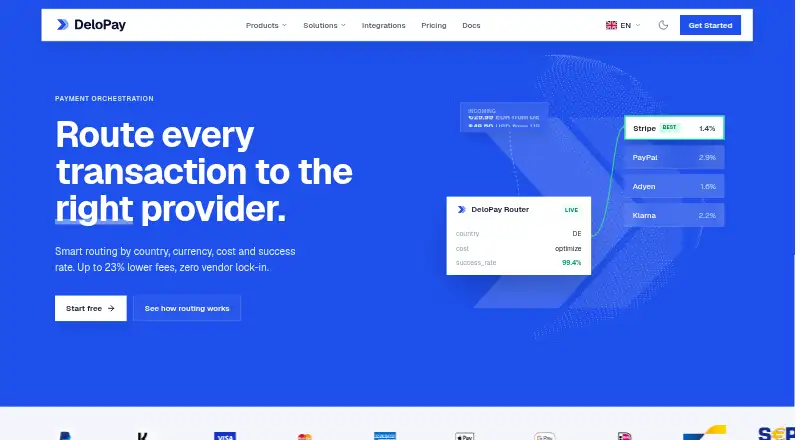
What DeloPay is
DeloPay is a payment orchestration platform that connects payment providers and routes transactions to a selected provider. Its Smart Routing option chooses a provider using cost, recent success rate, capability matching and business rules. Merchants can use a hosted iFrame checkout for card input, 3-D Secure, wallets and crypto, create payment links, connect a WooCommerce plugin or integrate through the REST API. Listed connectors include Stripe, PayPal, Airwallex, Klarna, Creem, e-Payouts, NomuPay, Cryptomus and NOWPayments. DeloPay offers JavaScript/TypeScript and Java SDKs; native mobile SDKs are on its roadmap. Subscriptions can be created, paused, resumed and cancelled through one API when billed through a billing-capable connector such as Stripe Billing or PayPal. DeloPay says it does not store raw card numbers or full payment credentials on its servers. Transaction rates are listed from 4.00% per transaction at the Starter tier to 2.25% per transaction at Power; there is no monthly plan or setup fee. A free trial is offered, but no free plan is listed.
Good
- Smart Routing uses cost, success rate and business rules.
- Hosted checkout supports cards, 3-D Secure, wallets and crypto.
- REST API plus JavaScript/TypeScript and Java SDKs.
- No monthly plan or setup fee.
Watch out
- No free plan is listed.
- Native mobile SDKs are on the roadmap.
- Starter rate is 4.00% per transaction.
Who it suits
DeloPay may suit e-commerce, SaaS, subscription, marketplace, gaming and platform businesses that need to connect payment providers. Its API and payment links also address merchants seeking different integration routes.
Verdict
DeloPay centralizes provider selection and offers several checkout and integration options. Its transaction-based pricing and lack of native mobile SDKs are important considerations.
Plans and prices
From DeloPay's own pricing page, checked 14 Oct 2026.
| Plan | Price | What it gives you |
|---|---|---|
| Power | $2.25 a month | No setup fee · no monthly minimum · 2.25% per transaction · $100,000–$500,000 volume |
| High volume | $2.75 a month | No setup fee · no monthly minimum · 2.75% per transaction · $50,000–$100,000 volume |
| Scale | $3.25 a month | No setup fee · no monthly minimum · 3.25% per transaction · $20,000–$50,000 volume |
| Growth | $3.50 a month | No setup fee · no monthly minimum · 3.50% per transaction · $5,000–$20,000 volume |
| Starter | $4 a month | No setup fee · no monthly minimum · 4.00% per transaction · $0–$5,000 processed in the prior 30 days |
| Enterprise | Priced on request | Custom pricing · Custom rate · over $500,000 volume |
The facts
Each one read from DeloPay's own pages, with the date it was checked.
What it does
- API and SDKs
- DeloPay offers a REST API, official JavaScript/TypeScript and Java SDKs, and an iFrame checkout; native mobile SDKs are described as being on the roadmap.checked 3 Oct 2026
- Business organization
- Projects contain shops, with separate keys, webhooks, connectors and analytics plus custom role permissions.checked 14 Oct 2026
- Card data
- DeloPay says it does not store raw card numbers or full payment credentials on its servers; connected payment providers handle that data.checked 3 Oct 2026
- Card-data scope
- Hosted checkout keeps PAN and CVV out of the merchant server, while direct API card collection leaves PCI responsibilities with the merchant.checked 14 Oct 2026
- Checkout
- Hosted or iframe checkout handles cards, 3-D Secure, wallets, bank redirects, buy-now-pay-later and crypto methods.checked 14 Oct 2026
- Data storage
- The FAQ says infrastructure is primarily EU-based in Frankfurt and that sensitive payment data is tokenized rather than stored in clear text.checked 14 Oct 2026
- Documentation depth
- The documentation covers quickstarts, authentication, payment lifecycle, products, invoices, refunds, disputes, subscriptions, webhooks, errors and SDK references.checked 14 Oct 2026
- Failover
- Fallback chains retry eligible soft declines through other connected providers while hard declines stop immediately.checked 14 Oct 2026
- Independent adoption signal
- The WordPress.org developer profile reported fewer than ten active installations and a May 2026 join date.checked 14 Oct 2026
- Infrastructure
- The FAQ says DeloPay primarily uses EU-based infrastructure in Frankfurt and tokenizes sensitive payment data at the provider level.checked 3 Oct 2026
- Integrations
- The connector catalog names Stripe, PayPal, Airwallex, Mollie, Rapyd, Klarna, Creem, Whop, e-Payouts, NomuPay, Cryptomus and NOWPayments.checked 14 Oct 2026
- Intended users
- The site describes use cases including e-commerce, SaaS and subscriptions, marketplaces, gaming, platforms and agencies, and international payments.checked 3 Oct 2026
- Legal limitation
- The terms cap Deloxity's aggregate liability at the amount paid during the preceding twelve months and exclude indirect damages.checked 14 Oct 2026
- Licence
- The WordPress integration code is MIT-licensed, while the hosted DeloPay platform and APIs remain proprietary commercial software.checked 14 Oct 2026
- Limit: domain maturity
- ScamAdviser reported low Tranco traffic rank, a young domain and a WHOIS registration date of 2025-05-17.checked 14 Oct 2026
- Limit: external trust signal
- ScamAdviser assigned delopay.com a trust score of 61 and characterized it as medium-to-low risk rather than guaranteeing safety.checked 14 Oct 2026
- Limit: WordPress commerce scope
- The WordPress product page says the standalone plugin does not provide shipping, tax, coupons, inventory, variants, customer accounts or order emails.checked 14 Oct 2026
- Merchant-of-record status
- The terms state that DeloPay is an intermediary and does not itself hold, transfer or settle merchant funds.checked 14 Oct 2026
- Payment links and WordPress
- Merchants can create payment links, use a WooCommerce plugin, or integrate through the API.checked 3 Oct 2026
- Payment operations
- The platform includes subscriptions, mandates, refunds, disputes, settlement statements, surcharges, payouts and revenue-recovery APIs.checked 14 Oct 2026
- Praise: WordPress integration
- The WordPress plugin provides catalog, cart, orders, refunds, disputes, signed webhooks and one-click account pairing.checked 14 Oct 2026
- Praise: WordPress security
- The WordPress directory listing says its hosted iframe keeps card numbers off the site's server and database.checked 14 Oct 2026
The company
- Company
- DeloPay says it is built and maintained by a three-person engineering team at Deloxity LLC.checked 3 Oct 2026
- Company team
- DeloPay says it is built and maintained by three engineers at Deloxity LLC.checked 14 Oct 2026
The full review of DeloPay
Overview
DeloPay is a payment orchestration platform for businesses that need to connect payment providers and direct transactions among them. It is best suited to merchants handling payments through web checkout, payment links, WooCommerce or an API, particularly when they need more than one provider. Its routing and checkout options are useful, but transaction fees and the absence of native mobile SDKs are meaningful trade-offs.
Smart Routing weighs provider cost, recent success rates, capability matching and business rules when selecting a route. That gives businesses with multiple suitable connections more control over payment handling; its value is more limited when there is only one viable provider.
Key features
Checkout and provider connections. The hosted iFrame handles card entry, 3-D Secure, wallets and crypto without payment data touching the merchant’s servers. Merchants can also create payment links, use the WooCommerce plugin or integrate through the API. Connections include Stripe, PayPal, Airwallex, Klarna, Creem, e-Payouts, NomuPay, Cryptomus and NOWPayments, giving merchants several routes to assemble a payment setup. Businesses should make sure the providers and payment methods they rely on are covered.
Routing and retries. Routing rules and automatic retries complement Smart Routing, allowing merchants to shape how payments are directed and handled. Tokenization and a vault are also supported. These capabilities are most relevant to businesses managing multiple providers or payment flows; they matter less to a merchant with a simple, single-provider checkout.
API and subscriptions. DeloPay provides a REST API, JavaScript/TypeScript and Java SDKs, plus an iFrame checkout. Native mobile SDKs are on the roadmap, so teams building native app payment flows should expect to use another integration approach for now. Subscriptions can be created, paused, resumed and cancelled through one API when billed through a billing-capable connector such as Stripe Billing or PayPal. That central control is useful, but it depends on using a connector with billing support.
Security and testing. DeloPay says data is encrypted in transit and at rest, credentials are hashed with Argon2, and access is controlled by roles. It does not store raw card numbers or full payment credentials on its servers; connected providers handle that data. Its infrastructure is primarily EU-based in Frankfurt, and sensitive payment data is tokenized at provider level. Test API keys enable test mode, but whether a test reaches a provider sandbox depends on the connected provider.
Technical support is handled through Control Center tickets, with typical response times under four hours during EU business days. DeloPay is built and maintained by a three-person engineering team at Deloxity LLC, a relevant consideration for businesses weighing their preferred vendor profile.
Pricing
DeloPay has no free plan and offers a free trial. Its tiers are based on monthly volume over the previous 30 days, with no monthly plan or setup fee on the five fixed-rate tiers. The amounts below are the listed monthly amounts; the transaction percentage is the charge that matters most as volume grows.
| Plan | Listed price | Transaction rate and monthly volume |
|---|---|---|
| Starter | $4 a month | 4.00% per transaction; $0 to $5,000 |
| Growth | $3.50 a month | 3.50% per transaction; $5,000 to $20,000 |
| Scale | $3.25 a month | 3.25% per transaction; $20,000 to $50,000 |
| High volume | $2.75 a month | 2.75% per transaction; $50,000 to $100,000 |
| Power | $2.25 a month | 2.25% per transaction; $100,000 to $500,000 |
| Enterprise | Custom pricing | Custom transaction rate; over $500,000 |
Starter is the entry tier for lower-volume merchants, but its 4.00% transaction rate makes transaction costs a key consideration. Growth, Scale, High volume and Power reduce that rate as the volume band rises, so they suit businesses consistently operating at those levels; the tier is based on the previous 30 days rather than a fixed annual commitment. Enterprise is for volume above $500,000, with custom pricing. No plan-specific seat or transaction-count quotas are given.
Platforms
DeloPay is listed for Android, iOS, Linux, macOS, Windows, web and API. The platform list does not change the integration trade-off: its official SDKs are JavaScript/TypeScript and Java, while native mobile SDKs remain on the roadmap.
Who it's for
DeloPay is aimed at e-commerce, SaaS and subscription businesses, marketplaces, gaming, platforms and agencies, and companies handling international payments. It is a stronger fit for teams that can use a hosted iFrame, payment links, WooCommerce or the API and want routing across connected providers. Mobile-first teams requiring native SDKs today, or merchants with only one suitable provider, have less reason to take on an orchestration layer.
Pros and cons
- Pro: Smart Routing considers cost, recent success, capability and business rules, giving multi-provider merchants several criteria for directing transactions.
- Pro: Hosted checkout, payment links, WooCommerce and API integration provide distinct ways to accept payments, while the iFrame keeps payment data off merchant servers.
- Pro: Subscription actions are available through one API when the billing connector supports them.
- Con: Transaction rates run from 4.00% to 2.25% on the fixed tiers, making the fee structure important to assess against payment volume.
- Con: Native mobile SDKs are not yet available, which complicates a direct fit for native app teams.
- Con: Test-mode sandbox behavior depends on the connected provider, so a consistent testing path is not assured across connections.
Alternatives
For a free option focused on tokenization rather than orchestration, Hyperswitch Card Vault offers a self-hosted community edition with 90+ payment integrations and community support, while leaving compliance management to the user. If your need is specifically token service coverage, American Express Token Service has a free plan with no deployment or use fees stated, though availability varies by market.
Basis Theory is a paid tokenization option with a Standard platform plan at $995 a month, including 20,000 tokens and charging $0.05 per additional token; it may suit buyers comparing a defined token allowance with DeloPay’s transaction-rate tiers. Cashfree Token Vault, FIS Data Integrity Manager, Very Good Security, Worldpay eProtect and Mastercard Decision Intelligence are also alternatives to consider.
For broader category comparisons, see Payment Orchestration Platforms and Payment Tokenization Software.
Verdict
Choose DeloPay if you need to connect payment providers, apply routing criteria and accept payments through web-oriented checkout, links, WooCommerce or an API. Its main advantage is bringing those routes and subscription controls together; its main drawbacks are transaction-based pricing and the lack of native mobile SDKs. Native app teams needing SDKs now, and merchants with a single-provider setup, should look elsewhere.
Getting started
- Visit https://delopay.net/ and start with the free trial.
- Choose an integration route: payment links, WooCommerce, or the REST API.
- Connect a listed payment provider, such as Stripe or PayPal.
- Use the JavaScript/TypeScript or Java SDK if it fits your integration.
- Create test API keys and check whether the connected provider routes tests to a sandbox.
Limits worth knowing
There is no free plan. The Starter tier covers $0 to $5,000 monthly volume at 4.00% per transaction; its volume tier is based on the previous 30 days.
Questions
Does DeloPay have a free plan?
No. A free trial is available.
How is DeloPay priced?
Listed tiers charge 4.00% per transaction at Starter, 3.50% at Growth, 3.25% at Scale, 2.75% at High volume, and 2.25% at Power. The tiers are based on monthly volume over the previous 30 days, with no monthly plan or setup fee; Enterprise pricing is custom.
Which platforms does DeloPay support?
The listed platforms are Android, API, iOS, Linux, macOS, web, and Windows.
Which payment providers are listed as integrations?
Stripe, PayPal, Airwallex, Klarna, Creem, e-Payouts, NomuPay, Cryptomus, and NOWPayments.
Can DeloPay manage subscriptions?
Yes. Subscriptions can be created, paused, resumed, and cancelled through one API when billing runs through a compatible connector such as Stripe Billing or PayPal.
What does DeloPay say about payment data?
It says connected providers handle raw card numbers and full payment credentials rather than DeloPay storing them. Its privacy policy says data is encrypted in transit and at rest, credentials are hashed with Argon2, and access uses role-based controls.
Alternatives to DeloPay
- 1

IXOPAY
AndroidiOSWebAPI7.6From $1,000 a month - 2
American Express Token Service
AndroidiOSWebAPI7.3 - 3

PayU
AndroidiOSWebAPI6.6 - 4

Basis Theory
AndroidiOSWebAPI6.4From $995 a month - 5
Hyperswitch Card Vault
Free planAPILinuxSelf-hosted6.4Free plan - 6
Very Good Security
AndroidiOSWebAPI6.4From $1,000 a month