
Archon Data Store
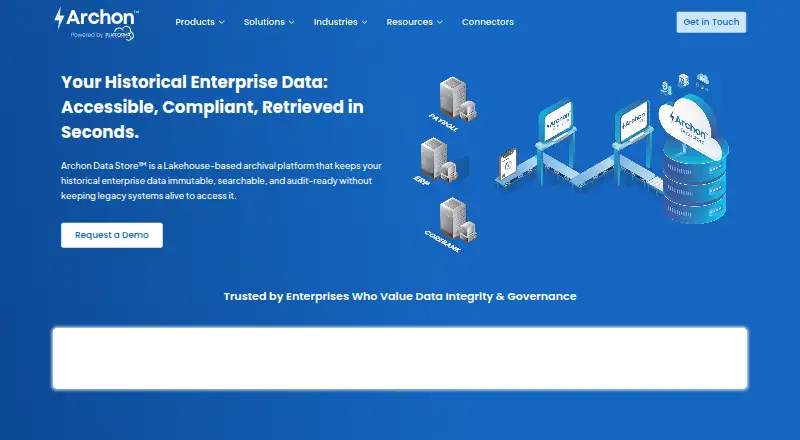
Archon Data Store is a Lakehouse-based archival platform for enterprises preserving historical data without keeping legacy systems available for access.
What Archon Data Store is
Archon Data Store is a Lakehouse-based archival platform for enterprises preserving historical data without keeping legacy systems available for access. It uses hot, warm, and cold storage tiers, with tier migration, codec workflows, and compression of up to 80%. Its write-once, read-many design supports retention-enforced immutability, chain of custody, and immutable audit logs. Teams can set retention policies and legal holds, route purges for approval, track data quality, and use redaction and defensible disposition workflows. Search options include SQL and metadata queries across applications, as well as e-discovery workflows. The platform supports analytics and AI-driven insights on archived data without first restoring it to a live system. It connects with enterprise systems through APIs and ETL connectors; retrieval options include Trino and Spark query engines, dashboards, SQL queries, and APIs. Deployment can span cloud archival storage, object storage, on-premises systems, and SaaS environments. Listed platforms are API, self-hosted, and web. Pricing is available on request.
Good
- Supports retention policies and legal holds.
- Offers immutable audit logs and chain of custody.
- Searches archived data with SQL and metadata.
- Supports analytics without restoring data to a live system.
Watch out
- Pricing is available on request.
- The listed platforms are API, self-hosted, and web.
- Designed for enterprise archival needs.
Who it suits
Archon Data Store suits mid- to large-sized businesses with legacy applications, multiple locations, and significant technology debt. Its retention and legal-hold workflows may also suit organizations needing controlled archival processes.
Verdict
Archon Data Store focuses on governed, searchable archival rather than maintaining legacy systems for access. Its tiering, retention controls, and multiple deployment environments are key factors for enterprise teams to evaluate.
The facts
Each one read from Archon Data Store's own pages, with the date it was checked.
What it does
- Analytics
- The product page says users can run analytics and AI-driven insights on archived data without restoring it to a live system first.checked 30 Sep 2026
- Certifications
- The maker’s Trust Center lists ISO 27001:2022, SOC 2 Type 2, PCI DSS, and Cloud Security Alliance (CSA) certifications.checked 30 Sep 2026
- Compliance workflows
- Features include automated retention and legal-hold controls, approval-based purge workflows, encryption, redaction, quality tracking and defensible disposition.checked 30 Sep 2026
- Data integrity
- The product page describes a WORM-compliant architecture, retention-enforced immutability, chain of custody, and immutable audit logs.checked 30 Sep 2026
- Deployment
- The solution supports tiering across cloud archival storage, object storage, on-premises systems and SaaS environments.checked 30 Sep 2026
- Governance
- It provides automated retention and legal holds, approval-based purge workflows, audit trails, encryption, and redaction.checked 30 Sep 2026
- Integrations
- The product FAQ says ADS connects with more than 250 enterprise systems, including SAP, Oracle, PeopleSoft, Epic, and custom databases, through open APIs and Archon ETL connectors.checked 30 Sep 2026
- Intended users
- The company describes Archon as serving enterprise organizations across industries including healthcare, manufacturing, financial services, and retail.checked 30 Sep 2026
- Purpose
- Archon Data Store is a Lakehouse-based archival platform for keeping historical enterprise data immutable, searchable, and audit-ready without maintaining legacy systems for access.checked 30 Sep 2026
- Retrieval
- The product FAQ says ADS supports sub-second retrieval through query engines such as Trino and Spark, with access via dashboards, SQL queries, or APIs.checked 30 Sep 2026
- Search
- Users can search with SQL and metadata, query across applications, and use e-discovery workflows.checked 30 Sep 2026
- Security
- The product page states that it uses AES-256 encryption at rest and in transit, role-based access controls, and an air-gapped Data Bunker.checked 30 Sep 2026
- Storage integrity
- The platform uses write-once, read-many architecture, retention-enforced immutability, chain of custody and immutable audit logs.checked 30 Sep 2026
- Storage tiering
- It provides hot, warm and cold storage tiering, built-in codec workflows, one-click tier migration and up to 80% data compression.checked 30 Sep 2026
- Storage tiers
- The platform supports hot, warm, and cold storage tiering, with up to 80% data compression.checked 30 Sep 2026
- Support
- The contact page provides customer support by email and lists phone numbers for the United States and India.checked 30 Sep 2026
- Target users
- Platform 3 Solutions describes its target customers as mid- to large-sized businesses with legacy applications, multiple locations and significant technology debt.checked 30 Sep 2026
The company
- Headquarters
- The company lists its address as 601 Carlson Parkway Suite 1050, Minnetonka, Minnesota 55305, USA.checked 30 Sep 2026
- Maker
- Archon is identified as a product of Platform 3 Solutions.checked 30 Sep 2026
The full review of Archon Data Store
Archon Data Store is a governed archive for enterprise data that needs to remain searchable and defensible after its source systems retire. It best suits mid- to large-sized organizations with substantial legacy estates and compliance obligations. Its combination of immutable retention, tiered storage and cross-system search is compelling, though custom pricing and an enterprise focus make it a poor fit for smaller teams.
Overview
Archon Data Store preserves historical data without keeping legacy applications running just to access it. Its Lakehouse-based approach combines write-once, read-many storage with retention-enforced immutability, chain of custody and immutable audit logs. That makes it a strong candidate where records must remain auditable, but it is an archival platform—not a replacement for operational systems.
Search spans applications through SQL and metadata, while e-discovery workflows support investigations. The product also supports analytics and AI-driven insights on archived data without restoring it to a live system first. These capabilities can make an archive useful beyond compliance, although they are most relevant to organizations with enough historical data and analytical needs to justify an enterprise deployment.
Key features
Governance and integrity
Automated retention policies and legal holds, approval-based purge workflows, redaction, quality tracking and defensible disposition provide controls for managing records through their lifecycle. AES-256 encryption at rest and in transit, role-based access controls and an air-gapped Data Bunker add security measures. The maker’s Trust Center lists ISO 27001:2022, SOC 2 Type 2, PCI DSS and Cloud Security Alliance certifications. Together, these are meaningful strengths for regulated environments; teams should still assess how the controls map to their own obligations.
Storage and retrieval
Hot, warm and cold tiers, built-in codec workflows, one-click tier migration and compression of up to 80% are designed to balance access needs against storage costs. Deployment can span cloud archival storage, object storage, on-premises systems and SaaS environments. The product FAQ describes sub-second retrieval through query engines such as Trino and Spark, with access by dashboard, SQL query or API. That breadth is useful for mixed estates, but organizations should evaluate their intended data volumes and access patterns before settling on a tiering design.
Connectivity
Archon connects with more than 250 enterprise systems through open APIs and Archon ETL connectors, including SAP, Oracle, PeopleSoft, Epic and custom databases. Supported sources also include legacy mainframes, relational databases, ERP and CRM applications, communication platforms and file systems. This reach can help consolidate a fragmented archive; it does not remove the need to confirm coverage for specific systems and data flows.
Pricing
Archon Data Store is paid software with custom pricing. No public plan tiers, seat limits, quotas, trial terms or renewal terms are given, so buyers should request a quote based on their deployment and storage requirements. That sales-led model is understandable for an enterprise archive, but it makes early cost comparison harder.
Platforms
Archon supports API, self-hosted and web access, with archival tiering across cloud, object storage, on-premises and SaaS environments. This range offers deployment flexibility for organizations with hybrid estates. The maker, Platform 3 Solutions, is headquartered in Minnetonka, Minnesota, USA. Customer support is available by email, with phone numbers for the United States and India.
Who it's for
Archon is best suited to mid- and large-sized businesses with legacy applications, multiple locations and significant technology debt, particularly in healthcare, manufacturing, financial services and retail. Its retention, legal-hold and audit controls favor teams that need defensible records, while SQL search and analytics help those that need to work with historical data. Organizations seeking a lightweight archive, published self-service pricing or access to live legacy workflows should look elsewhere.
Pros and cons
- Pros: Retention enforcement, legal holds, approval-based purges and immutable audit records support defensible governance.
- Pros: SQL and metadata search, e-discovery and analytics without restoring data make the archive more usable than a passive repository.
- Pros: Multiple storage tiers and deployment environments suit organizations managing hybrid or aging systems.
- Cons: Custom pricing and no public plan structure make budget comparisons difficult before engaging sales.
- Cons: Its broad enterprise feature set is likely excessive for small organizations without significant legacy data or compliance needs.
Alternatives
Compare data archiving software if you want to survey the category before choosing a platform.
- Preservica is worth considering for teams that want a free entry point: its Starter plan is free for one user and 1GB, with files and folders up to 50GB. Starter Plus is $310 a month, billed annually and excluding sales tax.
- Infobelt Enterprise Information Archiving is an alternative for organizations that want deployment on their own premises, with a low, fixed monthly cost.
- Archive360 is another paid archive option; buyers can request a demo or contact sales for pricing.
- Komprise Intelligent Data Management may suit teams seeking a trial before purchase; subscription capacity is documented in the customer quote.
- Docbyte Vault is another paid option, with pricing available by contacting Docbyte.
- OpenText Information Archive is another paid alternative.
- ZL Unified Archive is a paid alternative with web support.
- Arkivum offers a custom package tailored to each customer’s requirements.
Verdict
Choose Archon Data Store if your organization needs to retire legacy systems while preserving searchable, immutable records under formal retention and audit controls. Its strongest case is the blend of governance, tiering and access across a varied enterprise estate. Look elsewhere if you need transparent pricing, a small-scale archive or a way to keep legacy applications available for day-to-day work.
Alternatives to Archon Data Store
- 1
Fedora Repository
Free planWebAPILinuxmacOS7.0Free plan - 2

Archivematica
Free planWebAPILinuxSelf-hosted6.8From $11,440 a year - 3

Preservica
Free planWebAPISelf-hosted6.8From $310 a month - 4
SOLIXCloud Enterprise Archiving
WebAPISelf-hosted6.8$3,000 usage-based - 5

ESSArch Digital Archive
Free planWebAPILinuxSelf-hosted6.7Free plan - 6
RODA
Free planWebAPILinuxmacOS6.7Free plan