
AppStatus
AppStatus combines uptime monitoring, alerting, incident management, status pages, heartbeat monitoring, and host telemetry.
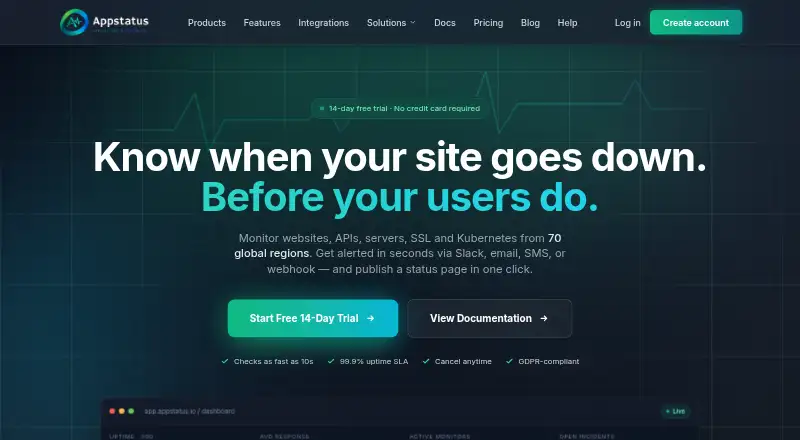
What AppStatus is
AppStatus combines uptime monitoring, alerting, incident management, status pages, heartbeat monitoring, and host telemetry. Its HTTP, API, Port, and Ping checks run from 70 global regions. Notifications include 12 channel types, with condition-based rules, escalation policies, quiet hours, and on-call rotation. Monitoring also covers SSL certificates and Kubernetes clusters, pods, nodes, and deployments. The host agent collects system metrics, process data, logs, security events, container statistics, file-integrity changes, HTTP probe results, and active sessions. Agents run on Linux, macOS, Windows, Docker, Kubernetes, and cloud virtual machines. Cloud connections cover services such as databases, queues, and runtimes, and are read-only by design. AI analyzes incidents and suggests likely root causes using recent changes, alert patterns, and incident history. Status pages support custom domains, branding, password protection, email subscribers, and maintenance schedules. The free plan includes five monitors and one status page. Starter costs $6 a month billed annually; REST API access requires Pro or above.
Good
- Checks HTTP, API, Port, and Ping from 70 regions.
- Supports 12 notification channel types.
- Host agent collects logs and system metrics.
- Status pages support custom domains and maintenance schedules.
- Cloud connections are read-only by design.
Watch out
- Free plan includes five monitors.
- REST API requires Pro or above.
- Starter is $6 a month billed annually.
Who it suits
It suits teams that need uptime checks, incident response, host telemetry, and status pages in one platform. Its range of monitoring and notification options may help teams managing Kubernetes or cloud services.
Verdict
AppStatus brings monitoring, alerting, incident analysis, and status pages into one service. Compare plan limits and note that REST API access starts at Pro.
Plans and prices
From AppStatus's own pricing page, checked 28 Sep 2026.
| Plan | Price | What it gives you |
|---|---|---|
| Free | Free | 5 monitors · 5-min checks · 3 heartbeats · 1 status page · 1 agent · 5 team members · 1 workspace · 1 K8s cluster · 30 days retention · 15 notifications/day · Email alerts |
| Starter | $67 a year | 50 monitors · 1-min checks · 30 heartbeats · 10 status pages · 10 agents · 10 K8s clusters · 15 team members · 3 workspaces · 365 days retention · Custom domains · Read-only API · 30 notifications/day · Unlimited alert channels · $6/mo billed annually(~20% off) |
| Pro | $182 a year | 200 monitors · 30-sec checks · 100 heartbeats · 50 status pages · 25 agents · 25 K8s clusters · 25 team members · 5 workspaces · 365 days retention · Custom domains · Multi-region · Unlimited alert channels · 50 notifications/day · Full API · AI incident analysis · Priority support · $15/mo billed annually(~20% off) |
| Business | $470 a year | 500 monitors · 30-sec checks · 300 heartbeats · 100 status pages · 75 agents · Unlimited team · 10 workspaces · 50 K8s clusters · 1 year retention · Custom domains · Multi-region · Unlimited alert channels · 100 notifications/day · Custom webhooks · SSO/SAML · White-label · SLA 99.9% · 24/7 priority support · $39/mo billed annually(~20% off) |
| Enterprise | $1,430 a year | Unlimited monitors · 10-sec checks · Unlimited heartbeats · Unlimited status pages · Unlimited agents · Unlimited team · Unlimited workspaces · Unlimited K8s clusters · 2 years retention · Unlimited notifications/day · Custom integrations · Dedicated CSM · SLA 99.99% · Custom contracts · Dedicated support · $119/mo billed annually(~20% off) |
The facts
Each one read from AppStatus's own pages, with the date it was checked.
Where it runs
- Agent platforms
- The agent runs on Linux, macOS and Windows hosts, plus Docker, Kubernetes and cloud virtual machines; binaries are listed for six architecture-platform combinations.checked 28 Sep 2026
What it does
- Alert integrations
- Alert integrations include Slack, Discord, Microsoft Teams, PagerDuty, Opsgenie, Telegram, WhatsApp, email, SMS, Pushover, GitHub and webhooks.checked 28 Sep 2026
- API availability
- The REST API is available on Pro plans and above for monitoring data access, alert management and custom integrations.checked 28 Sep 2026
- Cloud integrations
- Cloud integrations cover AWS, Azure, GCP, databases, queues, runtimes and platform services, and every connection is read-only by design.checked 28 Sep 2026
- Custom domain
- Yeschecked 19 Sep 2026
- Data protection
- AppStatus states that passwords use Argon2id hashing, data in transit uses TLS, and agent-to-server gRPC uses mutual TLS.checked 28 Sep 2026
- Global monitoring
- Uptime monitors support HTTP, API, Port and Ping checks from 70 global regions.checked 28 Sep 2026
- Host agent
- The agent collects system metrics, process data, logs, security events, container stats, file-integrity changes, HTTP probe results and active sessions.checked 28 Sep 2026
- Incident response
- AI analyzes incidents and suggests probable root causes using recent changes, alert patterns and incident history.checked 28 Sep 2026
- Incident updates
- Yeschecked 19 Sep 2026
- Maintenance scheduling
- Yeschecked 19 Sep 2026
- Monitoring features
- Features include multi-region uptime checks, SSL certificate tracking, heartbeat monitoring and Kubernetes cluster, pod, node and deployment monitoring.checked 28 Sep 2026
- Notification channels
- The platform supports 12 notification channel types with condition-based rules, escalation policies, quiet hours and on-call rotation.checked 28 Sep 2026
- Paid from
- 6checked 19 Sep 2026
- Private status page
- Yeschecked 19 Sep 2026
- Product scope
- AppStatus is a unified monitoring and incident-response platform combining uptime monitoring, alerting, incident management, public status pages, heartbeat monitoring and host telemetry.checked 28 Sep 2026
- Security controls
- Security controls include email/password and Google OAuth authentication, TOTP two-factor authentication, scoped API keys, four workspace roles, 13 granular permissions and audit logging.checked 28 Sep 2026
- Status pages
- Status pages support custom domains and branding, password-protected private pages, email subscribers and maintenance-window scheduling.checked 28 Sep 2026
- Subscriber channels
- emailchecked 19 Sep 2026
- Support
- The contact page lists typical response times of within 24 hours on weekdays for Free and Starter, within 8 hours for Pro and Business, and a 1-hour SLA for Enterprise.checked 28 Sep 2026
Money
- Free plan
- Yeschecked 19 Sep 2026
The full review of AppStatus
Overview
AppStatus combines service monitoring, host telemetry, alert routing, incident management and status-page publishing in one platform. The aim is to connect detection with response and communication: teams can watch services and infrastructure, direct alerts to the appropriate people, manage incidents, and share updates with subscribers.
Uptime checks cover HTTP, API, port and ping endpoints from 70 global regions. Monitoring also includes SSL certificate tracking and heartbeat checks, with visibility into Kubernetes clusters, pods, nodes and deployments. AppStatus's host agent collects system and process metrics, logs, security events, container statistics, file-integrity changes, HTTP probe results and active sessions.
For incident response, AI analyzes incidents and suggests possible root causes by considering recent changes, alert patterns and incident history. These suggestions can help focus an investigation, while the team remains responsible for assessing what happened and deciding what to do.
Status pages support custom domains and branding, private pages protected by passwords, email subscribers and scheduled maintenance windows. AppStatus also offers read-only cloud integrations covering AWS, Azure, GCP, databases, queues, runtimes and platform services. Read-only access is a useful boundary for teams connecting monitoring to cloud environments.
Key features
- Multi-region monitoring: HTTP, API, port and ping checks run from 70 global regions. SSL tracking and heartbeat monitoring extend coverage beyond endpoint availability.
- Kubernetes and host visibility: The service monitors Kubernetes clusters, pods, nodes and deployments. Its agent gathers system metrics, process information, logs, security events, container stats, file-integrity changes, HTTP probe results and active sessions.
- Alert routing: Twelve notification channel types are available, including Slack, Discord, Microsoft Teams, PagerDuty, Opsgenie, Telegram, WhatsApp, email, SMS, Pushover, GitHub and webhooks. Condition-based rules, escalation policies, quiet hours and on-call rotation help shape when and where notifications go.
- Incident assistance: AI reviews recent changes, alert patterns and incident history to suggest probable root causes.
- Status pages: Publish branded pages on custom domains, limit access with password-protected private pages, collect email subscribers and schedule maintenance windows.
- Cloud connections: Integrations span major cloud providers and services such as databases, queues, runtimes and platform services. Connections are read-only by design.
- Access and data protection: Authentication supports email and password or Google OAuth, with TOTP two-factor authentication, scoped API keys, four workspace roles, 13 granular permissions and audit logging. AppStatus says passwords are hashed with Argon2id, data in transit uses TLS, and agent-to-server gRPC uses mutual TLS.
- Agent deployment: The agent runs on Linux, macOS and Windows hosts, as well as Docker, Kubernetes and cloud virtual machines. Binaries are listed for six architecture-platform combinations.
- REST API: Available on Pro and higher plans for monitoring data access, alert management and custom integrations.
Pricing
AppStatus has a free plan and paid plans billed annually, with a 14-day trial available. The listed paid starting price is $6/mo (annual). Plan limits and included capabilities differ considerably, so the free tier's quotas are worth comparing with expected monitoring and team needs.
| Plan | Price | Included limits and features |
|---|---|---|
| Free | free | 5 monitors, 5-minute checks, 3 heartbeats, 1 status page, 1 agent, 5 team members, 1 workspace, 1 Kubernetes cluster, 30 days of retention, 15 notifications per day and email alerts. |
| Starter | $6 a month (billed annually) | 50 monitors, 10 status pages, 10 agents, 15 team members and 3 workspaces, with 365 days of retention. |
| Pro | $15 a month (billed annually) | 200 monitors, 50 status pages, 25 agents, 25 team members, 5 workspaces and custom domains. |
| Business | $39 a month (billed annually) | 500 monitors, 100 status pages, 75 agents, unlimited team members, custom domains and custom webhooks. |
| Enterprise | $119 a month (billed annually) | Unlimited monitors, status pages, agents and team members, plus custom integrations and a dedicated CSM. |
The free plan is capped at five monitors and five-minute checks, and includes one status page and one agent. Starter increases retention to 365 days and expands the monitor and agent allowances. Custom domains begin with Pro, while custom webhooks are listed for Business. The REST API is available from Pro upward.
Platforms
AppStatus is listed for API, Linux, macOS, web and Windows. Its monitoring agent supports Linux, macOS and Windows hosts, plus Docker, Kubernetes and cloud virtual machines. The platform's broad mix of web access and host deployment options suits teams managing both services and infrastructure.
Who it's for
AppStatus is suited to operations and engineering teams that want uptime checks, infrastructure telemetry, alerting, incident response and subscriber-facing status pages in a shared platform. Kubernetes monitoring and the host agent are relevant for teams that need visibility into hosts and workloads as well as endpoints. Teams with external users to inform can use branded, custom-domain pages, email subscriptions and maintenance scheduling.
Small teams can start with the Free plan, while growing teams may value higher monitor, agent, workspace and retention limits. Organizations with stricter access requirements can use scoped API keys, granular permissions and audit logging; those connecting cloud accounts can keep integrations read-only. Teams that need automated API access should note that the REST API starts at Pro.
Pros and cons
Pros
- Combines uptime checks, host telemetry, alerting, incident management and status pages.
- Checks run from 70 global regions, with HTTP, API, port and ping coverage.
- Supports a wide range of notification channels and routing controls, including escalation policies and on-call rotation.
- Offers Kubernetes monitoring, a multi-platform agent and read-only cloud integrations.
- Includes a free plan and a 14-day trial.
Cons
- The free tier is limited to five monitors, five-minute checks, one status page and one agent.
- Custom domains require Pro or above, and the REST API is not listed below Pro.
- Custom webhooks are listed only on Business, while custom integrations and a dedicated CSM are Enterprise features.
- The listed paid prices are billed annually, which may not suit teams seeking a monthly billing option.
Alternatives
Teams comparing status-page tools can browse Status Page Software. Other options include StatusIQ, openstatus, Spectate, StatusEntry, Instatus, StatusPage.me, Freshstatus and UpCanary.
Verdict
AppStatus brings monitoring, alert handling, incident assistance and status-page communication together, with a particularly broad scope across endpoints, hosts and Kubernetes. Its free tier provides a way to begin with modest limits, while higher plans add capacity, custom domains, API access and larger-team features. It is most compelling for teams that want these operational functions connected; prospective users should match plan limits and annual pricing to their required scale before choosing a tier.
Getting started
- Visit the AppStatus website.
- Start with the Free plan or choose a paid tier; paid plans have a 14-day trial.
- Set up monitors for HTTP, API, Port, or Ping checks.
- Install an agent on a supported host or deployment environment if host telemetry is needed.
- Configure notification rules and, if needed, a status page.
Limits worth knowing
The Free plan includes five monitors with five-minute checks, three heartbeats, one status page, one agent, five team members, one workspace, one Kubernetes cluster, 30 days of retention, and 15 notifications per day. REST API access requires Pro or above.
Questions
Is AppStatus free?
Yes. The Free plan costs nothing. It includes five monitors, five-minute checks, three heartbeats, one status page, one agent, five team members, one workspace, one Kubernetes cluster, 30 days of retention, and 15 notifications per day.
What do the paid plans cost?
Starter is $6 a month billed annually, Pro is $15 a month billed annually, Business is $39 a month billed annually, and Enterprise is $119 a month billed annually. A 14-day trial is listed.
Which platforms can run the host agent?
The agent runs on Linux, macOS, and Windows hosts, as well as Docker, Kubernetes, and cloud virtual machines.
Does AppStatus have status pages and email subscribers?
Yes. Status pages support custom domains and branding, password-protected private pages, email subscribers, and maintenance-window scheduling.
Which plans include REST API access?
The REST API is available on Pro plans and above for monitoring data access, alert management, and custom integrations.
What cloud integrations does AppStatus offer?
Cloud integrations cover AWS, Azure, GCP, databases, queues, runtimes, and platform services. Every connection is read-only by design.
Alternatives to AppStatus
- 1
StatusIQ
Free planAndroidiOSWebAPI8.6From $10 a month - 2

StatusPage.me
Free planWebAPIExtensionmacOS8.4From $6 a month - 3

openstatus
Free planWebAPILinuxmacOS8.3From $30 a month - 4

Atlassian Statuspage
Free planWebAPI8.1From $29 a month - 5

OnlineOrNot
Free planWebAPILinuxmacOS8.1From $15 a month - 6

Instatus
Free planWebAPI7.8From $20 a month