
Appspace Signage
Appspace Signage is a workplace display platform for broadcasting updates, announcements, and branded visuals across offices, campuses, and remote sites.
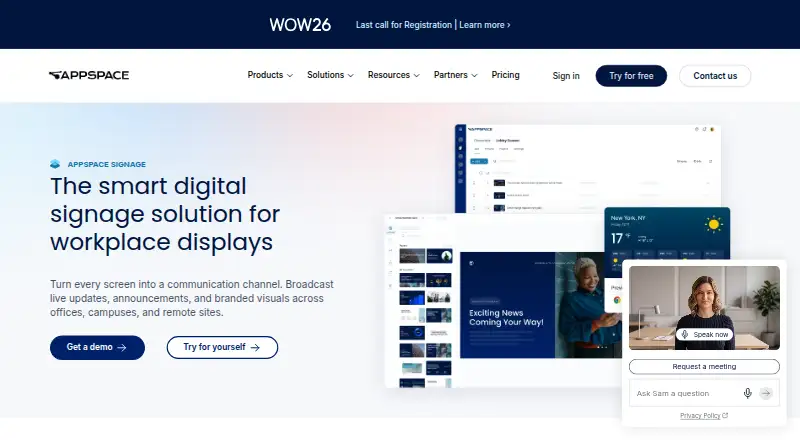
What Appspace Signage is
Appspace Signage is a workplace display platform for broadcasting updates, announcements, and branded visuals across offices, campuses, and remote sites. From one console, teams can create and publish content to signage, intranet, chat apps, and mobile. Customizable templates cover news, dashboards, and live data, and AI can create signage cards from a written brief. Users can schedule content by time and location, manage display connections and updates remotely, and keep playback running offline when the network drops. Video walls use configurable multi-screen layouts in the same console. The free plan costs nothing and includes one compatible device, two Premium Users, up to two Admins, 5GB storage, and 5GB/month bandwidth; it cannot add device IDs, storage, or bandwidth. Listed security and compliance provisions include SOC 2 Type II, ISO 27001, GDPR, SSO/SAML, and role-based access controls. The service is freemium and lists Android, iOS, Linux, macOS, web, and Windows platforms.
Good
- Publishes from one console to multiple channels.
- Schedules content by time and location.
- Remote display status and software updates.
- Offline playback when the network drops.
- Free plan includes one compatible device.
Watch out
- Free plan is limited to one compatible device.
- Free plan cannot add device IDs, storage, or bandwidth.
- Free plan includes two Premium Users.
Who it suits
Appspace Signage suits organizations that need to publish and schedule workplace messages across displays and other channels. Its free plan may suit a small deployment limited to one compatible device and two Premium Users.
Verdict
Appspace Signage brings content creation, scheduling, and display management into one console. The free plan has clear device, user, storage, and bandwidth limits, so check those against the scale of your deployment.
Plans and prices
From Appspace Signage's own pricing page, checked 15 Oct 2026.
| Plan | Price | What it gives you |
|---|---|---|
| Free | Free | 2 Premium Users · 1 Appspace Device ID · 5GB monthly storage · 5GB monthly bandwidth · credit-card payment only · base support |
| Enterprise | Priced on request | 50+ Premium Users · 50+ Device IDs · 50GB+ monthly storage · 50GB+ monthly bandwidth · premium or elite support · month-to-month or annual |
| Express | Priced on request | 25 Premium Users · 25 Device IDs · 25GB monthly storage · 25GB monthly bandwidth · advanced support · month-to-month or annual |
The facts
Each one read from Appspace Signage's own pages, with the date it was checked.
What it does
- AI content creation
- Appspace Intelligence can generate on-brand signage layouts, text, images and translations from a written brief.checked 15 Oct 2026
- API and webhooks
- Appspace provides cloud API access and webhooks for customer-built applications, automation and event-driven integrations.checked 15 Oct 2026
- Central publishing
- Administrators can create content once and publish it simultaneously to signage, intranet, messaging applications and mobile devices.checked 15 Oct 2026
- Content creation
- It offers customizable templates for news, dashboards, and live data, and AI can generate on-brand signage cards from a written brief.checked 4 Oct 2026
- Data protection
- The trust page says customer data is encrypted with TLS 1.2 or higher in transit and AES256 at rest, and backups occur at least every four hours.checked 4 Oct 2026
- Documentation
- The Knowledge Center documents device certification, installation, configuration, troubleshooting, broadcasts and release notes across many device platforms.checked 15 Oct 2026
- Integrations
- Listed integrations include Microsoft Outlook, Google Calendar and Workspace, Microsoft Teams, Slack, Webex, Salesforce, Power BI, Zoom, YouTube, Vbrick, MediaStar and Haivision.checked 15 Oct 2026
- License
- The software is proprietary subscription software licensed for internal business use; the agreement grants access rights rather than source-code rights.checked 15 Oct 2026
- Limit: authentication
- A Software Advice reviewer says advanced authentication websites can be difficult to use and may require expensive custom APIs.checked 15 Oct 2026
- Limit: bulk operations
- A Gartner reviewer specifically cites missing bulk edit, assignment and removal functions as a product gap.checked 15 Oct 2026
- Limit: interface complexity
- Reviewers report that the admin interface can be clunky, require too many clicks and take time for new users to learn.checked 15 Oct 2026
- Limit: pricing
- A Software Advice reviewer describes Appspace as expensive when many devices must be connected, while another reports leaving after the free plan ended.checked 15 Oct 2026
- Notable news: acquisition
- Appspace announced its acquisition of Igloo Software on September 11, 2025.checked 15 Oct 2026
- Offline playback
- Registered devices cache content locally so signage can continue playing when network connectivity is lost.checked 15 Oct 2026
- On-premises option
- Appspace offers on-premises licensing and supervised server installation services in addition to its cloud service.checked 15 Oct 2026
The company
- Company facts
- LinkedIn lists Appspace as privately held, founded in 2002, headquartered in Tampa, Florida, with 201–500 employees.checked 15 Oct 2026
- Company history
- Appspace says it started as a digital signage company in 2002.checked 4 Oct 2026
- Company legal name
- The user agreement identifies the supplier as Appspace, Inc., a Delaware corporation.checked 15 Oct 2026
- Founded
- 2002checked 28 Sep 2026
- Headquarters
- Tampa, Florida, United Stateschecked 28 Sep 2026
Where it runs
- Device management
- The dashboard can remotely show connection status and push software updates to displays.checked 4 Oct 2026
- Kiosks and wayfinding
- The platform supports interactive touchscreen kiosks with maps, turn-by-turn directions, room and people search, visitor check-in and alerts.checked 15 Oct 2026
- Limit: device synchronization
- Some reviewers report devices going offline or out of sync, stale content and slow loading of cards, channels and menus.checked 15 Oct 2026
Money
- Free-plan device limit
- The pricing FAQ says Appspace Free cannot purchase additional device IDs, storage, or bandwidth.checked 4 Oct 2026
The full review of Appspace Signage
Overview
Appspace Signage is a workplace display platform for sharing announcements, live updates, and branded content across offices, campuses, and remote sites. It suits organizations that need to coordinate screens and other employee channels from a central console. Its combination of scheduling, remote device management, and offline playback is compelling, though the free plan is a tightly capped way to start.
Key features
Content tools cover customizable templates for news, dashboards, and live data, plus AI-generated signage cards based on a written brief. That gives communications teams several ways to prepare display content without building every item from scratch. Scheduling by time and location is useful for targeted messages such as welcome notices, safety tips, or after-hours alerts.
Publishing can send content from one console to signage, an intranet, chat apps, and mobile devices. That wider reach is valuable when the same message needs to travel beyond screens, although signage remains the product’s defining use. Integrations and content sources include Outlook, Google Workspace, Salesforce, Power BI, Zoom, YouTube, Vbrick, MediaStar, and Haivision.
Remote device management shows connection status and can push software updates to displays, reducing the need to manage each screen separately. Appspace also says offline playback keeps content running when the network drops. Video walls can use configurable multi-screen layouts and share the management console with standard signage, making them a natural fit for deployments with both ordinary displays and larger visual installations.
Security features include SOC 2 Type II, ISO 27001, GDPR, SSO/SAML, and role-based access controls. Customer data is encrypted using TLS 1.2 or higher in transit and AES256 at rest, with backups at least every four hours. These controls are relevant for organizations with formal security requirements, alongside the need to confirm that the chosen plan and deployment meet their own policies.
Pricing
Appspace uses a freemium model. The Free plan costs nothing and includes one compatible device, two Premium Users, up to two Admins, 5GB of storage, and 5GB/month bandwidth. It also supports employee news and SSO. Those allowances make it a practical small-scale starting point, but the single-device cap sharply limits its value for a multi-screen rollout.
The Free plan cannot purchase additional device IDs, storage, or bandwidth. Teams that outgrow any of those ceilings cannot simply expand the free allocation, so they should weigh the plan as an evaluation or very small deployment option rather than assume it can scale with demand. Base support includes Appspace-managed cloud infrastructure, the latest software releases, online documentation, and video tutorials.
Platforms
Appspace lists Android, iOS, Linux, macOS, web, and Windows among its platforms. Its kiosk-supported device list also names BrightSign, Cisco Webex Board, Chrome OS, LG WebOS, Linux Ubuntu, MediaVue, Samsung SSP 6 (Tizen 4), and Windows 10/UWP, alongside Android, iOS, and macOS. That range suits mixed display estates, though organizations should check compatibility against their specific hardware before deployment.
Who it's for
Appspace Signage is best suited to organizations coordinating communications across workplace displays and other employee channels, particularly where scheduled messages, remote screen oversight, or video walls matter. Smaller teams can begin with the free plan, but its one-device, user, storage, and bandwidth limits make it a poor fit for broad deployments. Teams looking primarily for an employee intranet rather than display management can compare the wider Employee Intranet Software category.
Pros and cons
- Pros: One console publishes to signage, intranet, chat apps, and mobile, reducing the need to coordinate each channel separately.
- Pros: Scheduling by time and location, plus remote status checks and software updates, supports coordinated management of distributed screens.
- Pros: Offline playback and configurable video-wall layouts address two distinct display needs within the same management environment.
- Cons: The free plan permits only one compatible device and cannot add device IDs, storage, or bandwidth, which makes expansion a clear constraint.
- Cons: The two Premium User limit and 5GB monthly bandwidth cap may constrain even modest shared deployments.
Alternatives
For an open-source, self-hosted option, HumHub offers a Community Edition under an AGPLv3 license, with module marketplace access and community support. Choose it when running the software on your own servers and working within an open-source model are priorities.
MangoApps is a paid option with a free trial and a Communications & Intranet plan priced at $9 a month, billed from 200 employees with volume pricing and a second-suite discount. It may suit organizations evaluating a paid communications and intranet package at that stated employee scale. Akumina is another paid alternative.
Blink is a paid platform with a free trial; its Core plan is $4.50 a month, billed per user per month, and includes custom company branding, internal communications, real-time collaboration, and a knowledge hub. It is a better match when those employee communication tools are the priority. Flip offers a Growth plan at €4.95 a year, billed per year, for up to 300 employees, with the platform only and individual add-ons available on request; consider it when that employee limit and plan structure fit.
Jalios Intranet is a paid intranet with a free trial and pricing based on product and employee count, provided through a personalized offer. Omnia is another paid alternative. Axero is paid and offers a free trial; its Standard plan includes workspaces and groups, communication tools, content management, notifications, task management, and gamification. Those alternatives are worth considering when an employee intranet is a closer fit than signage management.
Verdict
Choose Appspace Signage if your organization needs centrally managed workplace displays, time- and location-based publishing, and the option to distribute content through additional employee channels. Its remote controls, offline playback, and video-wall support make a strong case for coordinated screen operations. Look elsewhere if you need a free multi-device deployment or your main requirement is a broader employee intranet: the free plan cannot expand its device, storage, or bandwidth allowances, and display management is the product’s core strength.
Getting started
- Visit the Appspace Signage website.
- Choose the Free plan at no cost.
- Set up the service for a compatible device.
- Create signage content with a template or a written brief for AI-generated cards.
- Schedule content by time and location, then publish it from the console.
Limits worth knowing
The free plan covers one compatible device, two Premium Users, up to two Admins, 5GB of storage, and 5GB/month of bandwidth. It does not allow additional device IDs, storage, or bandwidth to be purchased.
Questions
Does Appspace Signage have a free plan?
Yes. The Free plan costs nothing and includes one compatible device, two Premium Users, up to two Admins, 5GB of storage, and 5GB/month of bandwidth.
Which platforms does it support?
Listed platforms include Android, iOS, Linux, macOS, web, and Windows. The device page also lists kiosk support for Android, BrightSign, Cisco Webex Board, Chrome OS, iOS, LG WebOS, Linux Ubuntu, macOS, MediaVue, Samsung SSP 6 (Tizen 4), and Windows 10/UWP.
Can it publish beyond signage displays?
Yes. Content can be published from one console to signage, intranet, chat apps, and mobile.
What integrations and content sources are named?
They include Outlook, Google Workspace, Salesforce, Power BI, Zoom, YouTube, Vbrick, MediaStar, and Haivision.
What security controls are listed?
The signage page lists SOC 2 Type II, ISO 27001, GDPR, SSO/SAML, and role-based access controls. The trust page says data is encrypted with TLS 1.2 or higher in transit and AES256 at rest, with backups at least every four hours.
Can the free plan be expanded with more device IDs or storage?
No. The free plan cannot purchase additional device IDs, storage, or bandwidth.