
Apache Ozone
Apache Ozone is a free, self-hosted distributed object store for data lakes, lakehouse workloads, AI/ML, cloud-native applications, and Hadoop or Spark stora…
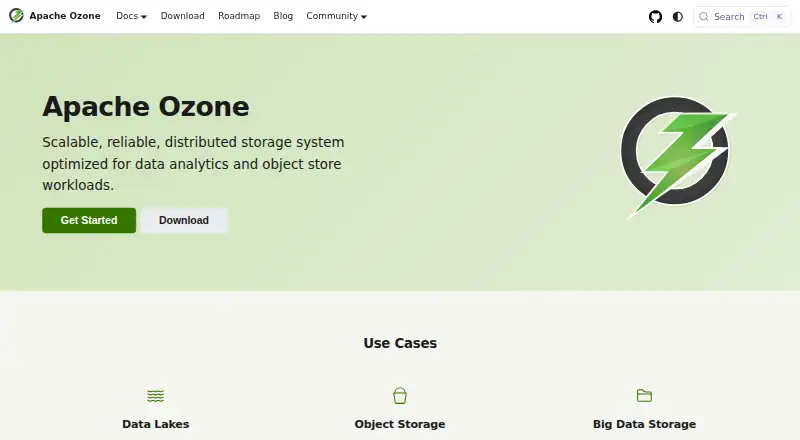
What Apache Ozone is
Apache Ozone is a free, self-hosted distributed object store for data lakes, lakehouse workloads, AI/ML, cloud-native applications, and Hadoop or Spark storage. The project describes deployments reaching billions of objects and exabytes of capacity. Teams can configure replication or erasure coding for buckets or individual objects, and strong consistency means reads reflect the latest completed writes. Applications can connect through an S3-compatible REST API, a Hadoop-compatible filesystem interface, Java client API, or CLI. Integrations include Hive, Spark, Flink, Iceberg, Trino, Impala, Ranger, Knox, Kerberos, Prometheus, Grafana, Oozie, Hue, HBase, and DistCp. Security controls include Kerberos, ACLs, Ranger policies, TLS/SSL in transit, and TDE at rest. Administrators also have quotas, read-only point-in-time bucket snapshots, a Recon web UI, and CLI tools. Deployment guides cover Docker, Kubernetes, and bare metal. Apache Ozone uses Apache License 2.0; the Apache Software Foundation does not provide formal or commercial support.
Good
- Free and licensed under Apache License 2.0.
- Supports S3, Hadoop filesystem, Java, and CLI access.
- Configurable replication and erasure coding options.
- Strong consistency reflects completed writes in reads.
- Deployment guides cover Docker, Kubernetes, and bare metal.
Watch out
- Self-hosted deployment requires administration.
- The Apache Software Foundation does not provide formal or commercial support.
- No free trial is listed.
Who it suits
It suits teams building data lakes, lakehouse platforms, or large-scale storage for AI/ML, cloud-native, Hadoop, or Spark workloads. It is for organizations able to deploy and administer self-hosted storage.
Verdict
Apache Ozone offers a broad set of interfaces, storage controls, and integrations for large-scale self-hosted workloads. Teams should account for operating it themselves and the absence of formal or commercial Apache support.
Plans and prices
From Apache Ozone's own pricing page, checked 5 Oct 2001.
| Plan | Price | What it gives you |
|---|---|---|
| Apache Ozone | Free | Apache License 2.0 · source and binary downloads |
The facts
Each one read from Apache Ozone's own pages, with the date it was checked.
What it does
- Administration
- Ozone provides volume and bucket quotas, point-in-time read-only bucket snapshots, a Recon web UI, and CLI administration tools.checked 5 Oct 2001
- Audience
- Ozone is intended for lakehouse, AI/ML, cloud-native, Hadoop ecosystem, and other large-scale storage workloads.checked 5 Oct 2001
- Consistency
- Ozone provides strong consistency, so reads reflect the latest successfully completed writes.checked 5 Oct 2001
- Deployment
- The documentation provides deployment guides for Docker, Kubernetes, and bare metal.checked 5 Oct 2001
- Downloads
- The downloads page lists source and binary packages and recommends verifying them with PGP signatures and SHA512 checksums.checked 5 Oct 2001
- Durability
- Ozone supports configurable replication and erasure coding options per bucket or object.checked 5 Oct 2001
- Integrations
- The project lists Hive, Spark, Flink, Iceberg, Trino, Impala, Ranger, Knox, Kerberos, Prometheus, Grafana, Oozie, Hue, HBase, and DistCp as integrations.checked 5 Oct 2001
- Interfaces
- Applications can access Ozone through its S3-compatible REST API, Hadoop-compatible filesystem interface, Java client API, and CLI.checked 5 Oct 2001
- License
- Apache Ozone is licensed under the Apache License, Version 2.0.checked 5 Oct 2001
- Purpose
- Apache Ozone is a scalable distributed object store designed for lakehouse workloads, AI/ML, and cloud-native applications.checked 5 Oct 2001
- Scale
- Ozone supports deployments up to billions of objects and exabytes of capacity.checked 5 Oct 2001
- Security
- Ozone supports Kerberos authentication, ACLs, Ranger policy management, TLS/SSL in transit, and TDE at rest.checked 5 Oct 2001
- Support
- The Apache Software Foundation says it does not provide formal or commercial support for its software packages.checked 5 Oct 2001
- Use cases
- The project describes data lakes, S3-compatible object storage, and big data storage for Hadoop and Spark as use cases.checked 5 Oct 2001
The company
- Founded
- 2019checked 28 Sep 2001
The full review of Apache Ozone
Apache Ozone is self-hosted object-storage software for data lakes, lakehouse platforms, and other large-scale workloads. It is best suited to teams with Hadoop, AI/ML, or cloud-native storage needs and the expertise to run their own infrastructure. Its broad interfaces and storage controls are valuable, but operating it—and arranging support outside Apache—is the team’s responsibility.
Overview
Ozone is open-source software under the Apache License 2.0, available as source and binary downloads. Its intended scale—up to billions of objects and exabytes of capacity—sets it apart from general-purpose file storage: the case for choosing it is strongest when a substantial data platform needs an object store, not when a small team simply needs shared files. Deployment guides cover Docker, Kubernetes, and bare metal, giving infrastructure teams options while leaving deployment and ongoing operation in their hands.
The Apache Software Foundation does not provide formal or commercial support for its software packages. That makes Ozone a more natural choice for organizations able to support their own deployments than for those whose storage platform must come with a vendor-backed support contract.
Key features
Multiple access paths and ecosystem integrations
Applications can reach Ozone through an S3-compatible REST API, a Hadoop-compatible filesystem interface, a Java client API, or CLI tools. This range accommodates S3-oriented applications and Hadoop workflows without requiring one access method for every workload. Integrations include Hive, Spark, Flink, Iceberg, Trino, Impala, HBase, and DistCp, alongside security and operations tools such as Ranger, Knox, Kerberos, Prometheus, and Grafana. Those connections make Ozone a stronger fit for teams already using this ecosystem than for organizations seeking a standalone managed storage service.
Durability, consistency, and administration
Replication and erasure coding can be configured per bucket or object, so teams can apply different durability approaches to different data. Ozone also provides strong consistency: reads reflect the latest successfully completed writes. That behavior is useful when applications need current data rather than accepting stale reads after a write.
Volume and bucket quotas, point-in-time read-only bucket snapshots, a Recon web UI, and CLI administration give operators controls for managing storage and inspecting deployments. Kerberos authentication, ACLs, Ranger policy management, TLS/SSL in transit, and TDE at rest provide security mechanisms for deployment teams to configure. These capabilities offer meaningful control, but do not remove the operational work of self-hosting. The downloads page recommends verifying source and binary packages with PGP signatures and SHA512 checksums.
Pricing
Apache Ozone is free: its Apache License 2.0 plan is free and includes source and binary downloads. There is no paid tier or free trial. The tradeoff is that the software is self-hosted, so teams must provide the infrastructure and operate it themselves; Apache does not offer formal or commercial support. No seat or storage quota limits are specified for the plan.
Platforms
Ozone is available for Linux and web access, with API access and self-hosted deployment. Guides cover Docker, Kubernetes, and bare metal. This is a deployment choice for infrastructure teams, not a turnkey hosted service.
Who it's for
Ozone suits organizations building data lakes, S3-compatible object storage, Hadoop or Spark storage, lakehouse platforms, and AI/ML or cloud-native workloads at large scale. It is particularly compelling when teams can use its Hadoop and analytics integrations and have the skills to operate storage themselves. Smaller workloads, or teams that need managed operations and formal commercial support, have less reason to take on that responsibility.
Pros and cons
- Pro: S3-compatible, Hadoop-compatible, Java, and CLI access give applications and operators several ways to work with the store.
- Pro: Per-bucket or per-object replication and erasure coding, strong consistency, and read-only snapshots provide useful control over durability and data access.
- Pro: A broad set of data-platform, security, and monitoring integrations supports deployments already built around the Hadoop ecosystem.
- Con: Self-hosting puts deployment and ongoing operation on the organization rather than a managed-service provider.
- Con: Apache provides no formal or commercial support for its software packages, which may not suit teams that require a support contract.
Alternatives
Data Lake Software is the broader category directory for comparing products in this space. Consider HPCC Systems for another free, Apache 2.0-licensed, self-hosted option. Parseable is worth considering when SQL queries, dashboards, threshold alerts, OIDC SSO, and customizable retention or object storage are priorities; its OSS plan is free and allows unlimited users.
Apache Hadoop HDFS is another free, self-hosted Apache project for teams looking at Hadoop storage. AWS Lake Formation may suit teams that want permissions managed through integrated AWS services, though those services carry standard usage rates. Tencent Cloud Application Performance Management is an alternative for readers comparing freemium monitoring software. Unilake may suit teams looking for a platform licensed under AGPL 3.0 and EUPL that can run fully isolated in an environment of their choice.
Cloudera Data Lake Service is a paid alternative with custom pricing. HPE Ezmeral Data Fabric is another paid option; its pricing varies by reseller, and the Canada store shows starting pricing of C$500.00 for offerings with one- to five-year terms.
Verdict
Choose Apache Ozone if your organization needs large-scale object storage, values its S3 and Hadoop interfaces and ecosystem integrations, and can operate the deployment itself. Its free Apache-licensed software and configurable storage controls are strong reasons to shortlist it. Look elsewhere if you need managed operations or formal commercial support.
Getting started
- Open the Apache Ozone website
- Choose source or binary packages from the downloads page
- Verify the package with its PGP signature or SHA512 checksum
- Follow the deployment guide for Docker, Kubernetes, or bare metal
- Connect applications through the S3-compatible REST API, Hadoop interface, Java API, or CLI
Questions
Is Apache Ozone free?
Yes. Apache Ozone costs 0.00 USD, is open source, and is licensed under Apache License 2.0.
How can Ozone be deployed?
It is self-hosted, with guides for Docker, Kubernetes, and bare-metal deployments.
Which interfaces are available?
Applications can use the S3-compatible REST API, Hadoop-compatible filesystem interface, Java client API, or CLI.
What scale does Ozone support?
Deployments can reach billions of objects and exabytes of capacity.
Does Apache provide commercial support?
The Apache Software Foundation says it does not provide formal or commercial support for its software packages.
Which security features are included?
Ozone supports Kerberos authentication, ACLs, Ranger policy management, TLS/SSL in transit, and TDE at rest.
Alternatives to Apache Ozone
- 1

HPCC Systems
Free planOpen sourceWebAPIExtensionLinux7.5Free plan - 2
Tencent Cloud Application Performance Management
WebAPILinuxSelf-hosted7.2 - 3

Apache Hadoop HDFS
Free planOpen sourceAPILinuxSelf-hostedWindows7.1Free plan - 4

Parseable
Free planWebAPILinuxSelf-hosted6.9From $0.39 a month - 5

Oracle Big Data Service
WebAPILinux6.2 - 6

Qubole
WebAPI6.2