
Parseable
Parseable is an open observability platform for logs, metrics, and distributed traces.
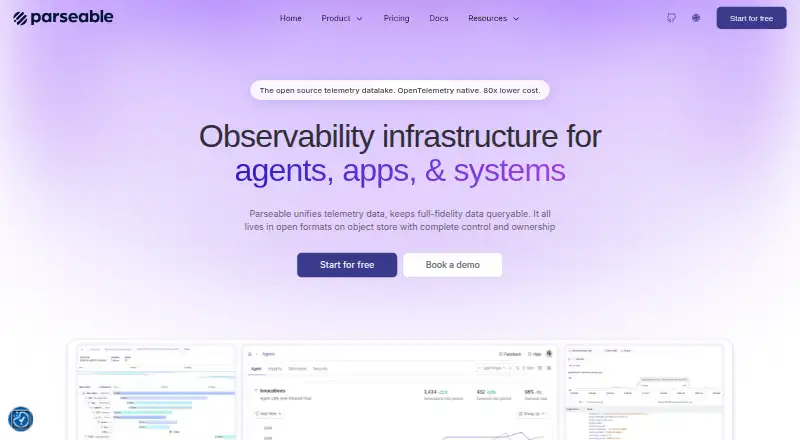
What Parseable is
Parseable is an open observability platform for logs, metrics, and distributed traces. It brings telemetry into dashboards, alerts, service maps, error views, and root-cause analysis, with SQL and natural-language queries, forecasting, and AI analysis for investigation. Written in Rust, it stores data in an open columnar format designed for object storage. Deployment options include self-hosted open source, managed cloud, and enterprise setups with BYOC. Listed integrations include Prometheus, Grafana, Kafka, Redpanda, AWS, Azure, OpenTelemetry, Kubernetes, Fluent Bit, Fluentd, Vector, MinIO, OpenAI, and Anthropic. Its MCP connects AI agents to live telemetry through structured tools, and a Slack bot brings operational answers into Slack. The OSS plan is free and includes SQL queries, dashboards, threshold alerts, OIDC SSO, unlimited users, and customizable retention and object storage. Cloud costs $0.39 per month, billed per GB ingested, and includes 365 days of retention and a 14-day trial. The OSS plan supports only one query node and does not support groups for RBAC.
Good
- Combines logs, metrics, and distributed traces.
- Supports SQL and natural-language queries.
- Offers self-hosted, managed cloud, and BYOC deployments.
- OSS includes dashboards, alerts, OIDC SSO, and unlimited users.
- Integrates with Prometheus, Grafana, and OpenTelemetry.
Watch out
- OSS supports only one query node.
- OSS does not support groups for RBAC.
- Cloud is billed per GB ingested.
Who it suits
Parseable suits teams that want logs, metrics, and traces in one observability platform, with a choice of self-hosted or managed deployment. The Enterprise plan is described for serious teams seeking enterprise-grade observability.
Verdict
Parseable brings several telemetry types and investigation tools together, with deployment options for different environments. Review the OSS query-node and RBAC limits, and note that Cloud billing is based on ingestion.
Plans and prices
From Parseable's own pricing page, checked 7 Oct 2026.
| Plan | Price | What it gives you |
|---|---|---|
| OSS | Free | SQL query and dashboards · Threshold alerts · OIDC SSO · Unlimited users · Customizable retention and object storage |
| Cloud | $0.39 a month | 365 days retention · 99.999% uptime · AI-native analysis · Unlimited users · Dashboards, alerts, and API access · 14 day free trial · per GB ingested |
| Enterprise | $15,000 a year | Custom plan · Premium support with dedicated SLA · Self-hosted, private cloud, or hybrid deployment · Custom partitioning · Multi-tenant cluster · Audit logging · Data residency and sovereignty options · Starts at $15,000/year |
The facts
Each one read from Parseable's own pages, with the date it was checked.
What it does
- AI tools
- The Parseable MCP connects AI agents to live telemetry through structured tools, and its Slack bot brings operational answers into Slack.checked 7 Oct 2026
- Architecture
- The product is written in Rust and uses an object-store-native, open columnar format.checked 7 Oct 2026
- Deployment
- Parseable offers self-hosted OSS, managed cloud, and enterprise deployments with BYOC.checked 7 Oct 2026
- Features
- The feature set includes alerts, dashboards, logs, metrics, distributed-trace views, service maps, error pages, AI analysis, and root-cause analysis.checked 7 Oct 2026
- Integrations
- The site lists integrations including Prometheus, Grafana, Kafka, Redpanda, AWS, Azure, OpenTelemetry, Kubernetes, Fluent Bit, Fluentd, Vector, MinIO, OpenAI, and Anthropic.checked 7 Oct 2026
- Intended users
- The site describes Enterprise as best for serious teams looking for enterprise-grade observability.checked 7 Oct 2026
- OSS limits
- The pricing comparison says OSS supports only one query node and does not support groups for RBAC.checked 7 Oct 2026
- Product
- Parseable is an open observability platform for logs, metrics, and distributed traces.checked 7 Oct 2026
- Queries
- Parseable offers SQL and natural-language querying, forecasting, and object-storage-native data management.checked 7 Oct 2026
- Security
- The site identifies Parseable as GDPR certified and SOC 2 Type II.checked 7 Oct 2026
- Support
- The Enterprise plan includes premium support with a dedicated SLA, and the site lists 24×7 product support via portal in its plan comparison.checked 7 Oct 2026
The company
- Company
- Parseable Inc. lists its San Francisco address as 584 Castro St. #2112, San Francisco, California 94114-2512.checked 7 Oct 2026
- Headquarters
- San Francisco, California, United Stateschecked 28 Sep 2026
The full review of Parseable
Parseable is an open observability platform for logs, metrics, and distributed traces. It suits teams that want several telemetry types and deployment choices in one tool. Its breadth is compelling, but the OSS edition’s query-node and access-control limits may push growing teams toward a paid plan.
Overview
Parseable combines telemetry in a Rust-based platform that uses an object-store-native columnar format. SQL and natural-language queries, dashboards, alerts, forecasting, and root-cause analysis give teams several ways to investigate operational data. The mix is useful for teams consolidating observability work, though OSS users should weigh its one-query-node ceiling and lack of RBAC groups before adopting it for shared or expanding workloads.
Deployment can be self-hosted, managed in the cloud, or configured for Enterprise BYOC. Integrations include Prometheus, Grafana, Kafka, Redpanda, AWS, Azure, OpenTelemetry, Kubernetes, Fluent Bit, Fluentd, Vector, and MinIO, alongside OpenAI and Anthropic. Parseable identifies itself as GDPR certified and SOC 2 Type II.
Key features
Telemetry and investigation
Logs, metrics, and distributed-trace views sit alongside service maps and error pages, giving teams a broader incident picture than log search alone. Dashboards, threshold alerts, live log tailing, structured parsing, and log pipelines support day-to-day operations; archive export gives teams a way to move data out. Forecasting, AI analysis, and root-cause analysis extend the platform into investigation, while SQL remains a conventional option for querying.
AI and integrations
Natural-language querying adds an alternative to SQL, and the Parseable MCP connects AI agents to live telemetry through structured tools. A Slack bot brings operational answers into Slack. Those features may suit teams that want to incorporate AI into incident workflows, but the platform’s dashboards and query tools remain useful without them.
Pricing
Parseable has a free OSS plan, a metered Cloud plan, and an annual Enterprise plan. Cloud is billed per GB ingested, so the advertised monthly rate is a usage rate rather than a flat subscription total.
| Plan | Price | What it includes |
|---|---|---|
| OSS | free | SQL query and dashboards, threshold alerts, OIDC SSO, unlimited users, customizable retention, and object storage. |
| Cloud | $0.39 a month, billed per GB ingested | 365 days retention, 99.999% uptime, AI-native analysis, unlimited users, dashboards, alerts, and API access; 14 day free trial. |
| Enterprise | $15,000 a year; starts at $15,000/year | Custom plan, premium support with a dedicated SLA, self-hosted, private cloud, or hybrid deployment, custom partitioning, multi-tenant cluster, audit logging, and data residency and sovereignty options. |
OSS is a substantial starting point for teams comfortable with a single query node and no RBAC groups; unlimited users and customizable retention avoid seat or fixed-retention caps, but do not remove those architectural and access-control constraints. Cloud adds managed service, long retention, and AI-native analysis, with ingestion volume determining the bill. Enterprise is aimed at teams needing deployment flexibility, tenancy controls, audit logging, or dedicated support; its starting annual price makes it a serious commitment. The pricing model is freemium, and the listed trial applies to Cloud.
Platforms
Parseable supports API, Linux, self-hosted, web, and Windows environments. Its self-hosted and managed-cloud choices suit different operating preferences, while Enterprise adds private-cloud and hybrid deployment options.
Who it's for
Parseable is best suited to teams seeking one platform for logs, metrics, and traces, particularly those that value SQL or natural-language investigation and object-storage-native data management. OSS can fit smaller or self-managed deployments that can work within one query node and without RBAC groups. Teams requiring more granular group-based access or greater query-node capacity should evaluate the paid options. Enterprise is positioned for serious teams that need enterprise-grade observability and control over deployment, tenancy, and support.
Pros and cons
Pros
- Logs, metrics, traces, service maps, and error views share one platform, reducing the need to split telemetry investigations across tools.
- Self-hosted OSS, managed Cloud, and Enterprise private or hybrid deployment give teams meaningful control over where the platform runs.
- Unlimited users on OSS and Cloud avoid per-seat limits in those plans.
- Cloud includes 365 days of retention and 99.999% uptime, useful for teams that need a managed service with a stated availability commitment.
Cons
- OSS is limited to one query node, which constrains teams that need additional query capacity.
- OSS lacks RBAC groups, a notable drawback where access needs to be divided among teams.
- Cloud cost scales with ingestion, so the per-GB rate does not provide a fixed monthly budget by itself.
- Enterprise starts at $15,000/year, placing its deployment and support controls beyond a modest budget.
Alternatives
For data-lake needs rather than a telemetry-focused observability platform, compare Data Lake Software; for a log-management shortlist, see Log Management Software.
HPCC Systems is a free, Apache 2.0-licensed self-hosted option for users seeking open-source software across a wider range of platforms. Apache Hadoop HDFS is a free open-source alternative from the Apache Hadoop project for teams focused on self-hosted storage. Apache Ozone is a free alternative distributed under Apache License 2.0, with source and binary downloads.
AWS Lake Formation may suit teams looking for a permissions-focused option; creating permissions through integrated services is provided at no charge, while those services have their own usage rates. Tencent Cloud Application Performance Management is another freemium option with developer packages that include three days of trace storage. Unilake is a free alternative for teams needing software that can run fully isolated under AGPL 3.0 and EUPL licensing.
Cloudera Data Lake Service is a paid data-lake service with custom pricing. HPE Ezmeral Data Fabric is a paid alternative with reseller-dependent pricing and a free trial.
Verdict
Choose Parseable if your team wants logs, metrics, and traces together, with query flexibility and a choice of self-hosted or managed deployment. The free OSS tier offers a meaningful entry point, but its single query node and lack of RBAC groups are the main reasons to look elsewhere or budget for a higher tier. Cloud suits teams comfortable with ingestion-based billing; Enterprise is for organizations prepared to pay for deployment control, tenancy, and dedicated support.
Getting started
- Visit the Parseable website.
- Choose self-hosted OSS, managed Cloud, or an Enterprise deployment.
- For Cloud, start the 14-day free trial; Cloud is billed per GB ingested.
- Connect telemetry using a listed integration such as OpenTelemetry, Prometheus, or Fluent Bit.
- Use dashboards, alerts, and SQL or natural-language queries to work with telemetry.
Limits worth knowing
OSS supports only one query node and does not support groups for RBAC. Cloud includes 365 days of retention and a 14-day trial; it is billed per GB ingested.
Questions
Does Parseable have a free plan?
Yes. OSS is free and includes SQL queries, dashboards, threshold alerts, OIDC SSO, unlimited users, and customizable retention and object storage.
What does the Cloud plan cost?
It includes 365 days of retention and a 14-day free trial.
How much does Enterprise cost?
It includes premium support with a dedicated SLA and self-hosted, private cloud, or hybrid deployment options.
What platforms or deployment options are available?
The listed platforms are API, Linux, self-hosted, web, and Windows. Deployment options include self-hosted OSS, managed cloud, and enterprise deployments with BYOC.
What data does Parseable handle?
Parseable is for logs, metrics, and distributed traces. Its feature set includes dashboards, alerts, service maps, error pages, and root-cause analysis.
Which integrations are listed?
Listed integrations include Prometheus, Grafana, Kafka, Redpanda, AWS, Azure, OpenTelemetry, Kubernetes, Fluent Bit, Fluentd, Vector, MinIO, OpenAI, and Anthropic.
Alternatives to Parseable
- 1

HPCC Systems
Free planOpen sourceWebAPIExtensionLinux7.5Free plan - 2

Apache Hadoop HDFS
Free planOpen sourceAPILinuxSelf-hostedWindows7.2Free plan - 3
Tencent Cloud Application Performance Management
WebAPILinuxSelf-hosted7.2 - 4

Qubole
WebAPI6.3 - 5

Oracle Big Data Service
WebAPILinux6.2 - 6

Apache Ozone
Free planWebAPILinuxSelf-hosted6.1Free plan