
HPCC Systems
HPCC Systems is a free, open-source platform for enterprise big-data processing and data-lake management.
What HPCC Systems is
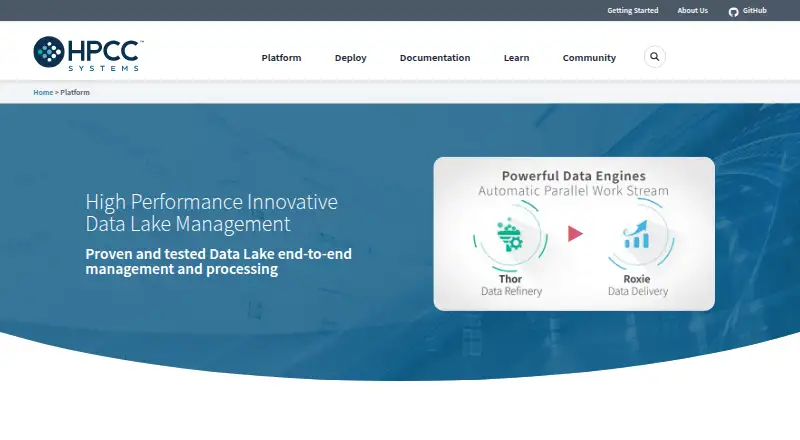
HPCC Systems is a free, open-source platform for enterprise big-data processing and data-lake management. It combines ECL, a declarative and modular programming language, with Thor for data refinement and Roxie for data delivery. ECL’s compiler optimizes code for parallel processing and compiles it into C++. Thor handles ingestion, transformation, linking, and indexing; Roxie serves concurrent queries. Clusters can scale from two computers to more than a thousand commodity-hardware nodes. The cloud-native platform runs on Kubernetes and supports Azure Kubernetes Service and Amazon Elastic Kubernetes Service. Its storage options include AWS S3, Azure Blob Storage, AWS Elastic Block Store, Azure Files, and Azure Disks. Security capabilities include end-to-end encryption, service meshes, OAuth 2.0 with Azure AD support, JWT, and configurable controls for data areas and services. The Machine Learning Library provides ECL-accessible algorithms for building and testing prediction models. Integrations include Spark, Kafka, Couchbase, Redis, Memcached, Pentaho, R, JDBC, Java APIs, and Tableau data connectors. ESP exposes queries through XML, HTTP, SOAP, and REST interfaces; deployed queries can also be called through REST/JSON. The platform is free under the Apache 2.0 license and is self-hosted.
Good
- Free to use under the Apache 2.0 license.
- Thor handles ingestion, transformation, linking, and indexing.
- Clusters can scale beyond a thousand nodes.
- Supports several cloud storage services.
- Offers REST, SOAP, HTTP, and XML query interfaces.
Watch out
- A current supported Linux system is required for a single-node cluster.
- ECL IDE is available for Windows.
- On Apple OSX, only client tools are supported.
Who it suits
HPCC Systems suits organizations building data lakes or processing large, mixed-schema datasets that can manage a self-hosted platform. It may also fit teams that need parallel processing, query interfaces, or ECL-accessible machine-learning algorithms.
Verdict
HPCC Systems brings data refinement, query delivery, and data-lake management together in an open-source platform. Its self-hosted model and operating-system requirements are key considerations for deployment.
Plans and prices
From HPCC Systems's own pricing page, checked 30 Sep 2001.
| Plan | Price | What it gives you |
|---|---|---|
| Open source | Free | free to use · Apache 2.0 licensed · self-hosted |
| Community Edition | Free | server platform · ECL · IDE · client tools · documentation · graph control · free download |
| Enterprise subscription | Priced on request | software · services · professional training support · contact vendor |
The facts
Each one read from HPCC Systems's own pages, with the date it was checked.
What it does
- APIs
- ESP exposes ECL queries through XML, HTTP, SOAP and REST interfaces, and deployed queries can be called with REST/JSON.checked 30 Sep 2001
- Architecture
- The platform includes the ECL programming language, Thor data-refinery engine, and Roxie data-delivery engine.checked 30 Sep 2001
- Client operating systems
- The ECL IDE runs on Windows, while client tools are available for Windows, Linux and macOS and container setup can be initiated from Windows, Mac or Linux terminals.checked 15 Oct 2001
- Cloud deployment
- The cloud-native platform runs on Kubernetes and supports Azure Kubernetes Service and Amazon Elastic Kubernetes Service.checked 30 Sep 2001
- Cloud storage integrations
- Cloud-native deployments support AWS S3, Azure Blob Storage, AWS EBS and Azure storage options.checked 15 Oct 2001
- Current release
- The download page identifies version 10.6 as the latest platform release.checked 15 Oct 2001
- Data lake
- HPCC Systems is a dedicated end-to-end data-lake management platform for combining mixed-schema data.checked 30 Sep 2001
- Documentation depth
- Documentation includes administrator, programmer, installation, containerized-platform, WsSQL, configuration and release-note materials.checked 15 Oct 2001
- ECL
- ECL is a declarative, modular language whose compiler optimizes code for parallel processing and compiles it into C++.checked 30 Sep 2001
- ECL language
- ECL is a declarative, data-oriented language that lets developers describe computations while the platform determines execution details.checked 15 Oct 2001
- Encryption
- ECL can encrypt output data with 256-bit AES and compress it with LZW before serialization.checked 15 Oct 2001
- Independent feature coverage
- Business-Software.com lists LDAP or Active Directory integration, thousands of nodes, high availability, monitoring, graphical configuration and collaborative source control.checked 15 Oct 2001
- Independent pricing finding
- Business-Software.com reports that pricing requires contacting the vendor directly.checked 15 Oct 2001
- Integrations
- Official integrations include Spark, Kafka, Couchbase, Redis, Memcached, Pentaho, R, JDBC, Java APIs and Tableau data connectors.checked 30 Sep 2001
- JDBC support
- The platform offers an HPCC JDBC driver and WsSQL as SQL access options, each supporting a subset of SQL.checked 15 Oct 2001
- Known output limit
- The ECL Programmer's Guide documents a deliberate failure when returning more than 10 MB of result data directly to a workunit.checked 15 Oct 2001
- Kubernetes deployment
- The containerized edition runs on Kubernetes and supports Helm, Terraform, Amazon EKS and Azure AKS deployments.checked 15 Oct 2001
- Language extensibility
- ECL can embed or call Java, JavaScript, Python, R, C++, MySQL, SOAP services, command-line programs and external plugins.checked 15 Oct 2001
- License
- The Community Edition is licensed under the Apache License 2.0.checked 15 Oct 2001
The company
- Company headquarters
- LinkedIn lists HPCC Systems headquarters at Alpharetta, Georgia and identifies the organization as founded in 2011.checked 15 Oct 2001
- Company origin
- The independent ODBMS.org interview says development began in 1999 as an internal LexisNexis Risk Solutions system and the platform was open-sourced in 2011.checked 15 Oct 2001
- Company ownership
- HPCC Systems is presented as a LexisNexis Risk Solutions project and is used as the foundation for many LexisNexis data products.checked 15 Oct 2001
- Founded
- 2000checked 28 Sep 2001
- Headquarters
- Atlanta metropolitan area, Georgia, United Stateschecked 28 Sep 2001
The full review of HPCC Systems
Overview
HPCC Systems is built for organizations that need to prepare and serve large, mixed-schema datasets across a cluster. Its open-source architecture combines data refinement with concurrent query delivery, giving teams a single platform for much of a data lake’s processing path.
The trade-off is operational: it is self-hosted software, and a single-node cluster requires a current supported Linux system. Teams without the infrastructure or Linux expertise to run it should consider a managed or simpler alternative.
For more options, browse our Data Lake Software directory.
Key features
Parallel processing with ECL
ECL is a declarative, modular language, and its compiler optimizes programs for parallel execution before compiling them to C++. That makes it a fit for teams expressing large-scale data work as code; it is less suited to readers seeking a platform that avoids specialized programming.
Separate engines for preparation and queries
Thor ingests, transforms, links and indexes data, while Roxie serves high-performance concurrent queries. Separating these workloads lets teams prepare data and make it available for query traffic within one platform.
Cluster and cloud deployment
Clusters can range from two computers to more than a thousand commodity-hardware nodes. The cloud-native platform runs on Kubernetes, including Azure Kubernetes Service and Amazon Elastic Kubernetes Service. Its storage plane supports AWS S3, Azure Blob Storage, AWS Elastic Block Store, Azure Files and Azure Disks.
Security, machine learning and integrations
Cloud-native security includes end-to-end encryption, Linkerd or Istio service meshes, OAuth 2.0 with Azure AD support, and JWT. Configurable security managers can control access to landing zones, file scopes, recordset data, workunit execution and ESP services. The Machine Learning Library provides ECL-accessible algorithms for building and testing qualitative or quantitative prediction models.
Official integrations include Spark, Kafka, Couchbase, Redis, Memcached, Pentaho, R, JDBC, Java APIs and Tableau data connectors. ESP exposes ECL queries through XML, HTTP, SOAP and REST; deployed queries can also be called with REST/JSON. This breadth helps teams connect data workflows and query consumers, though it does not remove the need to operate the platform themselves.
Pricing
Open source: free. The software is free to use under the Apache 2.0 license and self-hosted. There is no paid plan described; the main cost consideration for a user is running and maintaining its infrastructure.
Free online tutorials and training, along with public Stack Overflow community support, provide learning and troubleshooting routes without a subscription. Teams that need paid vendor support should weigh that support model before adopting it.
Platforms
HPCC Systems is listed for API, extension, Linux, macOS, self-hosted, web and Windows. Deployment requirements are more specific: a single-node cluster needs a current supported Linux system, ECL IDE is available for Windows, and Apple OSX supports client tools only. The broad platform reach therefore does not mean every operating system can host a cluster.
Who it's for
HPCC Systems suits data engineering teams managing enterprise-scale data lakes that need parallel ingestion and transformation, high-concurrency queries, governance controls and configurable security. Kubernetes support and integrations with common data and analytics tools make it relevant where cloud-native deployment and connected workflows matter.
It is a weaker fit for individuals or smaller teams that want managed hosting, minimal operations, or a general-purpose tool without a dedicated data engineering workflow. Linux cluster requirements and self-hosting are material commitments, even though the software itself is free.
Pros and cons
- Pros: Thor and Roxie cover both data refinement and concurrent query delivery, so teams can manage these linked workloads in one platform.
- Pros: Clusters can scale from two computers to more than a thousand commodity-hardware nodes, supporting a wide range of deployment sizes.
- Pros: Kubernetes deployment, multiple cloud storage options, configurable security controls and a substantial set of integrations support complex enterprise environments.
- Cons: Self-hosting leaves infrastructure operations to the adopting team, which is a poor match for readers seeking a managed service.
- Cons: A cluster requires supported Linux; Windows gets the ECL IDE and Apple OSX gets client tools only, limiting where core deployment can run.
- Cons: ECL and the multi-engine architecture are aimed at data engineering work, not users looking for a lightweight, low-setup data-lake tool.
Alternatives
Unilake is another free-plan option for readers who prioritize software that can run fully isolated in an environment of their choice; its maker says it is licensed under AGPL 3.0 and EUPL.
AWS Lake Formation is worth considering for readers who prefer a paid service with free permissions creation and use through integrated services; standard usage rates apply to integrated services such as Amazon S3.
HPE Ezmeral Data Fabric may suit readers looking for a paid, self-hosted option with a free trial; its software price varies by reseller.
lakeFS offers a free trial and enterprise options for managed cloud or self-managed deployment, including on-premises, in a user's own cloud, or air-gapped.
Tencent Cloud Application Performance Management is a freemium alternative with web support and developer packages that include trace storage and Agent*Hours.
Apache Hadoop HDFS is a free alternative for readers comparing Linux- and Windows-supported options.
Cloudera Data Lake Service is a paid alternative for readers prepared to contact sales for pricing.
Parseable is another freemium alternative with web, Windows and Linux support.
Verdict
Choose HPCC Systems if your team needs an open-source, self-hosted platform that joins large-scale data refinement with high-concurrency query delivery, and can support its Linux and cluster operations. Its breadth and scaling range are compelling for enterprise data engineering; look elsewhere if managed hosting or a lower operational burden is the priority.
Getting started
- Visit the HPCC Systems platform website.
- Choose a self-hosted deployment; the platform is free under the Apache 2.0 license.
- For a single-node cluster, use a currently supported Linux system.
- Use the Windows ECL IDE or Apple OSX client tools where applicable.
- Deploy in a Kubernetes environment for the cloud-native setup.
Questions
Is HPCC Systems free?
Yes. The Open source plan is free and is licensed under Apache 2.0.
Where can HPCC Systems run?
It is self-hosted and supports Linux, Windows ECL IDE use, and Apple OSX client tools. Its cloud-native platform runs on Kubernetes, including Azure Kubernetes Service and Amazon Elastic Kubernetes Service.
What are Thor and Roxie used for?
Thor handles ingestion, transformation, linking, and indexing. Roxie serves concurrent queries.
Which integrations are available?
Official integrations include Spark, Kafka, Couchbase, Redis, Memcached, Pentaho, R, JDBC, Java APIs, and Tableau data connectors.
What query interfaces does HPCC Systems expose?
ESP exposes ECL queries through XML, HTTP, SOAP, and REST interfaces. Deployed queries can also be called with REST/JSON.
Who makes HPCC Systems?
HPCC Systems was founded in 2000 and is headquartered in the Atlanta metropolitan area, Georgia, United States.
Alternatives to HPCC Systems
- 1
Tencent Cloud Application Performance Management
WebAPILinuxSelf-hosted7.2 - 2

Apache Hadoop HDFS
Free planOpen sourceAPILinuxSelf-hostedWindows7.1Free plan - 3

Parseable
Free planWebAPILinuxSelf-hosted6.9From $0.39 a month - 4

Oracle Big Data Service
WebAPILinux6.2 - 5

Qubole
WebAPI6.2 - 6

Apache Ozone
Free planWebAPILinuxSelf-hosted6.1Free plan