
Unilake
Unilake is an open-source data analytics platform that brings data integration, governance, modeling, sharing, and analytics together for data and AI workloa…
What Unilake is
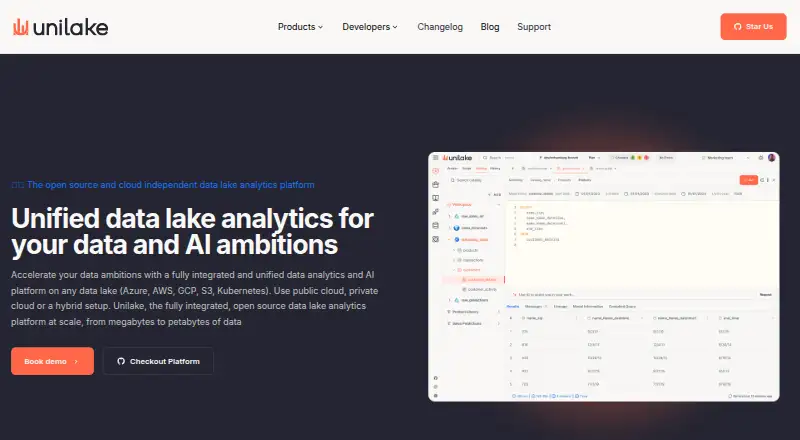
Unilake is an open-source data analytics platform that brings data integration, governance, modeling, sharing, and analytics together for data and AI workloads. It offers more than 350 pre-built connectors and supports full or incremental loads, streaming ingestion, API flattening, and privacy transformations. Its query interface combines data in Iceberg, Delta, Hudi, Kudu, and Paimon formats. The platform can be deployed on Azure, AWS, GCP, S3, Kubernetes, private or public cloud, hybrid environments, or on premises; its minimum requirements include a Kubernetes cluster and storage such as S3, Azure Storage, GCP Storage, or HDFS. Governance includes attribute-based controls, context-aware policies, and just-in-time access. Identity features include SAML 2.0 or OpenID Connect, SCIM provisioning, and immutable exportable audit logs. Unilake is licensed under AGPL 3.0 and EUPL 1.2, and can run in an isolated environment of the user's choice. The project is in active development and working toward an Alpha release; its AI/ML product is listed as on the roadmap.
Good
- More than 350 pre-built connectors.
- Supports full, incremental, and streaming ingestion.
- Queries five listed open table formats.
- Offers access policies, SSO, SCIM, and audit logs.
- Licensed under AGPL 3.0 and EUPL 1.2.
Watch out
- Requires a Kubernetes cluster and storage.
- The project is still working toward an Alpha release.
- AI/ML product is listed as on the roadmap.
Who it suits
Unilake may suit organizations seeking an open-source analytics platform with flexible deployment and governance controls. It is also relevant to teams working with multiple lakehouse formats or needing to run the platform in a chosen environment.
Verdict
Unilake combines broad ingestion, lakehouse querying, and governance in an open-source platform with several deployment options. Its development status and roadmap-listed AI/ML solution are important considerations.
The facts
Each one read from Unilake's own pages, with the date it was checked.
What it does
- AI/ML status
- The AI/ML product page labels the solution as on roadmap.checked 1 Oct 2026
- Analytics
- The lakehouse analytics page says Unilake uses StarRocks and supports SQL, object storage, and REST API endpoints.checked 2 Oct 2026
- Audit
- The governance page describes immutable, exportable, time-synchronized, searchable audit logs.checked 2 Oct 2026
- Custom connectors
- Users can create integrations with Unilake, Airbyte, or Meltano SDKs, including a low-code option.checked 1 Oct 2026
- Data management
- The data management page describes automatic cataloging, search, end-to-end lineage, data quality checks, and automated data classification.checked 2 Oct 2026
- Data sovereignty
- Unilake describes itself as a European cloud-independent platform with geo-fencing and support for European regulatory requirements.checked 1 Oct 2026
- Deployment
- The platform can run across public, private, and hybrid cloud environments, including on-premises deployments.checked 2 Oct 2026
- Development status
- The support FAQ says Unilake is in active development and working toward an Alpha version.checked 2 Oct 2026
- Encryption keys
- The data lake page says users can choose a platform-managed key or connect their own KMS.checked 2 Oct 2026
- Governance
- The governance layer provides attribute-based access control, global and local policies, policies as code, context-aware security, and just-in-time access.checked 1 Oct 2026
- Identity
- The governance page says Unilake requires SSO and supports SAML 2.0 or OpenID Connect identity providers and SCIM provisioning.checked 2 Oct 2026
- Identity and auditing
- Unilake supports SAML 2.0 and OpenID SSO, SCIM provisioning, immutable exportable audit logs, and customer-managed keys.checked 1 Oct 2026
- Integration features
- The integration page describes full and incremental loads, API data flattening, SCD type 2 tables, and integrated pipeline orchestration.checked 2 Oct 2026
- Integrations
- Unilake advertises more than 350 pre-built connectors using Singer and projects such as Airbyte and Meltano.checked 2 Oct 2026
- Lakehouse formats
- Unilake can query and combine Iceberg, Delta, Hudi, Kudu, and Paimon data through one interface.checked 1 Oct 2026
- Load patterns
- Integration supports full and incremental loads, API flattening, SCD type 2 tables, streaming ingestion, and privacy transformations.checked 1 Oct 2026
- Minimum requirements
- The minimum stated requirements are a Kubernetes cluster and storage such as S3, Azure Storage, GCP Storage, or HDFS.checked 1 Oct 2026
- Open source
- The maker says the platform is licensed under AGPL 3.0 and EUPL and can be run fully isolated in an environment of the user's choice.checked 2 Oct 2026
- Open source licenses
- Unilake is licensed under AGPL 3.0 and EUPL 1.2, with both control plane and compute plane open source.checked 1 Oct 2026
- Product
- Unilake describes itself as an open-source unified data lake analytics platform for data and AI.checked 2 Oct 2026
- Scale
- Unilake says it supports workloads ranging from megabytes to petabytes of data.checked 2 Oct 2026
- Security
- The governance page says policies apply across REST, SQL, and S3 access and describes attribute-based access control, context-aware rules, and just-in-time access.checked 2 Oct 2026
The company
- Company location
- The support FAQ identifies Unilake as a Dutch company based in the Netherlands.checked 2 Oct 2026
- Headquarters
- The Netherlandschecked 28 Sep 2026
Alternatives to Unilake
- 1

HPCC Systems
Free planOpen sourceWebAPIExtensionLinux7.5Free plan - 2

Apache Hadoop HDFS
Free planOpen sourceAPILinuxSelf-hostedWindows7.2Free plan - 3
Tencent Cloud Application Performance Management
WebAPILinuxSelf-hosted7.2 - 4

Parseable
Free planWebAPILinuxSelf-hosted7.0From $0.39 a month - 5

Qubole
WebAPI6.3 - 6

Oracle Big Data Service
WebAPILinux6.2