
AidOrbit
AidOrbit is a volunteer coordination platform for organizations that schedule service activities, manage signups, communicate with volunteers, and track hour…
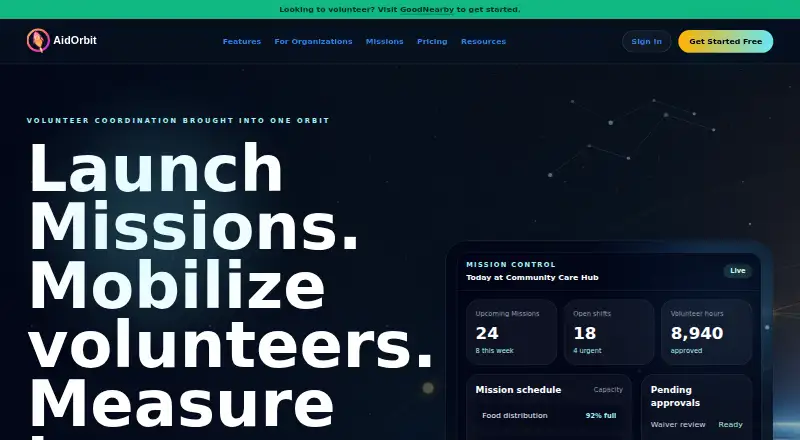
What AidOrbit is
AidOrbit is a volunteer coordination platform for organizations that schedule service activities, manage signups, communicate with volunteers, and track hours and impact. Teams can set up one-time or recurring Missions with roles, shifts, capacity limits, eligibility rules, reminders, and waitlists. Check-in can run through QR codes, kiosks, mobile flows, or staff assistance, with attendance connected to each Mission. The platform links that attendance to hour approvals, proof of service, exports, and impact reports. Teams can send confirmations, updates, cancellations, reminders, follow-ups, and thank-you notes. Mobile-friendly portals support registration, check-in and check-out, profiles, and hours workflows. AidOrbit lists security controls including role-based and program-scoped permissions, API authorization, audit trails, and secure portals. The free Countdown plan allows up to 50 Active Volunteers per year, one program, one staff user, and 10 Mission listings.
Good
- Schedules one-time and recurring Missions.
- Offers several check-in methods.
- Connects attendance to hours and impact reporting.
- Mobile-friendly portals support volunteer workflows.
- Galaxy Enterprise includes SSO/SAML and custom reporting.
Watch out
- Free Countdown is limited to 50 Active Volunteers yearly.
- Countdown includes one program and one staff user.
- Paid plans are billed annually.
Who it suits
AidOrbit suits volunteer programs at nonprofits, schools, churches, municipal programs, food banks, shelters, and other listed organizations. It may also fit teams that need scheduling, attendance, hour tracking, and impact reporting in one platform.
Verdict
AidOrbit brings Mission scheduling, volunteer communications, attendance, and service reporting together. The free tier has explicit limits, while larger programs can consider the higher-capacity plans and enterprise controls.
Plans and prices
From AidOrbit's own pricing page, checked 4 Oct 2026.
| Plan | Price | What it gives you |
|---|---|---|
| Countdown | Free | Up to 50 Active Volunteers/year · 1 Program · 1 staff user · 10 Mission listings · Basic impact reporting · annually |
| Pre-flight | $228 a year | Up to 250 Active Volunteers/year · 1 Program · 3 staff users · 30 Mission listings · annually |
| Launch | $588 a year | Up to 500 Active Volunteers/year · 2 Programs · 5 staff users · 100 Mission listings · annually |
| Orbit | $1,068 a year | 1,000–5,000 Active Volunteers/year · 5–20 Programs · 10–35 staff users · 250–1,000 Mission listings · annually |
| Galaxy | $5,988 a year | 15,000+ or custom Active Volunteers/year · 50+ or custom Programs · 75+ staff users · 3,000+ Mission listings · annually |
The facts
Each one read from AidOrbit's own pages, with the date it was checked.
What it does
- AI
- AidOrbit describes plan-based AI for guidance, operational intelligence, and preparing staffing plans, campaigns, reports, and follow-up actions for approval.checked 4 Oct 2026
- Check-in
- Check-in options include QR codes, kiosks, mobile flows, and staff-assisted check-in, with attendance tied to the Mission record.checked 4 Oct 2026
- Communications
- Teams can send confirmations, Mission updates, cancellations, reminders, follow-ups, and thank-you messages.checked 4 Oct 2026
- Enterprise controls
- Galaxy Enterprise supports SSO/SAML, advanced audit logs, API access, custom reporting, onboarding, procurement support, and SLA options.checked 4 Oct 2026
- Hours and impact
- The platform connects attendance, volunteer hours, approval workflows, proof of service, exports, and impact reporting.checked 4 Oct 2026
- Integrations
- The pricing page lists custom integrations as a Galaxy feature and custom integration support for Galaxy Enterprise.checked 4 Oct 2026
- Mobile access
- Volunteers and staff can use mobile-friendly portals, registration, check-in, check-out, profile, and hours workflows.checked 4 Oct 2026
- Product
- AidOrbit helps volunteer organizations coordinate Missions, manage signups, communicate with volunteers, track hours, and understand impact in one platform.checked 4 Oct 2026
- Scheduling
- Teams can schedule one-time and recurring Missions with roles, shifts, capacity, eligibility rules, reminders, and waitlists.checked 4 Oct 2026
- Security
- AidOrbit lists role-based access control, program-scoped permissions, API-level authorization, audit trails, secure portals, and private volunteer data as security capabilities.checked 4 Oct 2026
- Support
- Priority support is included in Orbit and Galaxy, and Galaxy includes a dedicated success manager.checked 4 Oct 2026
- Who it serves
- The site identifies small nonprofits, community groups, schools, churches, municipal programs, food banks, shelters, disaster response teams, healthcare outreach, and corporate volunteer programs as audiences.checked 4 Oct 2026
Money
- Plan limits
- Active Volunteers are unique volunteers who engage during the billing year; if usage exceeds the plan limit, the site says admins receive notices and current Mission operations are not interrupted.checked 4 Oct 2026
The full review of AidOrbit
AidOrbit is a web-based volunteer operations platform for organizations that need scheduling, attendance, communications, and impact records in one system. It suits nonprofits and community programs running recurring or complex Missions more than teams seeking only a lightweight roster. The main decision is whether its structured workflows justify annual paid pricing beyond the tightly capped free tier.
Overview
AidOrbit treats each service opportunity as a Mission and connects signups, staffing, volunteer messaging, check-in, hours, and reporting. That end-to-end approach is valuable when attendance must become approved service hours and measurable program results instead of remaining a separate spreadsheet exercise.
Key features
Scheduling handles one-time and recurring Missions with roles, shifts, capacity, eligibility rules, reminders, and waitlists. Coordinators can therefore manage routine rosters and constrained assignments in the same workflow. Groups with only occasional, uncomplicated signups may not need this breadth.
Check-in supports QR codes, kiosks, mobile flows, and staff-assisted entry, with attendance attached to the Mission record. AidOrbit then links attendance to hour tracking, approval workflows, proof of service, exports, and impact reporting. That chain suits programs needing auditable service records, documentation, or outcome reporting.
Communications cover confirmations, Mission changes, cancellations, reminders, follow-ups, and thank-you messages. Mobile-friendly portals let volunteers and staff register, check in and out, maintain profiles, and manage hours. The platform is identified as web-based, so organizations seeking native desktop or mobile applications should look elsewhere.
Listed security capabilities include role-based access, program-scoped permissions, API-level authorization, audit trails, secure portals, and private volunteer data. Plan-based AI can provide guidance and operational intelligence, and prepare staffing plans, campaigns, reports, and follow-up actions for approval rather than sending them automatically. Galaxy adds SSO/SAML, advanced audit logs, API access, custom reporting, onboarding, procurement support, SLA options, and custom integration support.
Pricing
AidOrbit uses annual billing. Countdown costs nothing and allows up to 50 Active Volunteers per year, one program, one staff user, 10 Mission listings, and basic impact reporting. It is a sensible way for a very small program to establish a workflow, but the volunteer and listing caps arrive quickly.
Pre-flight is $228 a year (billed annually), for up to 250 Active Volunteers, one program, three staff users, and 30 Mission listings. Launch costs $588 a year and raises capacity to 500 Active Volunteers, two programs, five staff users, and 100 Mission listings. These tiers fit growing single-program or small multi-program teams, while still limiting administrative seats and operational scale.
Orbit is $1,068 a year, covering 1,000–5,000 Active Volunteers, 5–20 programs, 10–35 staff users, and 250–1,000 Mission listings. Galaxy is $5,988 a year, with 15,000+ or custom Active Volunteers, 50+ or custom programs, 75+ staff users, and 3,000+ Mission listings. Orbit includes priority support; Galaxy also provides a dedicated success manager and enterprise controls. Active Volunteers are unique volunteers engaging during the billing year. If usage exceeds a plan limit, administrators receive notices and current Mission operations continue uninterrupted.
Platforms
AidOrbit is available on the web, with mobile-friendly portals for volunteer and staff workflows.
Who it's for
The audience includes small nonprofits, community groups, schools, churches, municipal programs, food banks, shelters, disaster-response teams, healthcare outreach, and corporate volunteer programs. It is strongest for organizations coordinating recurring shifts, multiple programs, or formal service records. A basic roster project is likely better served by a simpler tool.
Pros and cons
Pros
- End-to-end records: Mission attendance flows into hours, approvals, proof of service, exports, and impact reporting.
- Flexible staffing: Recurring schedules, shifts, eligibility rules, capacity controls, waitlists, and automated reminders handle complex assignments.
- Multiple check-in methods: QR, kiosk, mobile, and staff-assisted options accommodate different sites and volunteers.
- Enterprise governance: Permission controls, audit trails, SSO/SAML, API access, and custom reporting support larger programs.
Cons
- Small free tier: Countdown permits only 50 Active Volunteers, one staff user, one program, and 10 Mission listings.
- Annual commitment: Paid plans are billed annually, reducing flexibility for seasonal programs.
- Web-only platform: No platform beyond web is identified.
- Capacity jumps: Teams can quickly outgrow lower tiers as volunteer, staff, program, and listing limits expand.
Alternatives
For church-focused needs, browse Church Volunteer Management Software. GraceSquad is a better fit when a free tier for up to 100 members, one ministry, manual scheduling, profiles, basic CRM, and email notifications is enough. Planning Center suits organizations wanting separate free Calendar, People, or Services offerings. RosterThat is the simpler choice for roster administration, with a Pro plan at $5 a month for up to 50 people and three admins. SimpleServ fits very small teams needing a free plan for five volunteers and one admin. ChurchCMS offers self-hosting with all six core modules and no usage limits. WorshipTools Presenter, HolyJot, and WorshipMetrics serve different church, journaling, or media-oriented workflows.
Verdict
Choose AidOrbit if your organization needs Missions, recurring shift coordination, auditable attendance and hours, volunteer messaging, and impact reporting in one web system. Its main reason to look elsewhere is the restrictive free tier and annual paid commitment, especially when your program only needs a straightforward roster or a smaller, specialized church tool.
Alternatives to AidOrbit
- 1

Planning Center
Free planAndroidiOSWebAPI8.4From $15 a month - 2

ChurchCMS
Free planOpen sourceAndroidWebAPISelf-hosted8.3From $290 a year - 3

HolyJot
Free planAndroidiOSWebAPI8.1Free plan - 4

GraceSquad
Free planAndroidiOSWebAPI7.9From $39 a month - 5

ParishSOFT
AndroidiOSWebAPI7.6$250 one-time - 6

RosterThat
Free planWeb7.3From $50 a year