
Aerospike Database
Aerospike Database is a real-time database designed for millisecond latency and large-scale transaction processing, including document access and graph trave…
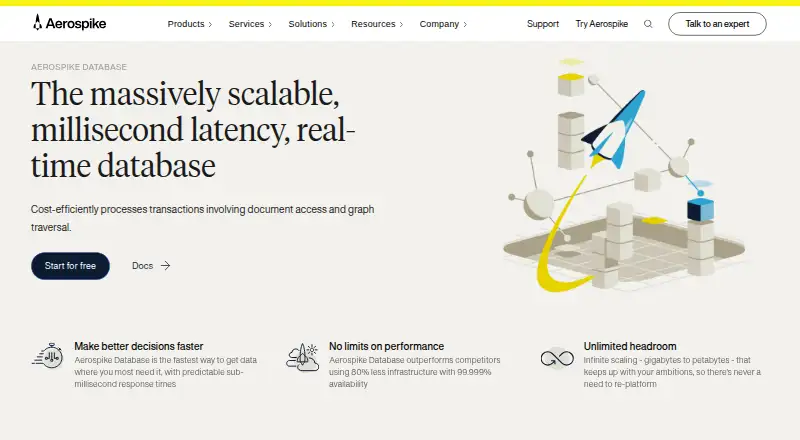
What Aerospike Database is
Aerospike Database is a real-time database designed for millisecond latency and large-scale transaction processing, including document access and graph traversal. Its single engine supports key-value, document, and graph data models. Aerospike 8 provides strict serializability for distributed ACID transactions. Storage choices include in-memory, hybrid memory and flash, all-flash, and network block storage. Cross Datacenter Replication supports global asynchronous replication between clusters, and synchronous active-active replication is also available. Aerospike Connect lists connectors for Elasticsearch, Spark, Kafka, JMS, Pulsar, Trino, and Event Stream Processing; additional licensing is noted for these connectors. Enterprise Edition lists TLS encryption, access control lists, Vault integration, and FIPS 140-2 compliance, with some features requiring additional licensing. Community Edition includes community support, while Enterprise includes production support and hot patch availability. Linux packages and client libraries for several programming languages are listed. Community and Enterprise plans are described with node, data, and namespace limits, but no prices are listed.
Good
- Supports key-value, document, and graph models.
- Distributed ACID transactions have strict serializability.
- Offers asynchronous and synchronous active-active replication.
- Client libraries are listed for multiple languages.
Watch out
- Aerospike Connect connectors require additional licensing.
- Some Enterprise security features require additional licensing.
- No plan prices are listed.
Who it suits
It may suit teams building large-scale transaction systems or data pipelines that need multiple data models and replication options. The Enterprise Edition is described for mission-critical workloads, including machine learning and generative and agentic AI workloads.
Verdict
Aerospike Database offers several data models, storage modes, and replication choices in one engine. Review edition limits and licensing notes for connectors and security features before selecting a plan.
Plans and prices
From Aerospike Database's own pricing page, checked 19 Oct 2026.
| Plan | Price | What it gives you |
|---|---|---|
| Community Edition | Free | AGPLv3 · up to 8 nodes · 2.5 TB cluster data · 2 namespaces · community support |
| Enterprise Edition | Priced on request | Commercial license · up to 256 nodes · unlimited data · enterprise support · all features and connectors |
The facts
Each one read from Aerospike Database's own pages, with the date it was checked.
What it does
- API documentation
- The Node.js API documentation includes connection tutorials, callback, Promise and async/await examples, semantic versioning guidance and generated API references.checked 19 Oct 2026
- Client languages
- Legacy production clients are provided for Java, Python, Go, C, C#, Node.js, Rust and PHP.checked 19 Oct 2026
- Client libraries
- The downloads page lists client libraries for C, Java, Go, C#, Python, Node.js, Ruby, Rust, and PHP.checked 30 Sep 2026
- Cloud pricing model
- Aerospike Cloud pricing combines infrastructure, network transfer and a management component, with estimates tailored to region and workload and no transaction charge.checked 19 Oct 2026
- Compliance
- Aerospike reports ISO 27001 certification, SOC 2 Type II attestation, periodic penetration testing and GDPR-related controls.checked 19 Oct 2026
- Connectors
- Official connectors cover Kafka, Pulsar, JMS, event-stream processing, Elasticsearch, Spark and Trino.checked 19 Oct 2026
- Consistency
- Aerospike offers high-availability consistency and strong consistency with distributed ACID transactions.checked 19 Oct 2026
- Data models
- The database supports key-value, document and graph data structures through one core engine.checked 19 Oct 2026
- Developer SDKs
- A newer Developer SDK is available for Java and Python with fluent APIs, Aerospike Expression Language queries and structured error handling.checked 19 Oct 2026
- Documentation depth
- The documentation covers quickstarts, architecture, client APIs, deployment, operations, transactions, storage, replication, tuning, troubleshooting and upgrade procedures.checked 19 Oct 2026
- Enterprise evaluation
- Enterprise and Federal Editions include a single-node evaluation key, and Aerospike offers a free multi-node evaluation signup.checked 19 Oct 2026
- Installation options
- Aerospike supports 64-bit Linux on AMD64 and ARM64, Docker, Kubernetes through the Aerospike Kubernetes Operator, and cloud virtual machines; macOS and Windows are supported for development through Docker.checked 19 Oct 2026
- Integrations
- Aerospike Connect includes connectors for Elasticsearch, Spark, Kafka, JMS, Pulsar, Trino, and Event Stream Processing, with additional licensing noted for these connectors.checked 30 Sep 2026
- Intended users
- Aerospike describes Enterprise Edition as suited to mission-critical workloads and data pipelines, including machine learning and generative and agentic AI workloads.checked 30 Sep 2026
- Latest release
- Database 8.2.0 was released September 29, 2026 with Ubuntu 26.04 support, server-side expression improvements, structured errors and a 64-level nesting limit for lists and maps.checked 19 Oct 2026
- Limit: AWS Marketplace pricing and upgrades
- An AWS Marketplace reviewer reports annual spending of about $36,000–$40,000 for roughly half a terabyte and requests better development-to-production upgrade automation.checked 19 Oct 2026
- Limit: G2 interface and querying
- Reviewers mention a lack of a polished interface, record-size constraints and difficulty limiting broad query results.checked 19 Oct 2026
- Limit: Gartner operations
- A critical Gartner review says installation is easy but dependable operation requires difficult monitoring.checked 19 Oct 2026
- Limit: Software Advice pricing
- A Software Advice reviewer calls Aerospike expensive and says some client libraries lack feature compatibility, especially Ruby, while training is basic.checked 19 Oct 2026
The company
- Company legal name
- A U.S. government purchasing document identifies the vendor as Aerospike, Inc.checked 19 Oct 2026
- Company profile
- LinkedIn lists Aerospike as a privately held software-development company headquartered in Mountain View, California, founded in 2009 with 201–500 employees.checked 19 Oct 2026
- Founded
- 2010checked 23 Sep 2026
- Headquarters
- Mountain View, California, United Stateschecked 28 Sep 2026
Money
- Free plan
- Yeschecked 22 Sep 2026
The full review of Aerospike Database
Overview
Aerospike Database is a distributed database built for millisecond-latency access and large transaction workloads. It is best suited to teams running demanding applications that need several data models and control over storage and replication. Its strongest case is breadth in one engine; production support and some security and integration capabilities require Enterprise Edition or additional licensing.
Key features
Aerospike combines key-value, document, and graph models, with graph traversal and Gremlin queries. That can serve applications with varied data shapes in one database, while teams needing only a simple single-model store may find the range unnecessary. Values can reach 8 MB, and the database supports TTL, clustering, and multi-region operation.
Aerospike 8 provides strict serializability for distributed ACID transactions, a useful fit where transaction consistency across distributed operations matters. Storage options span in-memory, hybrid memory and flash, all-flash, and network block storage. This flexibility gives operators room to match storage to their infrastructure, but also means choosing and managing a deployment approach.
Cross Datacenter Replication provides asynchronous replication between clusters; synchronous active-active replication is also supported. These options address different replication needs, from global cluster replication to synchronous active-active setups.
Aerospike Connect offers connectors for Elasticsearch, Spark, Kafka, JMS, Pulsar, Trino, and Event Stream Processing. They can connect the database to data pipelines and adjacent systems, but carry additional licensing. Enterprise Edition includes TLS transport encryption, access control lists, Vault integration, and FIPS 140-2 compliance; some security features also require additional licensing.
Linux packages are available for Standard and Enterprise editions. Client libraries cover C, Java, Go, C#, Python, Node.js, Ruby, Rust, and PHP, giving development teams a broad set of supported language options.
Pricing
Aerospike uses a freemium model, with Community and Enterprise editions and a free trial. Neither edition has a published price. Enterprise pricing is primarily based on unique production data volume and active production clusters, with no charge for operations, servers, or cores.
Community Edition: The free plan supports up to 8 nodes, 2.5 TB of data, and 2 namespaces. It includes community support, making it a reasonable starting point for teams evaluating or running within those capacity limits. The tradeoff is that it does not include Enterprise Edition's enterprise production support and hot patch availability.
Enterprise Edition: Custom pricing covers up to 256 nodes, unlimited data, and 32 namespaces. It is the stronger fit for mission-critical production workloads and data pipelines, including machine learning and generative and agentic AI workloads. Its capacity and production support suit larger deployments, though teams should account for additional licensing for connectors and some security features.
Platforms
Aerospike supports API, Linux, self-hosted, and web platforms. Its hybrid deployment model and Linux packages offer infrastructure choices for teams operating their own database environments.
Who it's for
Aerospike is for engineering teams that need low-latency, large-scale transaction processing alongside multiple data models, distributed ACID transactions, and regional replication choices. It is less compelling for small deployments that need only one basic data model or cannot justify Enterprise licensing for production support, connectors, or security capabilities.
Pros and cons
- Pros: Key-value, document, and graph models in one engine can cover applications with different data shapes.
- Pros: Strictly serializable distributed ACID transactions and synchronous active-active replication support demanding transaction and availability requirements.
- Pros: Four storage options and broad client-library coverage give operators flexibility across infrastructure and development languages.
- Cons: Community Edition is capped at 8 nodes, 2.5 TB, and 2 namespaces, which limits its fit for larger deployments.
- Cons: Enterprise pricing is custom, and connectors plus some security features may add licensing costs.
- Cons: Enterprise production support and hot patch availability are not part of Community Edition.
Alternatives
Infinispan is worth considering when a free Apache 2.0-licensed option with an embedded library or standalone server better suits the deployment.
VoltDB offers a free Developer Edition for individual developers and early exploration, with local or cloud use and sample apps, tutorials, and documentation.
Apache Geode is a free option available as binary and source distributions under the Apache License.
RonDB has a free serverless option via Hopsworks, with quotas on feature-group tables and memory usage.
eXtremeDB uses commercial licensing discussed with McObject and offers a free trial.
Couchbase Server offers a free Community Edition capped at 5 nodes, as well as an Enterprise Edition with a traditional subscription and commercial license.
SingleStore Helios has a free Shared workspace for evaluation, development, and non-production testing, with self-support.
Tarantool DB is another paid database option.
For broader comparisons, browse In-Memory Databases, Key-Value Databases, Multimodel Databases, and Database Software.
Verdict
Choose Aerospike when a production system needs low-latency transaction processing, multiple data models, and flexible storage and replication in one database. The main reason to look elsewhere is cost and licensing complexity: custom-priced Enterprise capacity and add-on licensing may outweigh that breadth for smaller or simpler workloads.
Getting started
- Visit the Aerospike Database website
- Choose Community Edition or Enterprise Edition
- Select a Linux package, self-hosted or web deployment approach
- Use the listed client library or Aerospike API
- Request Enterprise pricing based on production data volume and active clusters
Limits worth knowing
Community Edition is listed at 8 nodes, 2.5 TB of data and 2 namespaces. Enterprise Edition is listed at 256 nodes, unlimited data and 32 namespaces; some connectors and security capabilities require additional licensing.
Questions
Does Aerospike Database have a free plan or trial?
It uses a freemium model with a free plan, and a free trial is also listed.
What are the Community and Enterprise Edition limits?
Community Edition lists 8 nodes, 2.5 TB of data and 2 namespaces. Enterprise Edition lists 256 nodes, unlimited data and 32 namespaces.
Which data models and query language are supported?
It supports key-value, document and graph data models, with Gremlin listed as a query language.
Which platforms and deployment options are available?
Platforms include API, Linux, self-hosted and web, with hybrid deployment support.
What integrations are listed?
Aerospike Connect lists Elasticsearch, Spark, Kafka, JMS, Pulsar, Trino and Event Stream Processing connectors, with additional licensing noted.
How is Enterprise pricing determined?
Pricing is primarily based on unique production data volume and active production clusters, with no charge for operations, servers or cores.
Alternatives to Aerospike Database
- 1

Amazon DynamoDB
Free planAndroidiOSWebAPI7.8Free plan - 2

Apache Ignite
Free planOpen sourceAPILinuxmacOSSelf-hosted7.4Free plan - 3

Upstash Redis
Free planWebAPI7.3From $10 a month - 4
RocksDB
Free planiOSAPILinuxmacOS7.0Free plan - 5

Google Cloud Bigtable
Free planWebAPI6.8From $0.03 a month - 6

Redis Insight
Free planWebLinuxmacOSSelf-hosted6.7Free plan