
Google Cloud Bigtable
Google Cloud Bigtable is a fully managed NoSQL database for low-latency workloads such as machine learning, operational analytics, and user-facing applicatio…
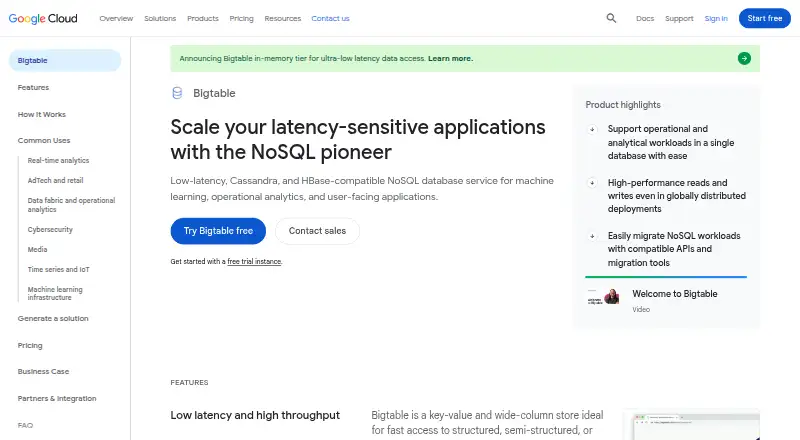
What Google Cloud Bigtable is
Google Cloud Bigtable is a fully managed NoSQL database for low-latency workloads such as machine learning, operational analytics, and user-facing applications. It stores structured, semi-structured, and unstructured data in key-value and wide-column formats. SQL queries include support for aggregations, windowing, geospatial and JSON processing, and vector search. Compute scales horizontally, and instances can span as many as eight regions with automatic replication between clusters. Integrations include Apache Spark, Hadoop, GKE, Dataflow, Dataproc, Vertex AI Vector Search, BigQuery, and LangChain. Bigtable offers APIs and migration tools for HBase, Cassandra, DynamoDB, and Aerospike. Security controls include IAM, customer-managed encryption keys, audit logging, access approvals, and table-, column-, or row-level access controls. Google says multi-region instances provide 99.999% availability and protection against regional failure. The service is cloud-based and supports gRPC, REST/HTTP, GoogleSQL, and Apache HBase and Cassandra APIs. Google describes its capacity-based low-latency compute as a stronger fit for larger workloads than small applications. A 10-day trial is available subject to eligibility requirements.
Good
- Scales compute horizontally and supports instances across up to eight regions
- SQL supports geospatial, JSON, and vector search
- Offers APIs and migration tools for several databases
- Google says multi-region instances offer 99.999% availability
Watch out
- Google describes it as less ideal for small applications
- The 10-day trial has eligibility requirements
- The listed plans are paid
Who it suits
Bigtable may fit teams handling larger low-latency workloads for machine learning, analytics, or user-facing applications. Its multi-region setup and database migration options may also suit teams with those needs.
Verdict
Bigtable combines a wide-column data model with SQL querying, scaling, and multi-region replication. Its capacity-based approach is described as more suitable for larger workloads than small applications.
Plans and prices
From Google Cloud Bigtable's own pricing page, checked 20 Sep 2026.
| Plan | Price | What it gives you |
|---|---|---|
| Enterprise | $0.65 a month | Standard Bigtable edition |
| Enterprise Plus | $0.85 a month | Premium Bigtable edition |
| Data Boost | Free | On-demand isolated compute for batch processing · per serverless processing unit per hour |
| Standard backup storage | $0.03 a month | Incremental backups · Billed by physical backup size · per GB per month |
| HDD storage | $0.03 a month | Infrequent Access uses HDD at the same rate · Each replica billed separately · per GB per month |
| Hot backup storage | $0.12 a month | Optimized for reduced restore time · Billed by physical backup size · per GB per month |
| SSD storage | $0.17 a month | Each replica billed separately · per GB per month |
| In-memory tier | $0.20 a month | Enterprise Plus only · Up to 120,000 rows per second per node · per 40,000 rows per second capacity |
| Enterprise compute capacity | $0.65 a month | Compute provisioned as nodes · per node per hour |
| Enterprise Plus compute capacity | $0.85 a month | Compute provisioned as nodes · Includes Enterprise edition capabilities · per node per hour |
The facts
Each one read from Google Cloud Bigtable's own pages, with the date it was checked.
What it does
- Availability
- Google says multi-region instances offer 99.999% availability and protection against a regional failure.checked 29 Sep 2026
- Data model
- It is a key-value and wide-column store for structured, semi-structured, and unstructured data.checked 29 Sep 2026
- Integrations
- The product page lists integrations with Apache Spark, Hadoop, GKE, Dataflow, Dataproc, Vertex AI Vector Search, BigQuery, and LangChain.checked 29 Sep 2026
- Migration
- Bigtable provides Apache Cassandra and HBase APIs and migration tools for HBase, Cassandra, DynamoDB, and Aerospike.checked 29 Sep 2026
- Pricing model
- Pricing is based on compute capacity, database storage, backup storage, and network usage; the page says ingress, same-region egress, and same-region replication are free.checked 29 Sep 2026
- Product
- Bigtable is a fully managed, low-latency NoSQL database service for machine learning, operational analytics, and user-facing applications.checked 29 Sep 2026
- Scaling and deployment
- Bigtable scales compute horizontally and supports instances spanning as many as eight regions, with automatic replication between clusters.checked 29 Sep 2026
- Security
- Security controls include customer-managed encryption keys with Cloud External Key Manager support, IAM, VPC Service Controls, Access Transparency, Access Approval, audit logging, and table-, column-, or row-level access control.checked 29 Sep 2026
- SQL
- Bigtable supports SQL queries, including a SQL query API with more than 200 functions and support for aggregations, windowing, geospatial and JSON processing, and vector search.checked 29 Sep 2026
- Workload fit
- Google says capacity-based low-latency compute can make Bigtable more favorable for larger workloads and less ideal for small applications.checked 29 Sep 2026
Money
- Free plan
- Nochecked 20 Sep 2026
- Free trial
- New Google Cloud users can receive $300 in Welcome credit for 90 days to spend on covered products and services, including Bigtable when covered by the trial program.checked 29 Sep 2026
- Trial eligibility
- Google says trial eligibility requires never having been a paying user of Google Cloud, Google Maps Platform, or Firebase and not having previously signed up for the Free Trial.checked 29 Sep 2026
The full review of Google Cloud Bigtable
Google Cloud Bigtable is a managed database for teams building low-latency services, analytics pipelines, or machine-learning workloads at scale. It suits organizations already working with large datasets and Google Cloud integrations; smaller applications may find its capacity-based compute an awkward fit.
Overview
Bigtable combines key-value and wide-column storage for structured, semi-structured, and unstructured data. It is a cloud deployment rather than a self-managed database, with clustering, TTL support, both persistence modes, and a maximum value size of 100 MB. That flexibility is useful for varied data shapes, but its model is not a substitute for a general-purpose relational database.
Clients can connect through gRPC, REST/HTTP, GoogleSQL, or the Apache HBase and Apache Cassandra APIs. Migration tools cover HBase, Cassandra, DynamoDB, and Aerospike, which can give teams a starting point for moving existing data; an API or tool does not eliminate the planning and conversion work a migration may require.
Key features
SQL support makes Bigtable more accessible to teams that need querying beyond direct key-value access. Its SQL query API offers more than 200 functions, including aggregations, windowing, geospatial and JSON processing, and vector search. This breadth can support analytics and AI-related queries while retaining Bigtable's wide-column foundation.
Compute scales horizontally, and an instance can span as many as eight regions with automatic replication between clusters. Google says multi-region instances offer 99.999% availability and protection against a regional failure. That makes the multi-region design relevant for services where continuity matters, though the stated availability applies to multi-region instances.
Integrations include Apache Spark, Hadoop, GKE, Dataflow, Dataproc, Vertex AI Vector Search, BigQuery, and LangChain. Security controls include customer-managed encryption keys with Cloud External Key Manager support, IAM, VPC Service Controls, Access Transparency and Access Approval, audit logging, and table-, column-, or row-level access controls. These controls suit organizations with detailed access and governance requirements.
Pricing
Bigtable is paid, with a 10-day trial and no free plan. Trial eligibility requires that the user has never been a paying customer of Google Cloud, Google Maps Platform, or Firebase and has not previously signed up for the Free Trial. Published prices are usage-based components rather than a single all-in monthly subscription, so the total depends on provisioned capacity, storage, replicas, and workload.
- Enterprise: $0.65 a month for the Standard Bigtable edition. Enterprise compute capacity is $0.65 a month per node per hour, billed by node.
- Enterprise Plus: $0.85 a month for the Premium Bigtable edition. Compute capacity is $0.85 a month per node per hour and includes Enterprise edition capabilities.
- Data Boost: free, billed per serverless processing unit per hour for isolated batch processing. The zero base price does not mean processing is free.
- Storage: HDD storage is $0.03 a month per GB, with Infrequent Access at the same rate; SSD storage is $0.17 a month per GB. Each replica is billed separately. Standard backup storage is $0.03 a month per GB, billed by physical backup size, while hot backup storage is $0.12 a month per GB and is optimized for reduced restore time.
- In-memory tier: $0.20 a month per 40,000 rows per second of capacity, available only with Enterprise Plus, up to 120,000 rows per second per node.
The lower-cost HDD tier and standard backups trade away SSD performance and reduced restore time, respectively. Per-replica storage charges and node-based compute matter when estimating larger deployments; capacity-based compute can make the service less attractive for a small application with modest demand.
Platforms
Bigtable is a cloud service accessed through web and API platforms. Its supported protocols—gRPC, REST/HTTP, Apache HBase API, Apache Cassandra API, and GoogleSQL—give application teams several integration paths without changing the cloud deployment model.
Who it's for
Bigtable is strongest for teams that need low-latency access across large workloads, horizontal scaling, multi-region replication, or a wide-column store connected to analytics and machine-learning tools. Existing HBase or Cassandra users may value the compatible APIs and migration tools. It is a weaker choice for small applications: Google describes its capacity-based compute as more favorable for larger workloads, so provisioning can be difficult to justify when demand is limited.
Pros and cons
- Pro: SQL includes advanced functions and vector search, extending the usefulness of the wide-column model for analytics and AI workloads.
- Pro: Horizontal scaling, replication across as many as eight regions, and Google's stated 99.999% availability for multi-region instances support demanding services.
- Pro: HBase and Cassandra APIs, migration tools, and a broad set of integrations offer practical routes into existing data and cloud workflows.
- Con: Capacity-based compute is better suited to larger workloads, making Bigtable a questionable fit for small applications.
- Con: Storage is charged separately by tier and replica, while compute is billed by node and hour; the component-based model requires careful workload sizing.
- Con: The 10-day trial has strict prior-customer eligibility requirements, and there is no free plan for ongoing use.
Alternatives
Apache Cassandra is a free, open-source, self-managed distributed NoSQL database; choose it when avoiding a paid managed service matters more than having Bigtable's managed cloud model.
Apache HBase is a free, open-source distributed database whose operators configure and manage deployments. It is an alternative for teams that prefer that operational responsibility.
Amazon Keyspaces offers a free plan and paid on-demand or provisioned capacity, making it an alternative for teams considering those capacity models.
Apache Accumulo is a free, open-source sorted distributed key/value store under the Apache License 2.0; consider it when that model and license suit the deployment.
Alibaba Cloud Lindorm is a paid web-based alternative.
Alibaba Cloud Tablestore is a paid web-based option billed hourly according to storage, throughput, and traffic usage.
HPE Ezmeral Data Fabric is a paid alternative with a free plan and trial; its software pricing varies by reseller.
Baidu Tera is a free alternative for API, Linux, or self-hosted use.
Browse Wide-Column Databases, Key-Value Databases, or Database Software for more options.
Verdict
Choose Google Cloud Bigtable when a large, low-latency workload needs horizontal growth, SQL querying, and multi-region resilience within a Google Cloud-connected stack. Its breadth of query, security, and migration capabilities is compelling, but teams with small workloads or a need for a free ongoing tier should look elsewhere.
Getting started
- Open the Bigtable website
- Choose the cloud deployment and required protocols
- Check eligibility for the 10-day free trial
- Create an instance through the web interface or API
- Select persistence, clustering, and regional settings
- Connect using gRPC, REST/HTTP, GoogleSQL, HBase, or Cassandra APIs
Limits worth knowing
There is no free plan. The trial lasts 10 days and requires that you have never been a paying user of Google Cloud, Google Maps Platform, or Firebase and have not previously signed up for the Free Trial. Listed charges include compute, storage, backups, replicas, and optional in-memory capacity.
Questions
Is Google Cloud Bigtable free?
No. It has a paid pricing model and no free plan, but a 10-day free trial is listed for eligible users.
Which platforms support Bigtable?
Bigtable is available through web and API access.
What protocols can applications use?
Supported protocols are gRPC, REST/HTTP, Apache HBase API, Apache Cassandra API, and GoogleSQL.
Does Bigtable support multiple regions?
Yes. Instances can span as many as eight regions with automatic replication between clusters.
Which integrations are listed?
Integrations include Apache Spark, Hadoop, GKE, Dataflow, Dataproc, Vertex AI Vector Search, BigQuery, and LangChain.
Alternatives to Google Cloud Bigtable
- 1

Apache Cassandra
Free planOpen sourceWebAPILinuxmacOS7.7Free plan - 2
Apache HBase
Free planOpen sourceAPILinuxSelf-hosted7.1Free plan - 3

Amazon Keyspaces
Free planWebAPI6.4Free plan - 4

Azure Cosmos DB for NoSQL
Free planAPISelf-hosted6.3Free plan - 5
Apache Accumulo
Free planAPILinuxSelf-hosted6.0Free plan - 6
SWC-DB
Free planAPILinuxSelf-hosted5.9Free plan