Baidu Tera
Baidu Tera is a free, self-hosted distributed NoSQL database for real-time applications.
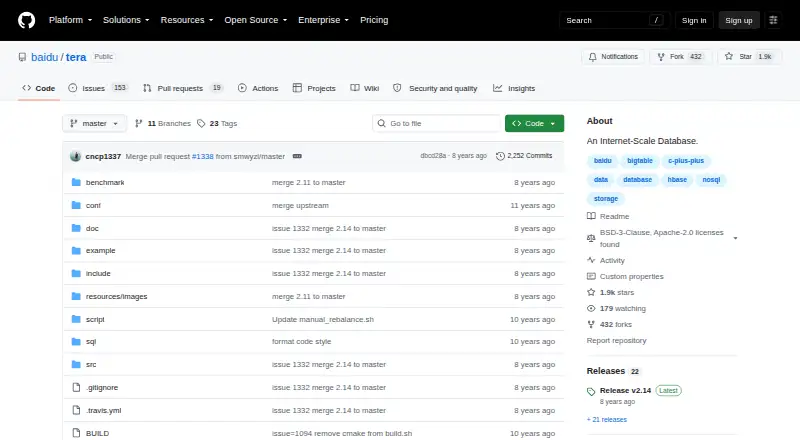
What Baidu Tera is
Baidu Tera is a free, self-hosted distributed NoSQL database for real-time applications. It organizes sparse, multidimensional tables by row key, column key, and timestamp, and is designed to scale across servers as data grows. The project describes capacity reaching petabytes across thousands of commodity machines, with linear or modular scaling and configurable sharding by range or hash. Tera lists strict consistency, MVCC, automatic failover, online schema changes, and snapshots. For storage and query work, it supports RAMDISK, SSD, and disk tables, with tiered and block caches and Bloom Filters. Applications can connect through C++, Java, Python, or REST APIs. The architecture comprises an SDK, a master, and tablet servers; those servers handle reads, writes, and scans with an enhanced LevelDB engine. Tera can run on raw machines or in Docker, with a single-host pseudo-distributed option using the local filesystem. Baidu describes use in web indexing, WebPage DB, and LinkBase DB, for both throughput-focused and latency-sensitive workloads.
Good
- Free plan is listed.
- Supports strict consistency and MVCC.
- Offers automatic failover and snapshots.
- Includes C++, Java, Python, and REST APIs.
- Runs on raw machines or in Docker.
Watch out
- Self-hosted deployment requires infrastructure.
- Listed interfaces are API-focused.
- No free trial is listed.
Who it suits
Tera may suit teams building real-time applications that need a self-hosted NoSQL store with strong consistency and configurable horizontal scaling. Its listed client interfaces and deployment modes offer options for integrating and running it.
Verdict
Baidu Tera combines distributed table storage with consistency and operational capabilities such as failover and online schema changes. Teams considering it should account for its self-hosted deployment model and the infrastructure dependencies listed in the README.
The facts
Each one read from Baidu Tera's own pages, with the date it was checked.
What it does
- Architecture
- Tera consists of an SDK, a master, and tablet servers; tablet servers use an enhanced LevelDB storage engine and handle read, write, and scan requests.checked 4 Oct 2026
- Client APIs
- The README lists C++, Java, Python, and RESTful APIs for accessing Tera.checked 4 Oct 2026
- Client interfaces
- The project lists C++, Java, Python, and REST APIs.checked 4 Oct 2026
- Consistency and availability
- Listed features include strict consistency, automatic failover, online schema changes, and snapshots.checked 4 Oct 2026
- Data and consistency
- Tera supports MVCC, column-oriented storage with locality groups, and strict consistency.checked 4 Oct 2026
- Data model
- Tera stores sparse, distributed, multidimensional tables indexed by row key, column key, and timestamp.checked 4 Oct 2026
- Deployment
- The README says Tera can run on raw machines or in Docker, and describes a pseudo-distributed mode on a single host using the local filesystem.checked 4 Oct 2026
- Documentation
- The English documentation index links to user manuals for pseudo-distributed mode, the API, and teracli, plus a performance benchmark page.checked 4 Oct 2026
- Integrations
- Tera's README lists HDFS and other filesystems, ZooKeeper and Nexus lock services, and Sofa-pbrpc as infrastructure dependencies.checked 4 Oct 2026
- Intended use
- The README describes use in throughput-oriented and latency-sensitive Baidu products, including web indexing, WebPage DB, and LinkBase DB.checked 4 Oct 2026
- License
- The repository lists BSD-3-Clause and Apache-2.0 licenses.checked 4 Oct 2026
- Operations
- Listed capabilities include automatic failover, online schema changes, and snapshots.checked 4 Oct 2026
- Product
- Tera is a high-performance distributed NoSQL database designed for real-time applications.checked 4 Oct 2026
- Scale
- The project says Tera can scale to petabytes of data across thousands of commodity servers.checked 4 Oct 2026
- Security and compliance
- The repository lists BSD-3-Clause and Apache-2.0 licenses; the README does not state security certifications or compliance claims.checked 4 Oct 2026
- Sharding
- Features include linear and modular scalability, automatic configurable sharding, and ranged or hashed sharding strategies.checked 4 Oct 2026
- Storage and queries
- Tera supports RAMDISK, SSD, and disk tables, tiered cache, block cache, and Bloom Filters for real-time queries.checked 4 Oct 2026
- Support and contribution
- The README welcomes contributions and provides [email protected] for joining the project.checked 4 Oct 2026
- Use cases
- Baidu says it uses Tera in products including web indexing, WebPage DB, and LinkBase DB, for workloads ranging from throughput-oriented applications to latency-sensitive services.checked 4 Oct 2026
Alternatives to Baidu Tera
- 1

Apache Cassandra
Free planOpen sourceWebAPILinuxmacOS7.7Free plan - 2
Apache HBase
Free planOpen sourceAPILinuxSelf-hosted7.1Free plan - 3

Google Cloud Bigtable
Free planWebAPI6.8From $0.03 a month - 4

Amazon Keyspaces
Free planWebAPI6.4Free plan - 5

Azure Cosmos DB for NoSQL
Free planAPISelf-hosted6.3Free plan - 6
Apache Accumulo
Free planAPILinuxSelf-hosted6.0Free plan