
Apache Cassandra
Apache Cassandra is an open-source NoSQL distributed database for mission-critical data and large active datasets.
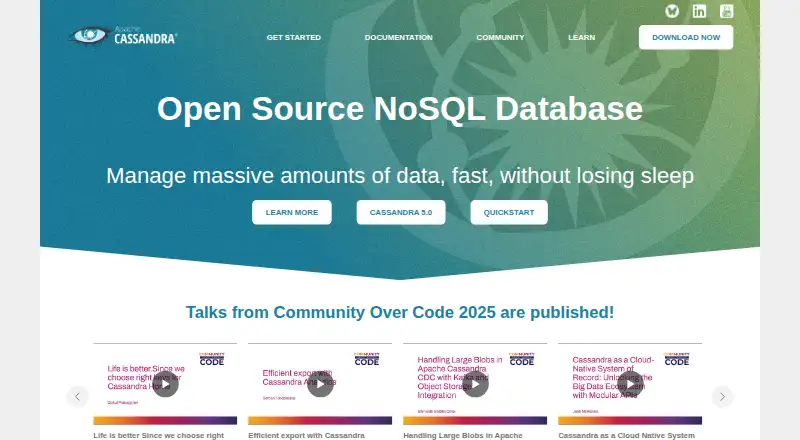
What Apache Cassandra is
Apache Cassandra is an open-source NoSQL distributed database for mission-critical data and large active datasets. Its masterless design gives each node the same role, and the project says read and write throughput can grow linearly as machines are added, without downtime or application interruption. It can be deployed on premises, with one cloud provider, across multiple providers, or in a mix of those environments. Replication across data centers and tunable query consistency give teams controls for distributed deployments. Cassandra supports CQL, transactions, and horizontal scaling. The project lists audit logging for DML, DDL, and DCL activity, plus fqltool for capturing and replaying production workloads. Drivers are available for Java, Go, Python, and Node.js; downloads include tarballs and packages, with Debian and RPM installation guidance. The listed ecosystem includes connectors and tools for Apache Kafka, Apache Flink, Apache Spark, and Kubernetes. Cassandra is free and self-managed. The project identifies version 5.0 as the latest GA release, maintained until the 8.0 release.
Good
- Free, open-source database
- Masterless architecture gives nodes the same functionality
- Supports replication across multiple data centers
- Drivers listed for Java, Go, Python, and Node.js
Watch out
- Self-managed deployment
- Third-party ecosystem projects are not community-supported
Who it suits
Cassandra suits teams managing large, active datasets that need a self-managed distributed database across on-premises or cloud environments. It may also fit workloads needing data-center replication and configurable query consistency.
Verdict
Cassandra offers a free, self-managed database with distributed deployment, tunable consistency, and horizontal scaling. Teams should account for the self-management requirement and distinguish community support from support for third-party ecosystem projects.
Plans and prices
From Apache Cassandra's own pricing page, checked 14 Oct 2026.
| Plan | Price | What it gives you |
|---|---|---|
| Apache Cassandra | Free | Open-source database · self-hosted |
The facts
Each one read from Apache Cassandra's own pages, with the date it was checked.
What it does
- Architecture
- Cassandra has a masterless architecture in which every node can provide the same functionality.checked 30 Sep 2026
- Audit logging
- The project says audit logging records DML, DDL and DCL activity with limited workload impact.checked 14 Oct 2026
- Caching and indexes
- G2 describes built-in caching, denormalization support, materialized views and column indexes in Cassandra's data model.checked 14 Oct 2026
- Cassandra Query Language
- CQL is an SQL-like language for defining schema and accessing data, with keyspaces, tables, rows and columns.checked 14 Oct 2026
- Client drivers
- Official downloads list Java, Go, Python, Node.js and other language drivers, with Java, Go and Node.js release artifacts linked.checked 14 Oct 2026
- Community support
- The repository directs users to ASF Slack, user and developer mailing lists, community pages and contribution documentation.checked 14 Oct 2026
- Consistency model
- Cassandra prioritizes availability and partition tolerance, normally providing eventual consistency while offering linearizable lightweight transactions through Paxos.checked 14 Oct 2026
- Deployment
- Cassandra can run on premises, with one cloud provider, across multiple cloud providers, or in a combination of these environments.checked 30 Sep 2026
- Developer documentation
- The documentation covers getting started, architecture, data modeling, CQL, configuration, operations, tools, vector search, troubleshooting and native protocols.checked 14 Oct 2026
- Drivers
- The download page lists Cassandra drivers for Java, Go, Python, and Node.js.checked 30 Sep 2026
- Fault tolerance
- Cassandra uses identical nodes without single points of failure and supports operation through datacenter outages.checked 14 Oct 2026
- Installation
- The project provides Cassandra downloads as tarballs and packages, and documents Debian and RPM installation.checked 30 Sep 2026
- Installation options
- Official installation methods include Docker, tarball binaries, Debian packages and RPM/YUM packages.checked 14 Oct 2026
- Integration listings
- GetApp lists 22 integrations, including Datadog, New Relic, DbVisualizer, ClicData, Grafana and Sematext Cloud.checked 14 Oct 2026
- Integrations
- The ecosystem page lists connectors and tools for Apache Kafka, Apache Flink, Apache Spark, and Kubernetes.checked 30 Sep 2026
- Intended use
- The project describes Cassandra as a platform for mission-critical data and large active datasets.checked 30 Sep 2026
- Java SDK
- The Java driver is a tunable client library using Cassandra's binary protocol and CQL v3.checked 14 Oct 2026
- Latest release
- The download page lists Cassandra 5.0.9 as the latest GA release, dated 2026-08-07.checked 14 Oct 2026
- License
- The Cassandra repository identifies Apache-2.0 as its license, and ASF lists Apache License 2.0 as its current software license.checked 14 Oct 2026
- Limit: learning curve
- G2 and GetApp reviewers describe a steep learning curve, especially for distributed architecture, compaction and data modeling.checked 14 Oct 2026
- Limit: operational complexity
- GetApp reviewers describe Cassandra as complex to set up and maintain and requiring substantial expertise.checked 14 Oct 2026
- Limit: relational features
- TrustRadius reviewers say Cassandra lacks joins, referential integrity and convenient ad-hoc aggregation queries.checked 14 Oct 2026
The company
- Company facts
- LinkedIn lists ASF headquarters in Wilmington, Delaware, founded in 1999, with a stated company size of 5,001–10,000 employees.checked 14 Oct 2026
- Founded
- 2008checked 23 Sep 2026
The full review of Apache Cassandra
Overview
Apache Cassandra is an open-source, self-managed NoSQL distributed database intended for mission-critical data and large active datasets. It uses CQL as its query interface and has a masterless design: every node can provide the same functionality rather than depending on one designated master.
Cassandra is designed to scale horizontally. The project says read and write throughput increase linearly as machines are added, without downtime or application interruption. It can be deployed on premises, with one cloud provider, across multiple cloud providers, or in a combination of these environments. Replication across data centers and tunable consistency levels let teams configure how data is distributed and how queries handle consistency.
Explore more options in Wide-Column Databases and Database Software.
Key features
- Masterless architecture: Any node can provide the same database functionality, with no single master role.
- Horizontal scaling: The project describes read and write throughput as growing linearly with added machines, without downtime or application interruption.
- Flexible deployment: Cassandra can run on premises, in one cloud, across multiple cloud providers, or in a mixed environment.
- Replication and consistency controls: It supports replication across multiple data centers and configurable consistency levels for queries.
- Transactions: Transaction support is listed among its capabilities.
- Audit logging and workload tools: Audit logging covers DML, DDL, and DCL activity. The fqltool can capture and replay production workloads.
- Drivers and ecosystem integrations: Drivers are listed for Java, Go, Python, and Node.js. The ecosystem includes connectors and tools for Apache Kafka, Apache Flink, Apache Spark, and Kubernetes.
- Installation choices: Downloads are available as tarballs and packages, with Debian and RPM installation documented.
Pricing
Apache Cassandra is free and open source. The listed plan is free for a self-managed open-source NoSQL distributed database. Self-management means deployment and operation are part of adopting the software rather than a listed hosted plan.
Platforms
Cassandra is listed for Linux, macOS, Windows, self-hosted environments, and web. Its deployment options include on-premises and cloud environments, including combinations of providers. Cassandra 5.0 is identified as the latest GA version and is maintained until the 8.0 release.
Who it's for
Cassandra is aimed at organizations that need a distributed database for mission-critical data or large active datasets, and that want to manage its deployment themselves. Its ability to scale by adding machines and replicate across data centers is relevant where throughput and data distribution are central requirements. The range of deployment arrangements gives teams options across on-premises and cloud infrastructure.
It also suits teams able to work with CQL and choose among the listed language drivers. The project notes that third-party projects, tools, products, and services listed in its ecosystem are not supported by the Cassandra community, so users should distinguish those integrations from community-supported Cassandra itself.
Pros and cons
Pros
- Masterless architecture lets every node provide the same functionality.
- Project-described linear growth in read and write throughput as machines are added, without downtime or application interruption.
- Multi-data-center replication, tunable query consistency, and deployment across on-premises and cloud environments.
- Drivers for Java, Go, Python, and Node.js, plus ecosystem connectors and tools for several widely used platforms.
- Free, open-source software with package and tarball downloads.
Cons
- It is self-managed, so the listed offering is not a managed database service.
- Third-party ecosystem projects and services are not supported by the Cassandra community.
- Running a distributed database across nodes and data centers entails deployment and configuration choices, including replication and consistency levels.
Alternatives
Other options to consider include Amazon Keyspaces, HPE Ezmeral Data Fabric, Apache HBase, Cloudera Data Lake Service, Elassandra, SWC-DB, Baidu Tera, and Google Cloud Bigtable.
Verdict
Apache Cassandra is a free, self-managed distributed database for teams that need to work with large active datasets and value horizontal scaling, multi-data-center replication, and deployment flexibility. Its drivers, installation formats, and integrations provide several ways to connect it to an existing stack. The main consideration is operational responsibility: teams must manage the deployment themselves, make configuration decisions around consistency and replication, and account for the community's stated support boundary for third-party ecosystem projects.
The project asks that potential vulnerabilities be reported privately to the Apache Security Team before public disclosure.
Getting started
- Download Cassandra as a tarball or package.
- Follow the Debian or RPM installation guidance if using one of those package systems.
- Choose a deployment environment: on premises, one cloud provider, multiple cloud providers, or a combination.
- Select a listed driver for Java, Go, Python, or Node.js if needed.
Questions
How much does Apache Cassandra cost?
Apache Cassandra is free and open source. The listed plan is free.
Is Cassandra self-hosted?
Yes. It is self-managed and can run on premises, with one or more cloud providers, or across a combination of those environments.
Which programming language drivers are listed?
The download page lists drivers for Java, Go, Python, and Node.js.
What integrations are in its ecosystem?
The ecosystem page lists connectors and tools for Apache Kafka, Apache Flink, Apache Spark, and Kubernetes.
Does Cassandra support multiple data centers?
Yes. Cassandra supports replication across multiple data centers and configurable consistency levels for queries.
Which Cassandra version is identified as the latest GA release?
The download page identifies Cassandra 5.0 as the latest GA version and says it is maintained until the 8.0 release.
Alternatives to Apache Cassandra
- 1
Apache HBase
Free planOpen sourceAPILinuxSelf-hosted7.1Free plan - 2

Google Cloud Bigtable
Free planWebAPI6.8From $0.03 a month - 3

Amazon Keyspaces
Free planWebAPI6.4Free plan - 4

Azure Cosmos DB for NoSQL
Free planAPISelf-hosted6.3Free plan - 5
Apache Accumulo
Free planAPILinuxSelf-hosted6.0Free plan - 6
SWC-DB
Free planAPILinuxSelf-hosted5.9Free plan