Infinispan
Infinispan is an open-source distributed in-memory database that combines caching with full-text and vector search.
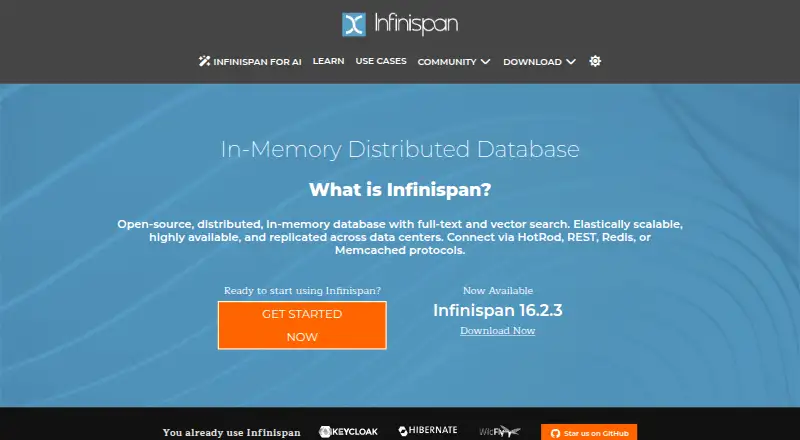
What Infinispan is
Infinispan is an open-source distributed in-memory database that combines caching with full-text and vector search. Its search features include distributed vector indexes, kNN similarity queries, semantic search, retrieval-augmented generation, and semantic caching. Applications can connect through Hot Rod, REST, Redis, or Memcached protocols; listed client libraries include Java, Go, JavaScript, C++, .NET, and Python. Infinispan can run as an embedded library, standalone server, or container image. Deployment options include a Kubernetes Operator and container images on OpenShift, AWS EC2, Azure, and GCP. Listed cache stores include filesystem, JDBC, SQL, RocksDB, and remote Infinispan clusters. Security features include role- and permission-based access control, security realms, and encryption for inter-cluster traffic and remote endpoints. It also supports distributed transactions with optimistic or pessimistic locking, configurable isolation levels, and XA recovery. Native integrations listed include Spring AI, LangChain4j, LangChain, and Quarkus LangChain4j. Infinispan is free under the Apache 2.0 license. Its support policy distinguishes support levels and covers only the latest minor release of a major version.
Good
- Free under the Apache 2.0 license.
- Offers Hot Rod, REST, Redis, and Memcached connections.
- Can run embedded, as a server, or as a container.
- Supports distributed transactions and configurable isolation levels.
Watch out
- Only the latest minor release of a major version is supported.
- Support levels vary by release and client.
Who it suits
Infinispan suits developers building applications that need distributed caching alongside full-text or vector search. It is also relevant to teams that want an open-source, self-hosted deployment.
Verdict
Infinispan provides multiple deployment choices, client protocols, persistence options, and search capabilities under an open-source license. Review its release support policy when choosing a version.
Plans and prices
From Infinispan's own pricing page, checked 2 Oct 2026.
| Plan | Price | What it gives you |
|---|---|---|
| Community Edition | Free | Apache 2.0 open-source license · embedded library or standalone server · deployment and support limits not stated |
The facts
Each one read from Infinispan's own pages, with the date it was checked.
What it does
- Client libraries
- The Hot Rod client page lists Java, Go, JavaScript, C++, .NET, and Python clients.checked 2 Oct 2026
- Cloud support
- The site lists a Kubernetes Operator and container image deployment on OpenShift, AWS EC2, Azure, and GCP.checked 2 Oct 2026
- Deployment
- Infinispan can run as an embedded library, standalone server, or container image.checked 2 Oct 2026
- Integrations
- The features page lists native integrations with Spring AI, LangChain4j, LangChain, and Quarkus LangChain4j.checked 2 Oct 2026
- License
- Infinispan is released under the Apache 2.0 open-source license.checked 2 Oct 2026
- Persistence
- Listed cache stores include filesystem, JDBC, SQL, RocksDB, and remote Infinispan cluster stores.checked 2 Oct 2026
- Product
- Infinispan is an open-source distributed in-memory database with full-text and vector search.checked 2 Oct 2026
- Protocols
- Clients can connect through Hot Rod, REST, Redis, or Memcached protocols.checked 2 Oct 2026
- Search and AI
- Features include distributed vector indexes, kNN similarity queries, semantic search, RAG, and semantic caching.checked 2 Oct 2026
- Security
- The feature page lists role and permission based access control, security realms, and encryption for inter-cluster traffic and remote endpoints.checked 2 Oct 2026
- Support channels
- For usage questions, the site recommends GitHub Discussions and Stack Overflow; development chat is on Zulip.checked 2 Oct 2026
- Support policy
- The releases page says only the latest minor release of a major version is supported and distinguishes full, limited, and limited client support.checked 2 Oct 2026
- Transactions
- Infinispan supports distributed transactions with optimistic or pessimistic locking, configurable isolation levels, and XA recovery.checked 2 Oct 2026
The full review of Infinispan
Overview
Infinispan is an open-source distributed in-memory database that combines caching with full-text and vector search. It suits teams building self-hosted or embedded applications that need clustering, multiple client protocols, and search-oriented workloads. Its flexibility is a strength, but choosing a release requires attention to the project’s support policy.
Key features
Infinispan can run as an embedded library, a standalone server, or a container image. That range lets developers keep it close to an application or operate it as a separate service; it also means teams must choose and manage a deployment model that fits their infrastructure. Kubernetes Operator support and container deployment on OpenShift, AWS EC2, Azure, and GCP broaden its hosting options.
Clients can connect over Hot Rod, REST, Redis, or Memcached protocols. The Hot Rod client page names libraries for Java, Go, JavaScript, C++, .NET, and Python, giving polyglot teams several ways to work with the system. Infinispan also supports clustering, multi-region operation, and time-to-live settings, useful for distributed data that needs expiry and broader placement.
Search features go beyond conventional cache lookup: distributed vector indexes support kNN similarity queries, semantic search, retrieval-augmented generation (RAG), and semantic caching. Native integrations with Spring AI, LangChain4j, LangChain, and Quarkus LangChain4j connect those capabilities to common AI development frameworks. This makes Infinispan relevant to applications combining fast access with semantic retrieval, though it is not simply a drop-in cache if those functions are not needed.
For persistence, cache stores include filesystem, JDBC, SQL, RocksDB, and remote Infinispan clusters. Security controls include role- and permission-based access, security realms, and encryption for inter-cluster traffic and remote endpoints. Distributed transactions support optimistic or pessimistic locking, configurable isolation, and XA recovery. These options serve systems with durability, access-control, or transaction requirements, but the breadth of configuration brings operational choices that simpler cache needs may not warrant.
Infinispan is licensed under Apache 2.0. Its support policy covers only the latest minor release of a major version and distinguishes full, limited, and limited client support. Teams should check that policy when selecting a version and plan upgrades accordingly. For usage questions, the project recommends GitHub Discussions and Stack Overflow; development chat is on Zulip.
Pricing
| Plan | Price | What it includes |
|---|---|---|
| Community Edition | free | Apache 2.0 open-source license; embedded library or standalone server |
The free Community Edition is the only stated plan and is a natural fit for developers and organizations able to run and support their own deployment.
Platforms
Infinispan is listed for API use, Linux, and self-hosted deployment. Container images can be deployed on OpenShift, AWS EC2, Azure, and GCP, with a Kubernetes Operator also available. It can be used as an embedded library or run as a standalone server.
Who it's for
Choose Infinispan if you need a distributed in-memory database that can span embedded and server deployments, connect through established cache protocols, and support persistence, transactions, or vector search. It is less compelling for a team seeking a managed service with a stated service tier, or for a basic cache that does not need these deployment and data features.
Pros and cons
- Pro: Multiple deployment forms and client protocols accommodate varied application architectures without tying clients to a single connection method.
- Pro: Distributed vector search, semantic features, and named AI integrations make it useful for retrieval-oriented applications as well as caching.
- Pro: Persistence stores, security controls, and distributed transaction options support workloads with durability and consistency needs.
- Con: The latest-minor-only support policy makes release selection and upgrade planning important, particularly for teams that cannot keep pace with updates.
- Con: The free plan gives no stated deployment or support limits, leaving production teams to establish their own operational support expectations.
Alternatives
For other category choices, browse In-Memory Databases, Caching Software, and Key-Value Databases.
- Aerospike Database is worth comparing if its Community Edition’s stated 8-node, 2.5 TB, and 2-namespace limits suit your needs; its Enterprise Edition is listed for up to 256 nodes.
- VoltDB is an alternative with a free Developer Edition for individual developers and early exploration, including local or cloud use, sample apps, tutorials, and documentation.
- Apache Geode is another free option, distributed as binaries and source under the Apache License.
- RonDB offers a free serverless option via Hopsworks, with quotas on Feature Groups (tables) and memory usage.
- eXtremeDB is a paid alternative with commercial licensing options discussed with McObject.
- Couchbase Server has a free Community Edition capped at five nodes, alongside an Enterprise Edition on a traditional subscription with no public price.
- SingleStore Helios offers a free Shared workspace for evaluation, development, and non-production testing with self-support.
- Tarantool DB is another paid, self-hosted option.
Verdict
Infinispan is a strong fit for teams that want an open-source, self-hosted distributed data layer with both cache protocols and modern search capabilities. Its broad deployment and integration choices are the main reason to choose it; teams that need a clearly defined support commitment or a service that does not require their own deployment should look elsewhere.
Alternatives to Infinispan
- 1

Amazon ElastiCache
Free planWebAPILinuxmacOS7.9From $0.09 a month - 2

Apache Traffic Server
Free planOpen sourceAPILinuxmacOSSelf-hosted7.2Free plan - 3
Ehcache
Free planOpen sourceAPISelf-hosted6.9Free plan - 4

Aiven for Valkey
Free planWebAPILinux6.8From $15 a month - 5
Google Cloud Memorystore
WebAPI6.4From $0.05 a month - 6
cache2k
Free planAndroidAPILinuxSelf-hosted6.2Free plan