
Amazon ElastiCache
Amazon ElastiCache is a managed caching service compatible with Valkey, Memcached, and Redis OSS.
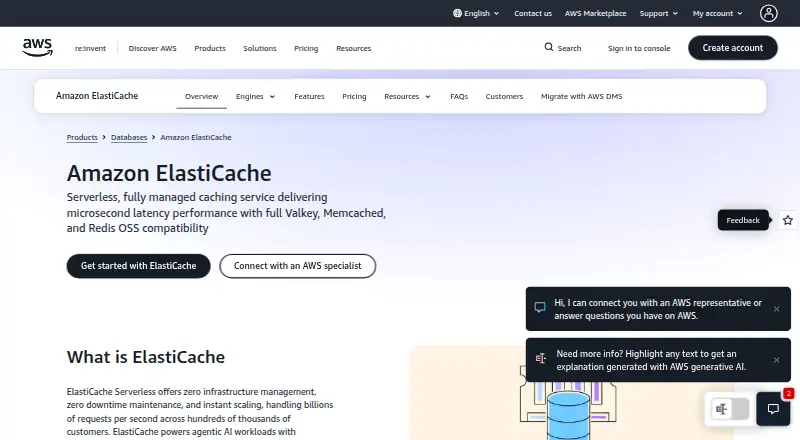
What Amazon ElastiCache is
Amazon ElastiCache is a managed caching service compatible with Valkey, Memcached, and Redis OSS. AWS describes its performance as microsecond latency. Customers can run a serverless cache or a node-based cluster. ElastiCache Serverless monitors compute, memory, and network use, then scales vertically and horizontally as demand changes. It replicates data across multiple Availability Zones and offers a 99.99% availability SLA for each cache. Listed uses include application data caching, semantic caching, data stores, session stores, and leaderboards. It can serve as a front-end cache for Amazon RDS, Aurora, DocumentDB, and DynamoDB, and can improve performance with EC2 and EMR. Security options include encryption in transit and at rest, IAM authentication, Valkey or Redis OSS AUTH, and role-based access control. CloudWatch provides more than 40 operational metrics at no additional charge. Data tiering is not available with ElastiCache Serverless.
Good
- Compatible with Valkey, Memcached, and Redis OSS.
- Serverless option scales vertically and horizontally with demand.
- Replicates serverless cache data across multiple Availability Zones.
- CloudWatch provides more than 40 operational metrics at no additional charge.
- Valkey serverless pricing starts at $6/mo.
Watch out
- Data tiering is unavailable with ElastiCache Serverless.
- On-demand node pricing depends on node type and node count.
- Redis OSS Extended Support can add an 80% or 160% premium.
Who it suits
ElastiCache may suit teams that want a managed cache for application data, sessions, leaderboards, or supported database integrations. It offers both serverless and node-based deployment options.
Verdict
ElastiCache offers managed caching in serverless and node-based forms, with several database integrations and security controls. Note that serverless does not support data tiering, and node costs depend on the chosen type and count.
Plans and prices
From Amazon ElastiCache's own pricing page, checked 15 Oct 2026.
| Plan | Price | What it gives you |
|---|---|---|
| AWS Free Tier | Free | $100 credits · up to an additional $100 for foundational services · credits unavailable in GovCloud and China Beijing · credits for new sign-ups after July 15, 2025 |
| Backup storage | $0.09 a month | all AWS Regions · no transfer fee for backup or restore · per GiB per month |
| ElastiCache Serverless | $6 a month | Valkey starting price · no infrastructure provisioning · pay for stored data and compute used |
| Database Savings Plans | — | 1-year term · eligible ElastiCache usage · commitment to a specific usage amount measured in USD per hour |
| On-demand nodes | — | memory capacity by hour · no long-term commitment · hourly from launch until termination; partial node-hours billed as full hours |
The facts
Each one read from Amazon ElastiCache's own pages, with the date it was checked.
What it does
- API and SDK access
- AWS documents complete ElastiCache API operations with sample requests, responses, and errors, and supports access through the console, CLI, and SDKs.checked 15 Oct 2026
- Compliance
- AWS lists ElastiCache as supporting SOC 1, SOC 2, SOC 3, ISO, MTCS, C5, PCI, HIPAA, and FedRAMP programs.checked 15 Oct 2026
- Database integrations
- The Aurora and Amazon RDS consoles can create and attach an ElastiCache cluster to accelerate relational-database reads.checked 15 Oct 2026
- Deployment
- Customers can run ElastiCache as a serverless cache or as a node-based cluster.checked 30 Sep 2026
- Documentation update
- AWS documentation added public endpoints for Valkey Serverless on September 29, 2026, allowing internet access without a VPC.checked 15 Oct 2026
- Durability
- Valkey 9.0+ clusters can use a Multi-AZ transactional log with synchronous zero-data-loss writes or asynchronous microsecond-latency writes.checked 15 Oct 2026
- Extended support
- For provisioned Redis OSS instances, Extended Support costs an 80% premium in Years 1 and 2 and a 160% premium in Year 3, with pricing depending on Region and calendar date.checked 30 Sep 2026
- Extended support news
- AWS announced that Redis OSS versions 4 and 5 would leave standard support on January 31, 2026 and then receive paid extended security and defect fixes.checked 15 Oct 2026
- Global Datastore
- Global Datastore replicates ElastiCache data across AWS Regions for cross-Region disaster recovery.checked 15 Oct 2026
- High availability
- Serverless and Multi-AZ configurations have a 99.99% monthly uptime SLA, while single-AZ configurations have a 99.5% SLA.checked 15 Oct 2026
- Limit: missing advanced features
- TrustRadius reviewers report that some advanced Memcached configurations cannot be replicated and may require running self-managed nodes.checked 15 Oct 2026
- Management integrations
- Users can create a serverless cache through the AWS Management Console, AWS SDK, or AWS CLI.checked 30 Sep 2026
- Memcached cluster size
- Memcached clusters can contain 1 to 60 nodes and provide a configuration endpoint with automatic node discovery.checked 15 Oct 2026
- Microsecond performance
- AWS says ElastiCache can deliver microsecond latency and scale to millions of operations per second for read-heavy workloads.checked 15 Oct 2026
- Monitoring
- Amazon CloudWatch metrics provide more than 40 operational metrics for ElastiCache resources at no additional charge.checked 30 Sep 2026
- Monitoring integration
- CloudWatch exposes more than 40 ElastiCache operational metrics, including memory use, cache hit ratio, connections, replication, and commands.checked 15 Oct 2026
- Network protection
- ElastiCache resources can run in Amazon VPC, and AWS PrivateLink provides private access to ElastiCache API operations.checked 30 Sep 2026
- Node availability
- Supported node types vary by AWS Region and include current-generation, burstable, and previous-generation families.checked 15 Oct 2026
- Notable limit
- Data tiering is not available with ElastiCache Serverless.checked 30 Sep 2026
The company
- Company profile
- LinkedIn lists Amazon Web Services as a public IT services company headquartered in Seattle, with more than 10,001 employees and a 2006 founding year.checked 15 Oct 2026
- Founded
- 2006checked 23 Sep 2026
- Maker founding
- AWS says Amazon Web Services launched in spring 2006.checked 30 Sep 2026
Money
- Limit: scaling and cost
- G2 reviews mention that large Redis scaling can require careful rebalancing and that the service can be expensive for smaller organizations.checked 15 Oct 2026
- Limit: support and billing complaints
- Trustpilot reviews prominently complain about account registration failures, slow or absent support responses, unexpected charges, and difficult billing resolution.checked 15 Oct 2026
The full review of Amazon ElastiCache
Overview
Amazon ElastiCache is a managed caching service built for workloads that need fast access to data. It is compatible with Valkey, Memcached, and Redis OSS, and is designed to deliver microsecond latency. Teams can deploy it as a serverless cache or as a node-based cluster, depending on how they want to manage capacity.
ElastiCache can sit in front of Amazon RDS, Aurora, DocumentDB, or DynamoDB as a caching layer, and can improve performance with EC2 and EMR. AWS identifies application data caching, semantic caching, data stores, session stores, and leaderboards as possible uses.
For more options, browse Caching Software and In-Memory Databases.
Key features
Two deployment models
ElastiCache supports serverless caches as well as node-based clusters. Serverless monitors compute, memory, and network use, then scales vertically and horizontally as demand changes. AWS says serverless caches replicate data across multiple Availability Zones and carry a 99.99% availability SLA for each cache.
Management and monitoring
A serverless cache can be created through the AWS Management Console, AWS SDK, or AWS CLI. Amazon CloudWatch provides more than 40 operational metrics for ElastiCache resources at no additional charge.
Security and network controls
Security options include encryption in transit and at rest, IAM authentication, Valkey or Redis OSS AUTH, and role-based access control. Resources can run in Amazon VPC, while AWS PrivateLink provides private access to ElastiCache API operations. AWS lists SOC 1, SOC 2, SOC 3, ISO, MTCS, C5, PCI, HIPAA, and FedRAMP among the compliance programs covering ElastiCache.
Storage and availability considerations
ElastiCache supports persistent storage and automatic backups. One important deployment limitation is that data tiering is not available with ElastiCache Serverless.
Pricing
ElastiCache is a paid service with a listed starting price of $6/mo. The AWS Free Tier plan is listed as free. New AWS Free Tier signups can choose a Free Plan with $100 in credits and may receive up to an additional $100 for activating foundational AWS services. Credits apply across participating AWS services, excluding the AWS GovCloud (US) and China (Beijing) Regions.
ElastiCache Serverless is listed at $6 a month, billed for data stored in GB-hours and requests measured in ECPUs. Valkey pricing starts at $6/month, with no minimum fee or upfront commitment. Minimum metered storage is 100 MB for Valkey and 1 GB for Memcached and Redis OSS.
On-demand nodes are billed hourly from launch until termination, and each partial node-hour is billed as a full hour. There is no long-term commitment, but the price depends on node type and node count. Database Savings Plans require a commitment to a specified usage amount measured in $/hour over a 1-year term; eligible usage details are provided on AWS's Database Savings Plans pricing page.
For provisioned Redis OSS instances, Extended Support adds an 80% premium in Years 1 and 2 and a 160% premium in Year 3. The price depends on Region and calendar date.
Platforms
ElastiCache is listed for API, Linux, macOS, web, and Windows. It also integrates with the AWS Management Console, SDK, and CLI for creating serverless caches.
Who it's for
ElastiCache is suited to teams building or operating applications on AWS that need a managed cache alongside databases or compute services such as RDS, Aurora, DocumentDB, DynamoDB, EC2, or EMR. Its supported use cases also make it relevant for session storage, leaderboards, semantic caching, and other data-store workloads. The choice between serverless and node-based deployment gives teams two different ways to provision the cache.
Pros and cons
- Pros: Supports Valkey, Memcached, and Redis OSS; offers serverless and node-based deployment; serverless scaling responds to compute, memory, and network demand.
- Pros: Serverless caches replicate across multiple Availability Zones and have a 99.99% availability SLA; CloudWatch includes more than 40 operational metrics at no additional charge.
- Pros: Offers encryption, authentication and access-control options, private networking, persistent storage, and automatic backups.
- Cons: Serverless data tiering is unavailable.
- Cons: Node pricing varies by node type and count, and provisioned Redis OSS Extended Support adds substantial percentage premiums in later support years.
Alternatives
For other caching and data-platform options, consider KeyDB, Redis Insight, VoltDB, Aerospike Database, VMware Workstation Pro, Apache Geode, SingleStore Helios, and RonDB.
Verdict
Amazon ElastiCache combines support for three cache engines with serverless and node-based deployment, AWS database integrations, monitoring, and security controls. The listed serverless starting price is $6/month for Valkey, while node and savings-plan costs depend on usage or commitment. Its broad deployment and integration choices suit AWS-centered applications, but teams considering serverless should account for the lack of data tiering, and provisioned Redis OSS users should factor Extended Support premiums into longer-term costs.
Getting started
- Open the Amazon ElastiCache website.
- Create an AWS account to access the service.
- Choose a serverless cache or node-based cluster.
- Create a serverless cache through the AWS Management Console, AWS SDK, or AWS CLI.
- Choose a billing approach, such as Serverless, on-demand nodes, or Database Savings Plans.
Limits worth knowing
Valkey Serverless starts at $6 a month and has minimum metered storage of 100 MB; Memcached and Redis OSS have a 1 GB minimum. Data tiering is not available with ElastiCache Serverless. On-demand nodes bill each partial node-hour as a full hour.
Questions
How much does Amazon ElastiCache cost?
It charges for data stored in GB-hours and requests measured in ECPUs; node pricing depends on node type and number of nodes.
Does ElastiCache have a free plan or trial?
An AWS Free Tier plan is available to new signups, with $100 in credits and up to an additional $100 for activating foundational AWS services. There is no free trial listed for ElastiCache.
Which platforms are listed?
The listed platforms are API, Linux, macOS, web, and Windows.
Which caching engines does it support?
ElastiCache is compatible with Valkey, Memcached, and Redis OSS.
How can I create a serverless cache?
A serverless cache can be created through the AWS Management Console, AWS SDK, or AWS CLI.
Does ElastiCache Serverless support data tiering?
No. Data tiering is not available with ElastiCache Serverless.
Alternatives to Amazon ElastiCache
- 1

Apache Traffic Server
Free planOpen sourceAPILinuxmacOSSelf-hosted7.2Free plan - 2
Ehcache
Free planOpen sourceAPISelf-hosted6.9Free plan - 3

Aiven for Valkey
Free planWebAPILinux6.8From $15 a month - 4
Google Cloud Memorystore
WebAPI6.4From $0.05 a month - 5
cache2k
Free planAndroidAPILinuxSelf-hosted6.2Free plan - 6
Garnet
Free planLinuxmacOSSelf-hostedWindows6.2Free plan