KeyDB
KeyDB is a free, open-source, in-memory database that can also be used as a cache and message broker.
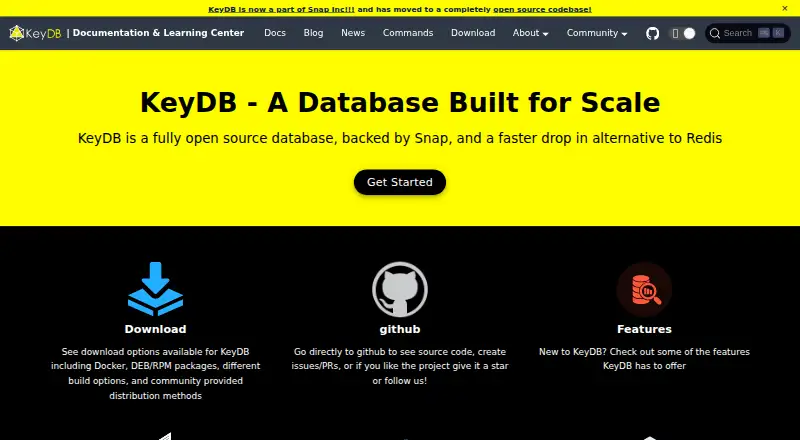
What KeyDB is
KeyDB is a free, open-source, in-memory database that can also be used as a cache and message broker. It is compatible with the Redis API and protocol, so Redis client libraries work with it. Supported data types include strings, hashes, lists, sets, sorted sets, bitmaps, HyperLogLogs, geospatial indexes, and streams. KeyDB can scale through active replication or cluster mode with a sharded dataset, and it supports high availability and automatic failover options. Its MVCC architecture allows snapshot queries, including SCAN and KEYS, to run alongside workloads without blocking them. Asynchronous multi-master replication can span regions and uses last-write-wins handling. Persistence options include RDB snapshots and AOF command logging, with configurable durability. The maker says a single node can handle over 1 million operations per second with submillisecond latency. Linux and macOS are developed and tested, with Linux recommended for deployment. Support is community-based, and paid support is unavailable. Security features include TLS, authentication, and ACLs; the maker recommends restricting network access to trusted clients.
Good
- Compatible with the Redis API, protocol, and client libraries.
- Supports active replication and cluster mode.
- Offers RDB snapshots and AOF command logging.
- TLS, authentication, and ACLs are supported.
Watch out
- No paid support is available.
- Linux is recommended for deployment.
- Maker warns against direct internet exposure.
Who it suits
KeyDB suits developers and operators looking for an in-memory database, cache, or message broker compatible with Redis clients. It is described for uses ranging from small projects to workloads serving millions of users.
Verdict
KeyDB combines Redis compatibility with replication, clustering, and configurable persistence. Its community-based support and security guidance are important considerations for deployment.
The facts
Each one read from KeyDB's own pages, with the date it was checked.
What it does
- Additional deployment options
- Community contributed options include Homebrew, a Kubernetes Helm chart, and an Arch Linux package.checked 3 Oct 2026
- Architecture
- Its MVCC architecture allows snapshot queries, including SCAN and KEYS, to run concurrently without blocking existing workloads.checked 2 Oct 2026
- Compatibility
- KeyDB is compatible with the Redis API and protocol, and Redis client libraries work with it.checked 2 Oct 2026
- Data structures
- KeyDB supports strings, hashes, lists, sets, sorted sets, bitmaps, hyperloglogs, geospatial indexes, and streams.checked 3 Oct 2026
- Deployment
- Officially managed download options include Docker images, Ubuntu and Debian packages, CentOS RPM packages, and source builds.checked 3 Oct 2026
- History
- The project began in 2019 as a multithreaded Redis fork and found a permanent home at Snap at the end of 2021.checked 2 Oct 2026
- Integrations
- Because KeyDB is Redis-compatible, the maker says Redis client libraries can also be used with KeyDB.checked 3 Oct 2026
- Intended users
- The maker describes KeyDB as useful from small projects to workloads serving millions of users.checked 2 Oct 2026
- Multi-master
- KeyDB supports asynchronous multi-master replication across regions using a last-write-wins method.checked 3 Oct 2026
- MVCC
- Its MVCC architecture lets concurrent queries use database snapshots without blocking calls such as SCAN and KEYS.checked 3 Oct 2026
- Operating systems
- The documentation says Linux and macOS are developed and tested, recommends Linux for deployment, and notes there is no official Windows build support.checked 3 Oct 2026
- Performance
- The maker says a single KeyDB node benchmarks at over 1 million operations per second and that its multithreaded design outperforms Redis per node.checked 3 Oct 2026
- Persistence
- KeyDB supports configurable RDB snapshots and AOF disk logging for persistence.checked 3 Oct 2026
- Product
- KeyDB is a high-performance, open-source database and a drop-in alternative to Redis.checked 2 Oct 2026
- Purpose
- KeyDB is an open source, in-memory database used as a database, cache, and message broker.checked 3 Oct 2026
- Redis compatibility
- KeyDB is compatible with the Redis API and protocol, and Redis clients work with KeyDB.checked 3 Oct 2026
- Replication
- KeyDB supports asynchronous multi-master replication across regions using a last-write-wins method.checked 2 Oct 2026
- Scaling
- KeyDB supports horizontal scaling through active replication or cluster mode with a sharded dataset.checked 2 Oct 2026
- Scaling and availability
- KeyDB supports horizontal scaling through active replication or cluster mode, with high availability and automatic failover options.checked 3 Oct 2026
- Security
- KeyDB offers TLS support for client connections, replication links, and the cluster bus, and its security guidance recommends restricting access to trusted clients.checked 3 Oct 2026
- Security configuration
- The security guide warns that authentication is optional and its password is stored in clear text in the configuration file; it recommends network protections and TLS.checked 3 Oct 2026
- Security guidance
- The maker recommends restricting network access to trusted clients and warns against exposing KeyDB directly to the internet.checked 2 Oct 2026
- Support
- Support is community-based and managed by the KeyDB team at Snap; the maker says paid support services are unavailable.checked 3 Oct 2026
The company
- Founded
- 2019checked 28 Sep 2026
Alternatives to KeyDB
- 1
SingleStore Helios
Free planWebAPILinuxmacOS8.1Free plan - 2

Amazon ElastiCache
Free planWebAPILinuxmacOS7.9From $0.09 a month - 3

Aerospike Database
Free planOpen sourceWebAPILinuxmacOS7.8Free plan - 4
VoltDB
Free planOpen sourceWebAPILinuxmacOS7.6Free plan - 5

Apache Ignite
Free planOpen sourceAPILinuxmacOSSelf-hosted7.4Free plan - 6

Apache Geode
Free planOpen sourceAPILinuxmacOSSelf-hosted7.2Free plan