Garnet
Garnet is a free remote cache-store from Microsoft Research for self-hosted use.
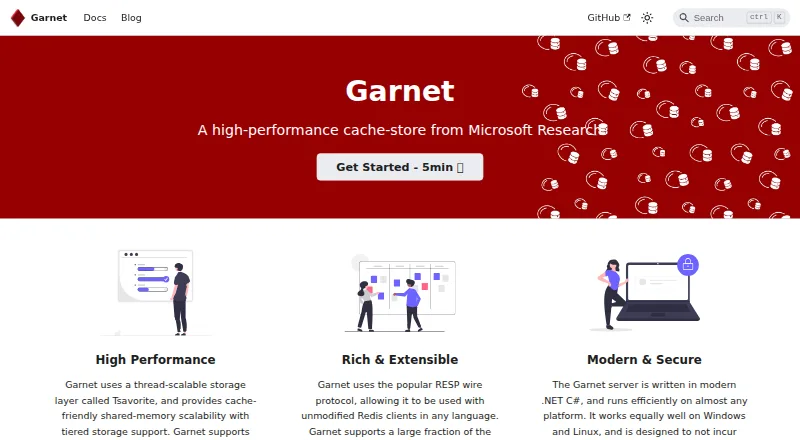
What Garnet is
Garnet is a free remote cache-store from Microsoft Research for self-hosted use. It uses the RESP protocol and works with many unmodified Redis clients, including StackExchange.Redis. Its APIs cover strings, lists, hashes, sets, sorted sets, geo operations, HyperLogLog, bitmaps, ACLs, pub/sub, transactions, and Lua scripting. It can handle datasets larger than memory using local or cloud storage, with checkpointing and recovery. Multi-node cluster mode supports sharding, state migration, and replication. Developers can add C# data structures and read-modify-write operations through a custom operator framework. Garnet supports TLS/SSL connections and RESP password-based authentication. Vector database support using DiskANN and range index support using Bf-Tree are marked as preview features. The project is MIT-licensed, but is not intended as a fully compatible Redis drop-in replacement and does not support Redis modules. Self-hosted users manage infrastructure, updates, and operations. Azure Cosmos DB Garnet Cache, a managed service, is in expanded Private Preview; no price is listed.
Good
- MIT-licensed and free for self-hosting.
- Works with many unmodified Redis clients.
- Supports checkpointing and recovery for larger-than-memory datasets.
- Cluster mode supports sharding and replication.
- TLS/SSL and password-based authentication are supported.
Watch out
- Not a fully compatible Redis drop-in replacement.
- Redis modules are not supported.
- Self-hosted users manage infrastructure and updates.
- DiskANN and Bf-Tree support are preview features.
Who it suits
Garnet may suit developers seeking a self-hosted cache-store with RESP support, storage beyond memory, or multi-node clustering. Teams that need full Redis drop-in compatibility or Redis modules should note its stated limitations.
Verdict
Garnet offers broad data APIs and cluster capabilities, but it does not aim for full Redis compatibility. Consider its self-hosting responsibilities and preview-feature status alongside the managed service's expanded Private Preview.
Plans and prices
From Garnet's own pricing page, checked 29 Sep 2026.
| Plan | Price | What it gives you |
|---|---|---|
| Garnet | Free | Self-hosted; you manage infrastructure, updates, and operations |
| Azure Cosmos DB Garnet Cache | Priced on request | Expanded Private Preview; per-node SKU pricing · Billed per instance per hour; no licensing fees. Disk is billed separately when persistence is enabled. |
The facts
Each one read from Garnet's own pages, with the date it was checked.
What it does
- Cluster features
- Multi-node cluster mode supports sharding, state migration, and replication.checked 29 Sep 2026
- Compatibility limit
- Garnet is not intended to be a fully compatible Redis drop-in replacement, and it does not support Redis modules.checked 29 Sep 2026
- Data APIs
- Its API includes strings, lists, hashes, sets, sorted sets, geo operations, HyperLogLog, bitmaps, ACLs, pub/sub, transactions, and Lua scripting.checked 29 Sep 2026
- Extensibility
- A custom operator framework lets developers register C# data structures and read-modify-write operations.checked 29 Sep 2026
- Integrations
- The documented Redis client libraries include StackExchange.Redis, Jedis, Redisson, redis-py, node_redis, and go-redis.checked 29 Sep 2026
- License
- The Garnet project is licensed under the MIT License.checked 29 Sep 2026
- Managed service
- Azure Cosmos DB Garnet Cache handles infrastructure provisioning, scaling, patching, and monitoring automatically; it is in expanded Private Preview.checked 29 Sep 2026
- Preview features
- Vector database support using DiskANN and range index support using Bf-Tree are marked preview.checked 29 Sep 2026
- Protocol and clients
- Garnet uses the RESP protocol and works with many unmodified Redis clients, including StackExchange.Redis.checked 29 Sep 2026
- Purpose
- Garnet is a remote cache-store from Microsoft Research designed for high performance, extensibility, and low latency.checked 29 Sep 2026
- Security
- Garnet supports TLS/SSL connections and RESP password-based authentication.checked 29 Sep 2026
- Storage and recovery
- Garnet supports datasets larger than memory using local or cloud storage, along with checkpointing and recovery.checked 29 Sep 2026
- Support and community
- The project site links to Discord and GitHub for community and project information.checked 29 Sep 2026
The company
- Founded
- 2024checked 28 Sep 2026
Where it runs
- Platforms
- The server is extensively tested on Windows and Linux, and is also described as running on Azure hardware and edge devices.checked 29 Sep 2026
The full review of Garnet
Garnet is a free, MIT-licensed remote cache-store from Microsoft Research for developers building low-latency applications and willing to operate their own infrastructure. It is strongest for teams that want broad data APIs, persistence, clustering, and familiar Redis clients without requiring exact Redis parity.
Overview
Garnet speaks RESP and works with many unmodified Redis clients, including StackExchange.Redis. That can make it practical to use with existing client libraries, but it is not a fully compatible Redis replacement and does not support Redis modules. Teams whose applications depend on module support or precise Redis behavior should look elsewhere.
The self-hosted software gives teams control over deployment, but they remain responsible for infrastructure, updates, and operations. Azure Cosmos DB Garnet Cache offers a managed alternative that takes on provisioning, scaling, patching, and monitoring; it is in expanded Private Preview.
Key features
Broad data APIs and clients
Garnet supports strings, lists, hashes, sets, sorted sets, geo operations, HyperLogLog, bitmaps, ACLs, pub/sub, transactions, and Lua scripting. Its documented client libraries include StackExchange.Redis, Jedis, Redisson, redis-py, node_redis, and go-redis. This range suits applications that need varied key-value data structures and client choices, though the compatibility caveat still matters for workloads built around Redis-specific behavior.
Storage and cluster operations
Datasets can exceed memory by using local or cloud storage, with checkpointing and recovery for persistence. Multi-node cluster mode adds sharding, state migration, and replication. These capabilities give teams options for larger datasets and distributed deployments, but they do not remove the operational work of running the self-hosted plan.
Extensibility, security, and preview features
A custom operator framework lets developers register C# data structures and read-modify-write operations, making Garnet more adaptable to application-specific needs. TLS/SSL connections and RESP password authentication provide connection security options. Vector database support using DiskANN and range indexing with Bf-Tree are marked preview, so they are a poor foundation for requirements that need settled production features.
Pricing
Garnet
The self-hosted Garnet plan costs nothing. There is no software license charge, but teams must provide and manage infrastructure, updates, and operations. It fits developers and organizations prepared to take on that work; readers seeking a managed cache should consider the Azure service instead.
Azure Cosmos DB Garnet Cache
This managed service has custom pricing: it is billed per instance per hour with no licensing fees, using per-node SKU pricing. Disk is billed separately when persistence is enabled. It handles infrastructure provisioning, scaling, patching, and monitoring, which may suit teams that want less operational overhead, but it remains in expanded Private Preview.
Platforms
Garnet is available for Linux, macOS, and Windows, with self-hosted deployment. Its documented client libraries span StackExchange.Redis, Jedis, Redisson, redis-py, node_redis, and go-redis, offering options across several development ecosystems.
Who it's for
Garnet is a fit for teams that need a low-latency remote cache, broad data structures, persistence or multi-node clustering, and the ability to run their own infrastructure. Developers with application-specific data needs may also value the C# operator framework. It is not a strong match for workloads that require Redis modules, full Redis compatibility, or production-ready vector and range-index features.
Pros and cons
Pros
- Free, MIT-licensed self-hosted software avoids a licensing fee while leaving teams control over deployment.
- Broad data APIs, Lua scripting, transactions, and support for familiar Redis client libraries cover a wide range of cache workloads.
- Storage beyond memory, checkpointing, recovery, and multi-node cluster features support larger and distributed deployments.
- The managed Azure service automates provisioning, scaling, patching, and monitoring for teams seeking less infrastructure work.
Cons
- Self-hosted users must manage infrastructure, updates, and operations themselves.
- Incomplete Redis compatibility and no Redis module support rule it out for some existing Redis workloads.
- Disk charges apply separately to the managed service when persistence is enabled, and its expanded Private Preview status may not fit every deployment need.
- Vector database and range index support are preview features, not settled choices for production-critical requirements.
Alternatives
Explore caching software for more options. Consider Amazon ElastiCache if you want a paid alternative with a free AWS tier. Aiven for Valkey is worth considering if you prefer a freemium service with a free plan and trial; its free plan provides one dedicated VM, one CPU, and 1 GB RAM, without integrations or connection pooling. Choose Memcached for free, open-source, self-hosted cache software. Ristretto is an open-source Go in-process cache, while Squid is free, self-hosted proxy software. Alibaba Cloud Tair offers a 30-day trial of its Redis OSS-compatible Open Source Edition for new users, with 1 GB RAM. Consider Ehcache for an open-source, Apache 2.0-licensed alternative. Accessibility Test Framework for Android is another free option.
Verdict
Choose Garnet if you want a free, extensible cache with broad data APIs, persistence, and clustering, and can own the self-hosting work. Its main reason to choose it is that capability range without a licensing fee; look elsewhere if your application needs complete Redis compatibility or depends on Redis modules.
Getting started
- Open the Garnet project website
- Choose Linux, macOS, or Windows for self-hosted deployment
- Deploy Garnet on infrastructure you manage
- Connect through RESP-compatible clients such as StackExchange.Redis
- Configure storage, checkpointing, clustering, and authentication as needed
Limits worth knowing
The free Garnet plan is self-hosted, so you manage infrastructure, updates, and operations. Redis modules are not supported, and DiskANN and Bf-Tree capabilities are preview features.
Questions
Is Garnet free?
Yes. The self-hosted Garnet plan costs nothing and is MIT licensed.
Which platforms can run Garnet?
Garnet supports Linux, macOS, Windows, and self-hosted deployment.
Can Redis clients connect to Garnet?
Yes. Garnet uses RESP and works with many unmodified Redis clients, including StackExchange.Redis.
Does Garnet support persistent data?
Yes. It can use local or cloud storage for datasets larger than memory and supports checkpointing and recovery.
Is a managed Garnet service available?
Azure Cosmos DB Garnet Cache is in expanded Private Preview, with per-instance hourly billing and separate disk billing when persistence is enabled.
Alternatives to Garnet
- 1

Amazon ElastiCache
Free planWebAPILinuxmacOS7.9From $0.09 a month - 2

Apache Traffic Server
Free planOpen sourceAPILinuxmacOSSelf-hosted7.2Free plan - 3
Ehcache
Free planOpen sourceAPISelf-hosted6.9Free plan - 4

Aiven for Valkey
Free planWebAPILinux6.8From $15 a month - 5
Google Cloud Memorystore
WebAPI6.4From $0.05 a month - 6
cache2k
Free planAndroidAPILinuxSelf-hosted6.2Free plan