
Amazon DynamoDB
Amazon DynamoDB is a cloud-based, fully managed NoSQL database for applications that need single-digit millisecond performance at any scale, according to AWS.
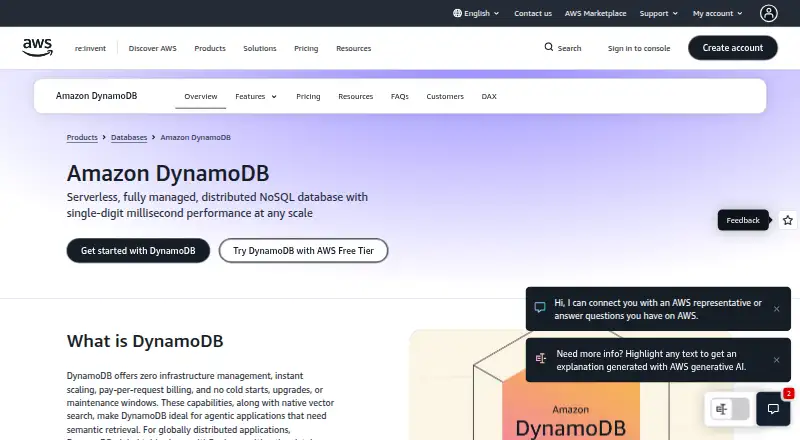
What Amazon DynamoDB is
Amazon DynamoDB is a cloud-based, fully managed NoSQL database for applications that need single-digit millisecond performance at any scale, according to AWS. It is serverless: users do not provision or patch database servers, and tables can scale automatically, including down to zero in on-demand mode. Data access uses primary keys, with global and local secondary indexes for queries through alternate keys. Global tables support active operation across multiple Regions; AWS says they are designed for up to 99.999% availability. DynamoDB also supports native vector search for similarity searches and agent memory use cases. Data is encrypted in transit and at rest by default, and IAM policies can control access down to individual items and attributes. Point-in-time recovery provides continuous backups with per-second granularity and restoration within a configured period of 1 to 35 days. A free tier lists 25 WCUs, 25 RCUs, and 25 GB of storage per Region and payer account. On-demand capacity is billed by requests consumed; provisioned capacity is billed for specified capacity even if usage is lower.
Good
- No server provisioning or patching is required.
- Tables can scale automatically, including to zero on-demand.
- Encryption in transit and at rest is on by default.
- Point-in-time recovery offers per-second backup granularity.
- Native vector search supports similarity-search use cases.
Watch out
- Provisioned capacity is billed even when usage is lower.
- Free tier uses provisioned capacity and the Standard table class.
- Maximum value size is 0.4 MB.
Who it suits
DynamoDB may suit teams building cloud applications that need a managed NoSQL database, automatic scaling, or multi-Region operation. Its listed workloads include mission-critical, internet-scale, agentic, modernization, and Internet of Things applications.
Verdict
DynamoDB brings managed NoSQL storage, automatic scaling, and recovery options together, with both request-based and capacity-based billing. Consider the 0.4 MB maximum value size and the distinction between on-demand and provisioned charges when assessing fit.
Plans and prices
From Amazon DynamoDB's own pricing page, checked 22 Sep 2026.
| Plan | Price | What it gives you |
|---|---|---|
| Free tier | Free | 25 WCUs · 25 RCUs · 25 GB storage · 25 replicated WCUs · Per Region, per-payer account basis |
| On-demand capacity | — | Automatic scaling · no capacity planning · Standard or Standard-IA table classes · monthly usage based |
| Provisioned capacity | — | Specify read and write capacity · auto scaling available · Standard or Standard-IA table classes · hourly provisioned capacity |
| DynamoDB Free Tier | Free | 25 WCUs · 25 RCUs · 25 rWCUs for global tables across two Regions · 25 GB storage · 2.5 million Streams read requests · 1 GB data transfer out · monthly per AWS Region and payer account |
The facts
Each one read from Amazon DynamoDB's own pages, with the date it was checked.
What it does
- ACID transactions
- DynamoDB provides native ACID transactions for coordinated all-or-nothing updates across items and tables in a Region.checked 15 Oct 2026
- API
- The public low-level API provides actions for table and index administration plus create, read, update, and delete operations.checked 15 Oct 2026
- Compliance
- AWS says DynamoDB security controls and compliance standards address requirements for governments, global banks, and other high-sensitivity organizations.checked 29 Sep 2026
- Data access
- DynamoDB supports primary keys and global and local secondary indexes for querying by alternate keys.checked 29 Sep 2026
- DAX caching
- DynamoDB Accelerator is a managed in-memory cache intended to improve table read performance at scale.checked 15 Oct 2026
- Encryption
- Customer data is encrypted in transit and at rest by default, with AWS KMS owned, managed, or customer-managed key choices.checked 15 Oct 2026
- Flexible schema
- DynamoDB tables can use flexible key-value and document schemas, allowing rows to contain different attributes without redefining a relational schema.checked 15 Oct 2026
- Global availability
- Global tables provide multi-Region, multi-active operation, and AWS says they are designed for up to 99.999% availability.checked 29 Sep 2026
- Global tables
- Global tables replicate data actively across selected AWS Regions and support local single-digit-millisecond reads and writes.checked 15 Oct 2026
- Integrations
- The feature page lists integrations with AWS services; it describes AWS KMS encryption, IAM access control, and VPC endpoints with AWS PrivateLink.checked 29 Sep 2026
- Intended workloads
- AWS describes use cases including mission-critical, internet-scale, agentic, modernization, and Internet of Things applications.checked 29 Sep 2026
- Item-size limit
- A DynamoDB item cannot exceed 400 KB including attribute names and values.checked 15 Oct 2026
- Kinesis integration
- Kinesis Data Streams for DynamoDB captures item-level changes for real-time analytics, dashboards, log aggregation, and IoT pipelines.checked 15 Oct 2026
- Lambda integration
- DynamoDB integrates with AWS Lambda triggers so functions can run when table items change.checked 15 Oct 2026
- License
- DynamoDB Local is proprietary AWS software licensed for internal use with an AWS account; redistribution, modification, sublicensing, and reverse engineering are prohibited.checked 15 Oct 2026
- Limit: ecosystem dependence
- TrustRadius reviewers report that integrations outside the AWS ecosystem can be difficult.checked 15 Oct 2026
- Limit: pricing complexity
- TrustRadius reviewers report that estimating costs is difficult and that on-demand pricing can be expensive or punishing.checked 15 Oct 2026
- Limit: relational workloads
- Reviewers say DynamoDB is a poor fit for heavily relational data because joins are limited and relational applications may suit another database better.checked 15 Oct 2026
- Limit: small records and schema validation
- Reviewers complain about comparatively small record limits and the lack of built-in schema validation.checked 15 Oct 2026
- Local development
- DynamoDB Local runs as a self-contained database for development and testing and is distributed as a download requiring a JRE, Maven dependency, or Docker image.checked 15 Oct 2026
The company
- Company profile
- Gartner lists Amazon Web Services as a public company founded in 2006, headquartered in Seattle, with more than 10,001 employees.checked 15 Oct 2026
- LinkedIn company facts
- AWS's LinkedIn page identifies Seattle as its headquarters, says it launched in 2006, and displays more than 146,000 employees.checked 15 Oct 2026
Money
- Free plan
- Yeschecked 22 Sep 2026
- Free tier limits
- The free tier uses provisioned capacity and the Standard table class, and its request volume is described as about 200 million requests per month depending on item size.checked 29 Sep 2026
The full review of Amazon DynamoDB
Overview
Amazon DynamoDB is a cloud-based NoSQL database from Amazon Web Services, part of Amazon. AWS launched in 2006. It is fully managed and distributed, with single-digit millisecond performance at any scale. Because AWS manages the database servers, customers do not need to provision or patch them.
DynamoDB stores data on disk and supports values up to 0.4 MB. Its interfaces include HTTP(S), JSON, and PartiQL, and it supports time-to-live (TTL) and multi-Region operation. The service is aimed at workloads including mission-critical and internet-scale applications, agentic systems, modernization projects, and Internet of Things applications.
It is available through a free tier and capacity-based options. The main billing distinction is that on-demand capacity is charged by requests consumed, while provisioned capacity is charged on the capacity specified even when the application uses less.
Key features
Managed scaling and data access
DynamoDB can scale tables automatically, including scaling to zero in on-demand mode. That mode avoids capacity planning and charges for consumed requests. With provisioned capacity, customers specify read and write capacity and can opt into auto scaling, but pay for the provisioned amount.
Primary keys provide the main access path, while global and local secondary indexes allow queries using alternate keys. DynamoDB also offers native vector search for similarity search and agent memory use cases.
Multi-Region operation and recovery
Global tables support multi-Region, multi-active operation. AWS says they are designed for up to 99.999% availability. Point-in-time recovery makes continuous backups at per-second granularity and supports restoration within a configured window of 1 to 35 days.
Security and integrations
Customer data is encrypted in transit and at rest by default. IAM policies can control access down to specific items and attributes. Listed AWS integrations include KMS encryption, IAM access control, and VPC endpoints through AWS PrivateLink. AWS says its security controls and compliance standards address requirements for governments, global banks, and other organizations handling highly sensitive information.
Pricing
DynamoDB uses a freemium model, with a free plan and free trial. The listed free options are:
- Free tier: free, billed Per Region, per-payer account basis; includes 25 WCUs, 25 RCUs, 25 GB storage, and 25 replicated WCUs.
- DynamoDB Free Tier: free, billed Each month, per Region, per payer account; includes 25 WCUs, 25 RCUs, 25 rWCUs for global tables across two AWS Regions, 25 GB storage, 2.5 million stream read requests, and 1 GB data transfer out.
The free tier uses provisioned capacity and the Standard table class. Its request volume is described as about 200 million requests per month, depending on item size.
- On-demand capacity: price not listed. Pay per read and write request, with automatic scaling and no capacity planning.
- Provisioned capacity: price not listed. Specify read and write capacity; charged for provisioned capacity, with optional auto scaling.
Platforms
DynamoDB is a cloud-deployed service. Listed platforms are Android, API, iOS, Linux, macOS, web, and Windows.
Who it's for
DynamoDB is suited to teams building distributed applications that need managed database infrastructure, automatic scaling, and multi-Region operation. Its documented workload areas include mission-critical and internet-scale services, agentic applications, modernization, and IoT. Vector search and agent memory support may also be relevant to developers building similarity-search use cases.
Pros and cons
Pros
- Server provisioning and patching are handled as part of the managed service.
- On-demand mode scales automatically, can scale to zero, and bills by consumed requests.
- Primary keys and secondary indexes provide multiple ways to query data.
- Multi-Region, multi-active tables, point-in-time recovery, and default encryption are documented capabilities.
Cons
- Provisioned capacity is billed as specified even when usage is lower.
- Prices for the listed on-demand and provisioned plans are not provided here.
- The free tier uses provisioned capacity and the Standard table class, so its limits should be considered when estimating fit.
- Values are limited to 0.4 MB each.
Alternatives
For other database options, compare DynamoDB with Riak KV, Aerospike Database, Upstash Redis, RocksDB, Oracle Database, and Cloudflare Workers KV. Readers can also browse Key-Value Databases, Multimodel Databases, and Database Software.
Verdict
DynamoDB combines managed NoSQL infrastructure with automatic scaling, alternate-key indexes, multi-Region tables, vector search, and continuous point-in-time recovery. Its capacity model deserves close attention: on-demand billing follows consumed requests, while provisioned billing follows allocated capacity even when not fully used. The free tier gives a concrete starting allowance, but the listed plan prices for paid capacity options are not specified here.
Getting started
- Visit the Amazon DynamoDB website.
- Choose a free tier or a capacity model.
- Use the cloud service through a listed platform such as web, API, or an operating system client.
- Select primary keys and, if needed, global or local secondary indexes for alternate-key queries.
- Configure access with IAM policies and enable point-in-time recovery if required.
Limits worth knowing
The free tier uses provisioned capacity and the Standard table class; its request volume is described as about 200 million requests per month depending on item size. The free tier plan lists 25 WCUs, 25 RCUs, 25 GB storage, and 25 replicated WCUs. Provisioned capacity is billed on the specified capacity even when consumption is lower.
Questions
Is Amazon DynamoDB free?
A free plan is available at no cost. The listed DynamoDB Free Tier includes 25 WCUs, 25 RCUs, 25 replicated WCUs for global tables across two AWS Regions, 25 GB storage, 2.5 million stream read requests, and 1 GB data transfer out.
What paid capacity options does DynamoDB offer?
On-demand capacity bills per read and write request and scales automatically without capacity planning. Provisioned capacity lets you specify read and write capacity and charges for that capacity, with optional auto scaling.
Which platforms and protocols are supported?
Listed platforms are Android, API, iOS, Linux, macOS, web, and Windows. Supported protocols are HTTP(S), JSON, and PartiQL.
Does DynamoDB support multiple Regions?
Yes. Global tables provide multi-Region, multi-active operation. AWS says they are designed for up to 99.999% availability.
What security and recovery features are included?
Customer data is encrypted in transit and at rest by default, and IAM policies can control access down to items and attributes. Point-in-time recovery provides continuous backups and restoration within a configured period of 1 to 35 days.
Who makes DynamoDB?
Amazon Web Services makes DynamoDB. AWS says it launched in 2006 and is part of Amazon.
Alternatives to Amazon DynamoDB
- 1

Aerospike Database
Free planOpen sourceWebAPILinuxmacOS7.8Free plan - 2

Apache Ignite
Free planOpen sourceAPILinuxmacOSSelf-hosted7.4Free plan - 3

Upstash Redis
Free planWebAPI7.3From $10 a month - 4
RocksDB
Free planiOSAPILinuxmacOS7.0Free plan - 5

Google Cloud Bigtable
Free planWebAPI6.8From $0.03 a month - 6

Redis Insight
Free planWebLinuxmacOSSelf-hosted6.7Free plan