Riak KV
Riak KV is a self-hosted distributed NoSQL key-value database for workloads that need data replicated locally or across clusters.
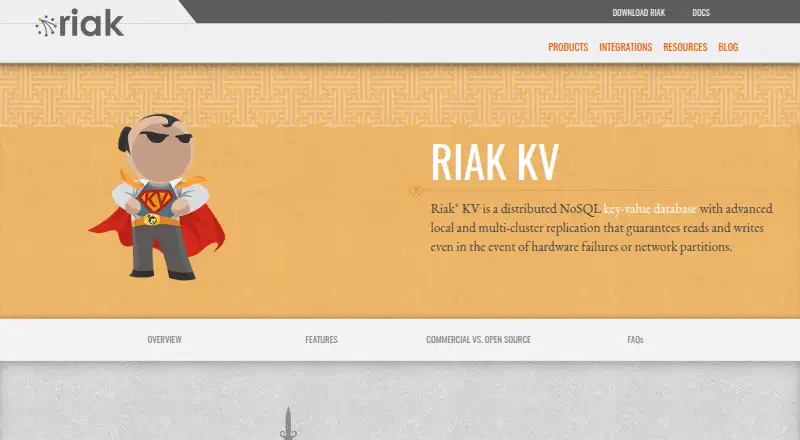
What Riak KV is
Riak KV is a self-hosted distributed NoSQL key-value database for workloads that need data replicated locally or across clusters. Its masterless architecture distributes data and is designed to keep reads and writes available through hardware failures or network partitions, while scaling near linearly on commodity hardware. For querying, it supports Solr full-text search, secondary indexes, and MapReduce. Global Object Expiration removes data according to configured expiry settings, and dotted version vectors track logical time to resolve object conflicts automatically. Client libraries or clients cover Java, Ruby, Python, C#, Erlang, Node.js, and .NET. Integrations include Apache Spark, Apache Mesos, and Redis caching, and supported protocols are HTTP and Protocol Buffers. Downloads or source builds cover Debian, FreeBSD, Mac OS X, RHEL/CentOS, SUSE Linux Enterprise Server, Solaris, and Ubuntu. The free Apache 2 plan includes the key-value data module, built-in masterless replication, and both APIs. Commercial configurations add options such as multi-cluster replication and engineering support with SLAs ranging from 24 hours to 30 minutes. Documentation describes authentication, authorization, and SSL configuration, but not fine-grained role-based security.
Good
- Masterless replication distributes data across clusters.
- Designed to keep reads and writes available through failures.
- Offers Solr search, secondary indexes, and MapReduce.
- Expiry settings can remove aged data automatically.
- Provides clients for Java, Ruby, Python, C#, Erlang, Node.js, and .NET.
Watch out
- Fine-grained role-based security is not provided.
- Self-hosted deployment requires operating the database environment.
Who it suits
Riak KV suits teams building Big Data applications around session or user data, connected-device data, or workloads replicated across regions. It is also a fit for developers who want a self-hosted key-value database with HTTP or Protocol Buffers and language clients.
Verdict
Choose Riak KV for self-hosted key-value workloads that need masterless replication, availability through failures, and flexible query options. Look elsewhere if fine-grained role-based security is essential.
Plans and prices
From Riak KV's own pricing page, checked 1 Oct 2026.
| Plan | Price | What it gives you |
|---|---|---|
| Riak KV Open Source | Free | Apache 2 license · key-value data module · masterless built-in replication · HTTP API and Protocol Buffers |
| Riak KV Developer | Priced on request | Commercial license · multi-cluster replication · SNMP/JMX support · business-hours engineering support · 24-hour SLA |
| Riak KV Enterprise | Priced on request | Commercial license · multi-cluster replication · 24x7x365 engineering support · emergency patches · 1-hour SLA |
| Riak KV Enterprise Plus | Priced on request | Commercial license · multi-cluster replication · SNMP/JMX support · baseline and system assessment · 24x7x365 support · onsite assessment twice yearly · emergency patches · 30-minute SLA |
| Riak KV Pro | Priced on request | Apache 2 license · business-hours engineering support · 4-hour SLA |
The facts
Each one read from Riak KV's own pages, with the date it was checked.
What it does
- Architecture
- Its masterless architecture automates data distribution across clusters and scales near linearly on commodity hardware.checked 1 Oct 2026
- Availability
- Riak KV is designed to continue reads and writes during hardware failures or network partitions.checked 1 Oct 2026
- Client libraries
- The product provides libraries or clients for Java, Ruby, Python, C#, Erlang, Node.js and .NET.checked 1 Oct 2026
- Conflict resolution
- Dotted version vectors track logical time to resolve object conflicts automatically.checked 1 Oct 2026
- Data expiration
- Global Object Expiration automatically removes aged data according to configured expiry settings.checked 1 Oct 2026
- Integrations
- Riak KV integrates with Apache Spark, Apache Mesos and Redis caching.checked 1 Oct 2026
- Product type
- Riak KV is a distributed NoSQL key-value database with local and multi-cluster replication.checked 1 Oct 2026
- Querying
- Riak KV supports Solr full-text search, secondary indexes and MapReduce queries.checked 1 Oct 2026
- Security
- Riak documentation describes authentication and authorization controls and SSL configuration, while noting that Riak does not provide fine-grained role-based security.checked 1 Oct 2026
- Support tiers
- Commercial configurations include engineering support ranging from business hours to 24x7x365, with stated SLAs from 24 hours to 30 minutes.checked 1 Oct 2026
- Target workloads
- Riak KV is presented for Big Data applications such as session or user data, connected-device data and globally replicated workloads.checked 1 Oct 2026
Where it runs
- Deployment platforms
- Official downloads provide packages or archives for Debian, FreeBSD, Mac OS X, RHEL/CentOS, SUSE Linux Enterprise Server, Solaris, Ubuntu and source builds.checked 1 Oct 2026
The full review of Riak KV
Riak KV is a self-hosted distributed NoSQL key-value database for teams running data across clusters. It is most compelling for workloads that prize availability and flexible querying over fine-grained access controls.
Overview
Riak KV’s masterless architecture distributes data across clusters and is designed to scale near linearly on commodity hardware. That makes it a practical fit for session and user records, connected-device data, and globally replicated applications. The trade-off is that teams operate the database themselves, taking on deployment and ongoing infrastructure responsibilities.
The open-source edition includes built-in masterless replication; multi-cluster replication is part of several commercial configurations. Applications can connect over HTTP or Protocol Buffers. Riak KV is aimed at teams that want control over their deployment rather than a managed database service.
Key features
Riak KV is designed to keep reads and writes available through hardware failures and network partitions. For applications that must keep serving requests when infrastructure is disrupted, this is a meaningful strength. Dotted version vectors track logical time and automatically resolve object conflicts, reducing the need for application teams to manage that process themselves.
Query options extend beyond key lookups: Solr full-text search, secondary indexes, and MapReduce support different ways to find and process stored data. Global Object Expiration can remove aged data according to configured settings, a useful mechanism for data with a defined lifetime.
Client libraries cover Java, Ruby, Python, C#, Erlang, Node.js, and .NET, while integrations include Apache Spark, Apache Mesos, and Redis caching. That breadth helps teams connect Riak KV to varied application stacks, though it does not replace the need to assess operational fit for a self-hosted system.
Security is the clearest constraint. Riak documentation describes authentication, authorization controls, and SSL configuration, but Riak KV does not provide fine-grained role-based security. Organizations that require granular role separation should look elsewhere.
Pricing
Riak KV Open Source costs nothing and includes an Apache 2 license, the key-value data module, masterless built-in replication, HTTP API, and Protocol Buffers. It is the no-cost option for teams able to operate the software without commercial engineering support.
Commercial configurations have custom pricing. Riak KV Developer uses a commercial license and includes multi-cluster replication, SNMP/JMX support, business-hours engineering support, and a 24-hour SLA. It suits teams that need those operational capabilities and a support commitment without round-the-clock coverage.
Riak KV Pro costs custom pricing and pairs an Apache 2 license with business-hours engineering support and a 4-hour SLA. Riak KV Enterprise uses a commercial license and adds multi-cluster replication, 24x7x365 engineering support, emergency patches, and a 1-hour SLA. Enterprise Plus also uses a commercial license, with multi-cluster replication, SNMP/JMX support, a baseline and system assessment, 24x7x365 support, twice-yearly onsite assessment, emergency patches, and a 30-minute SLA. These higher tiers are for teams whose support response and assessment requirements justify a commercial arrangement; the tighter stated SLA and onsite assessments distinguish Enterprise Plus.
Platforms
Riak KV is self-hosted, with platform support listed for API, Linux, macOS, web, and Windows. Official downloads include packages or archives for Debian, FreeBSD, Mac OS X, RHEL/CentOS, SUSE Linux Enterprise Server, Solaris, Ubuntu, and source builds. Its deployment model gives teams infrastructure control, but they remain responsible for running it.
Who it's for
Riak KV is best suited to teams building self-hosted, distributed applications that need availability through failures, replication across clusters, and more than basic key-based access. Session or user data, connected devices, and globally replicated workloads align with its stated focus. It is a weaker fit for organizations that require fine-grained role-based security or prefer not to manage database infrastructure.
Pros and cons
- Pro: Masterless architecture and continued reads and writes through failures support availability-sensitive distributed workloads.
- Pro: Solr search, secondary indexes, MapReduce, and expiration controls provide useful options beyond straightforward key-value access.
- Pro: The free open-source plan includes built-in masterless replication and supports both HTTP and Protocol Buffers.
- Con: Fine-grained role-based security is absent, which can rule it out for teams needing granular access policies.
- Con: Self-hosting places deployment and operational responsibility on the team.
- Con: Multi-cluster replication and commercial support are tied to commercial configurations, whose prices are custom.
Alternatives
For a broader directory of products in this category, see Key-Value Databases.
Choose Amazon DynamoDB if you want a freemium option with a free tier whose stated per-region, per-payer-account allowances include 25 WCUs, 25 RCUs, 25 GB of storage, and 25 replicated WCUs. Choose RocksDB if a free, open-source C++ library under GPLv2 or Apache 2.0 better suits your use case. Redis Insight is a free option with no plan limits stated.
Aerospike Database is another freemium database with a free Community Edition and a paid Enterprise Edition. etcd is a free, self-hosted project under Apache 2.0. Google Cloud Bigtable is a paid alternative with a free trial. SuperMassive is free, self-hosted software under a BSD-3-Clause license. TiKV is a free alternative.
Verdict
Riak KV is a strong choice for teams that can run their own infrastructure and need a masterless key-value database designed to stay available through failures, with replication and varied query options. Its main reason to pass is the lack of fine-grained role-based security; teams that require granular access controls should choose another database.
Getting started
- Visit the Riak KV website.
- Choose the free Apache 2 plan or review commercial configurations.
- Download a package or archive for a listed operating system, or use a source build.
- Deploy Riak KV in a self-hosted environment.
- Connect using HTTP or Protocol Buffers and a supported client library.
Limits worth knowing
The free plan includes the key-value data module, built-in masterless replication, HTTP API, and Protocol Buffers. The listed commercial plans vary in replication, monitoring support, and engineering support; their stated SLAs range from 24 hours to 30 minutes.
Questions
Is Riak KV free?
Yes. The Riak KV Open Source plan is free and is licensed under Apache 2.
What does the free plan include?
It includes the key-value data module, built-in masterless replication, HTTP API, and Protocol Buffers.
Where can Riak KV run?
It is self-hosted, with packages or archives for Debian, FreeBSD, Mac OS X, RHEL/CentOS, SUSE Linux Enterprise Server, Solaris, and Ubuntu, plus source builds.
Which protocols and client languages are supported?
Supported protocols are HTTP and Protocol Buffers. Clients are available for Java, Ruby, Python, C#, Erlang, Node.js, and .NET.
Does Riak KV provide security controls?
Its documentation describes authentication, authorization, and SSL configuration, while noting that fine-grained role-based security is not provided.
What commercial support options are available?
Commercial configurations include engineering support from business hours to 24x7x365, with stated SLAs from 24 hours to 30 minutes.
Alternatives to Riak KV
- 1

Aerospike Database
Free planOpen sourceWebAPILinuxmacOS7.8Free plan - 2

Amazon DynamoDB
Free planAndroidiOSWebAPI7.8Free plan - 3

Apache Ignite
Free planOpen sourceAPILinuxmacOSSelf-hosted7.4Free plan - 4

Upstash Redis
Free planWebAPI7.3From $10 a month - 5
RocksDB
Free planiOSAPILinuxmacOS7.0Free plan - 6
Google Cloud Bigtable
Free planWebAPI6.8From $0.03 a month