Virtual Jaguar
Virtual Jaguar libretro is a free, open-source emulator core for Atari Jaguar cartridges and Jaguar CD media.
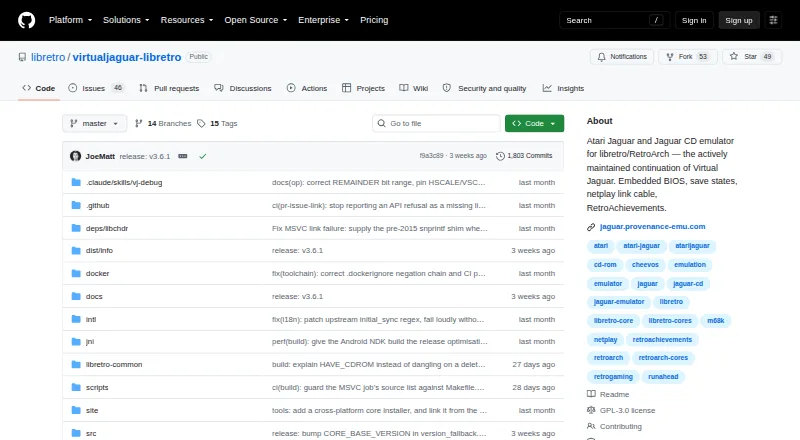
What Virtual Jaguar is
Virtual Jaguar libretro is a free, open-source emulator core for Atari Jaguar cartridges and Jaguar CD media. It is designed to run through a libretro frontend such as RetroArch, rather than as a standalone emulator. The core emulates the Jaguar’s 68000, GPU, DSP, Object Processor, and Jaguar CD hardware. It supports cartridge files such as .j64, .jag, .rom, .abs, .cof, .bin, and .prg, along with Jaguar CD CUE, CDI, and CHD images. Console and Jaguar CD BIOS images are embedded, so external BIOS files are not required. Through the frontend, users can access save states, cheats, rewind, run-ahead, netplay, shaders, remapping, and fast-forward. Optional settings include true-color rendering, 2× internal resolution, overclock controls, and adjustable CD read speed. Jaguar CD images can use a high-level-emulated BIOS or a real BIOS path, and audio CDs use the Virtual Light Machine visualizer. Link-cable emulation supports TCP transport and a multi-peer hub. The project notes that its blitter is not fully cycle-accurate, GPU/DSP pipeline hazards are not modeled, and some titles can run too fast.
Good
- Embedded BIOS images mean no external BIOS files.
- Supports cartridge and Jaguar CD image formats.
- RetroArch features include save states and netplay.
- Optional 2× internal resolution and overclock controls.
Watch out
- Requires a libretro frontend such as RetroArch.
- Blitter emulation is not fully cycle-accurate.
- Some titles can run too fast.
Who it suits
Virtual Jaguar suits Atari Jaguar owners who use a libretro frontend such as RetroArch. It may also suit users interested in Jaguar CD emulation and frontend features such as save states and netplay.
Verdict
Virtual Jaguar offers Jaguar cartridge and CD emulation with a wide set of frontend features. Its documented accuracy limits may affect some titles.
Plans and prices
From Virtual Jaguar's own pricing page, checked 29 Sep 2026.
| Plan | Price | What it gives you |
|---|---|---|
| Free | Free | Open-source emulator core · Requires a libretro frontend such as RetroArch |
| Virtual Jaguar Android app | Free | Android 4.0.3+ · 3.49 MB APK · discontinued on Google Play · Free download |
| Virtual Jaguar libretro core | Free | Requires RetroArch or another libretro frontend · ROM images required · Free |
The facts
Each one read from Virtual Jaguar's own pages, with the date it was checked.
What it does
- API
- The product exposes the standard libretro C API rather than a hosted web API or commercial SDK.checked 14 Oct 2026
- Build and self-hosting
- The source builds with make into a shared libretro library and supports host builds, debug builds, iOS cross-compilation and a test target.checked 14 Oct 2026
- Compatibility limitation
- Batocera describes Jaguar emulation as immature and warns that many games remain incompatible.checked 14 Oct 2026
- Controllers
- Supported inputs include standard pads, Pro Controller, Team Tap, ST and Amiga mice, Tempest rotary, analog and driving controllers, 6D stick and light gun.checked 14 Oct 2026
- Developer debugging
- An optional local GDB remote stub lets GDB, LLDB and VS Code inspect registers, memory, breakpoints and execution across the 68000, GPU and DSP.checked 14 Oct 2026
- Documentation
- Documentation covers core options, controls, file formats, BIOS behavior, performance tuning, networking, patches, texture packs, savestates, profiling and release procedures.checked 14 Oct 2026
- Emulated hardware
- The core emulates the Jaguar 68000 CPU, GPU, DSP, Object Processor, CD controller, link port, Memory Track and GameDrive hardware.checked 14 Oct 2026
- Emulation
- The core emulates the Jaguar’s 68000, GPU, DSP, Object Processor, and Jaguar CD hardware.checked 29 Sep 2026
- Enhancement rendering
- Optional enhancements include true-color Gouraud shading, 2x internal resolution, widescreen output and texture replacement packs.checked 14 Oct 2026
- Enhancements
- Optional enhancements include true-color rendering, 2× internal resolution, overclock controls, and adjustable CD read speed.checked 29 Sep 2026
- GameDrive
- Jaguar GameDrive detection and bank switching allow compatible GD-locked homebrew to run.checked 14 Oct 2026
- Historical release
- The original standalone Virtual Jaguar site records version 2.1.2 as released on October 10, 2014.checked 14 Oct 2026
- Independent catalogue listing
- A French Wikipedia emulator list places VirtualJaguar among Atari Jaguar emulators alongside Phoenix.checked 14 Oct 2026
- Independent compatibility evidence
- The historical Virtual Jaguar site lists numerous games as working while documenting failures, DSP requirements, freezes and graphical glitches for others.checked 14 Oct 2026
- Installation
- Users can install through RetroArch's Core Downloader or place a downloaded core binary in RetroArch's cores directory.checked 14 Oct 2026
- Integrations
- The core runs through RetroArch and supports its libretro frontend features, including RetroAchievements.checked 29 Sep 2026
- Jaguar CD
- Jaguar CD images can boot through an included high-level BIOS or an emulated real BIOS, with audio-CD playback and Virtual Light Machine support.checked 14 Oct 2026
- Licence
- The core is open source under the GNU General Public License version 3.0.checked 14 Oct 2026
- License
- The project is distributed under the GNU General Public License version 3.0.checked 29 Sep 2026
Where it runs
- App status
- The Android app was removed from Google Play on April 27, 2024; AppBrain lists version 1.01, last updated April 17, 2019, with about 17 thousand downloads.checked 14 Oct 2026
- BIOS
- Console and Jaguar CD BIOS images are embedded, so external BIOS files are not required.checked 29 Sep 2026
- BIOS requirement
- No BIOS files are required because Jaguar boot ROMs and CD BIOS images are embedded, although optional external CD BIOS overrides are supported.checked 14 Oct 2026
- Limit: Android compatibility
- AppBrain comments include reports of slow or choppy play, crashes while browsing ROM folders and games failing to load.checked 14 Oct 2026
- Limit: Android controls
- An AppBrain reviewer reported that the Android port lacked usable physical-button remapping and access to the Jaguar numeric keypad.checked 14 Oct 2026
The full review of Virtual Jaguar
Overview
Virtual Jaguar is a free, open-source core for running Atari Jaguar cartridge and CD games inside RetroArch or another libretro frontend. It suits players who want Jaguar-specific emulation with frontend tools such as save states and netplay; its accuracy limits make it a less dependable choice for titles sensitive to timing.
The core emulates the Jaguar’s 68000, GPU, DSP, Object Processor and CD hardware. It accepts cartridge images in .j64, .jag, .rom, .abs, .cof, .bin and .prg formats, and Jaguar CD images in CUE, CDI and CHD formats. Console and CD BIOS images are embedded, so an external BIOS is not required. CD images can use high-level BIOS emulation or a real BIOS path, and audio CDs can play with a Virtual Light Machine visualizer.
Virtual Jaguar is licensed under GNU General Public License version 3.0. Compatibility questions and reports go to GitHub Discussions, while confirmed bugs go to GitHub Issues.
Key features
- RetroArch tools: Save states, rewind, run-ahead, cheats, shaders, controller remapping, fast-forward, netplay and RetroAchievements are supported through the libretro frontend. This is a substantial set of conveniences for players already using RetroArch, but the frontend requirement rules it out as a standalone emulator.
- Link-cable networking: JagLink and netlink emulation supports TCP transport and a multi-peer hub. The project documents validation of Doom deathmatch over a LAN, making this a useful option for local network play rather than a general online multiplayer service.
- Rendering and speed controls: Optional true-color rendering, 2× internal resolution, overclock controls and adjustable CD read speed let users alter presentation and performance. These options cannot correct the underlying accuracy gaps.
- Release verification: Release binaries are built on GitHub Actions from public source, and releases include SHA-256 checksums for artifact verification. This gives technically minded users a way to verify downloaded binaries.
Pricing
Free: free. The plan includes the open-source emulator core, with a libretro frontend such as RetroArch required. There is no paid tier to compare; the trade-off for the zero price is that users must supply and configure a compatible frontend.
Platforms
Virtual Jaguar supports Android, iOS, Linux, macOS, web and Windows. Despite that broad platform range, it remains a libretro core rather than a standalone app, so the practical fit depends on using a compatible frontend on the chosen device.
Who it's for
Choose Virtual Jaguar if you want to play Jaguar cartridges or CDs, already use RetroArch, and value features such as save states, remapping, rewind or link-cable networking. Its embedded BIOS images also avoid the need to obtain external console or CD BIOS files.
Look elsewhere if accurate timing is essential to the games you play. The blitter is not fully cycle-accurate, GPU and DSP pipeline hazards are not modeled, and some titles may run too fast. Those are meaningful limits for players seeking faithful behavior across the library.
Pros and cons
- Pros: Cartridge and CD support covers several image formats, with embedded BIOS images removing an external BIOS requirement.
- Pros: RetroArch integration brings save states, rewind, run-ahead, netplay and other useful frontend tools to Jaguar emulation.
- Pros: JagLink and netlink support TCP and multi-peer play, with Doom LAN deathmatch validation documented by the project.
- Cons: It requires a libretro frontend, so it is not a ready-to-run standalone emulator.
- Cons: Incomplete blitter accuracy and unmodeled GPU/DSP hazards can affect behavior; some games may run too quickly.
Alternatives
For more Atari-focused choices, browse Atari Emulators. For an emulator centered on a different system, see Neo Geo Emulators, Nintendo 3DS Emulators, Nintendo 64 Emulators, Multi-System Emulators or SNES Emulators.
For Neo Geo rather than Jaguar emulation, Geolith is a free option for Linux, macOS and Windows, while GnGeo is free for Linux and requires SDL 1.2.x, libz and a NeoGeo BIOS; its license forbids commercial use of GnGeo as a whole. NeoCD/SDL is a free Linux and Windows option with an original NeoGeo CD BIOS requirement and non-commercial limits on source reuse and technical knowledge. NeoRAGEx is a free Windows emulator, with games and BIOS not included. NeoDS is free for non-commercial use. Lynx.emu is a paid Android app at $2.99, paid once, with ROMs supplied by the user. DREAMNEOCD and NeoCD/SDLx Unleashed are also free options.
Verdict
Virtual Jaguar is the right pick for RetroArch users who want broad Jaguar cartridge and CD support without sourcing a BIOS, plus a strong set of frontend conveniences. Its free price and networking features are appealing, but players who prioritize timing accuracy should look elsewhere because some titles can run too fast and key hardware behavior remains unmodeled.
Getting started
- Open the Virtual Jaguar project website.
- Install or open a libretro frontend such as RetroArch.
- Load the Virtual Jaguar core through the frontend.
- Provide a supported cartridge image or Jaguar CD image.
- Use the frontend to access features such as save states or remapping.
Questions
What does Virtual Jaguar cost?
The Free plan is free.
Which systems and platforms does it support?
It emulates Atari Jaguar and Jaguar CD. Listed platforms are web, Windows, macOS, Linux, iOS, and Android.
Do I need a BIOS file?
No. Console and Jaguar CD BIOS images are embedded.
Does it support multiplayer?
It supports netplay through the libretro frontend, and JagLink and netlink provide link-cable emulation over TCP. The listed feature data also marks online multiplayer and online netplay as no.
Is Virtual Jaguar open source?
Yes. It is distributed under the GNU General Public License version 3.0.
What are its documented emulation limitations?
The blitter is not fully cycle-accurate, GPU/DSP pipeline hazards are not modeled, and some titles can run too fast.