GnGeo
GnGeo is a free, open-source NeoGeo emulator for Linux.
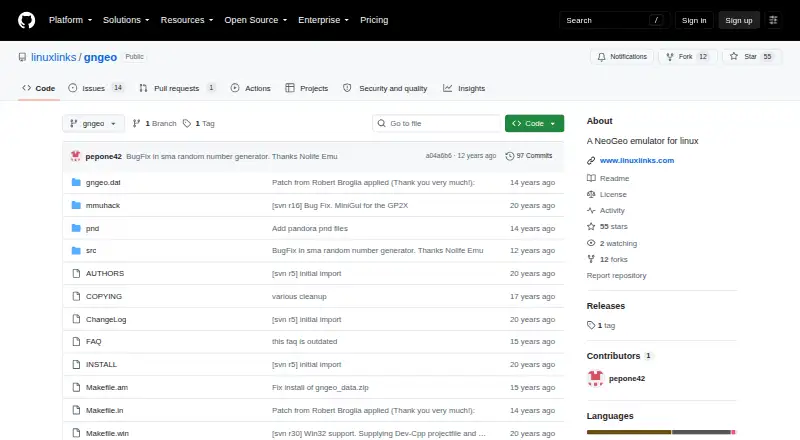
What GnGeo is
GnGeo is a free, open-source NeoGeo emulator for Linux. It runs NeoGeo ROM sets identified by their MAME names; the listed example starts Metal Slug with `gngeo mslug`. Command-line settings cover home, arcade, and unibios modes, plus display options such as fullscreen, scaling, interpolation, raster interrupts, blitters, and effects. Sound, joystick input, player controls, and hotkeys can be configured, with settings supplied on the command line or in user and per-game configuration files. The project describes graphical frontends that offer features such as game previews and configuration controls. GnGeo requires SDL 1.2.x, libz, and a NeoGeo BIOS; NASM 0.98 is optional for i386 assembly optimization. Games must be ZIP files, while the BIOS must not be, and the default search location is `$prefix/share/gngeo/`. Its README describes a source build with `./configure`, `make`, and `make install. It lists no repository releases. The README also warns that commercial use of GnGeo as a whole is forbidden because of included MAME code and licensing.
Good
- Free and open source.
- Offers home, arcade, and unibios modes.
- Supports configurable controls and hotkeys.
- Includes command-line and per-game configuration.
- Provides graphical frontends with game previews.
Watch out
- Requires SDL 1.2.x, libz, and a NeoGeo BIOS.
- Repository lists no releases.
- Commercial use of the whole emulator is forbidden.
Who it suits
GnGeo suits Linux users who want to run NeoGeo ROM sets and configure display, sound, and controls. Users need the listed libraries and BIOS, and should note the commercial-use restriction.
Verdict
GnGeo offers Linux users configurable NeoGeo emulation, with command-line and frontend options. Check its dependencies and licensing restrictions before choosing it.
Plans and prices
From GnGeo's own pricing page, checked 3 Oct 2026.
| Plan | Price | What it gives you |
|---|---|---|
| GnGeo | Free | Requires SDL 1.2.x, libz, and a NeoGeo BIOS · License notes that commercial use of GnGeo as a whole is forbidden |
The facts
Each one read from GnGeo's own pages, with the date it was checked.
What it does
- Build
- The README gives `./configure && make` as the installation build steps, followed by `make install` as root.checked 3 Oct 2026
- Configuration
- Configuration can be set in `$HOME/.gngeo/gngeorc` or on the command line, and per-game configuration is supported in `$HOME/.gngeo/game.rc`.checked 3 Oct 2026
- Controls
- The command-line options include joystick support and per-player control and hotkey configuration.checked 3 Oct 2026
- CPU cores
- It can use Cyclone, Starscream, or Gen68k for the 68k core and DrZ80, Raze, or MAME Z80 for the Z80 core, with defaults depending on the target.checked 3 Oct 2026
- Dependencies
- It requires SDL 1.2.x, libz, and a NeoGeo BIOS; NASM 0.98 is optional for i386 assembly optimization.checked 3 Oct 2026
- Display and sound
- Options include fullscreen, hardware screen surface, interpolation, selectable blitters and effects, resolution scaling, sample rate, and sound.checked 3 Oct 2026
- Emulation target
- It emulates NeoGeo ROM sets, which can be started using a game’s MAME name.checked 2 Oct 2026
- Frontends
- The README describes GGF, XGngeo, and gngeogui frontends, listing game previews and various descriptions, options, or configuration features.checked 3 Oct 2026
- Game files
- By default, GnGeo searches for BIOS and games under `$prefix/share/gngeo/`; games must be ZIP files and the BIOS must not be.checked 3 Oct 2026
- License
- The README says the original code is GPLv2 with a special linking exception and warns that commercial use of GnGeo as a whole is forbidden because of MAME code licensing.checked 2 Oct 2026
- License and commercial use
- The README says the original code is GPLv2 with a linking exception and says commercial use of GnGeo as a whole is forbidden because of included code and licenses.checked 3 Oct 2026
- Purpose
- GnGeo is a NeoGeo emulator for Linux and possibly other Unix systems.checked 3 Oct 2026
- Release availability
- The GitHub releases page states that there are no releases in the repository.checked 2 Oct 2026
- Repository activity
- The GitHub repository page shows no listed releases and describes the project as a Linux NeoGeo emulator.checked 3 Oct 2026
- Requirements
- The README lists SDL 1.2.x, libz, and a NeoGeo BIOS as requirements; NASM 0.98 is optional for i386 assembly optimization.checked 2 Oct 2026
- ROM support
- It emulates NeoGeo ROMs identified by ROMSET, with the example command `gngeo mslug` for Metal Slug.checked 3 Oct 2026
- Security and compliance
- The repository page shows no security advisories and does not describe a security or compliance program.checked 2 Oct 2026
- Sound and controls
- The emulator has sound and joystick options, player control settings, and configurable hotkeys.checked 2 Oct 2026
- System modes
- The command line offers home, arcade, and unibios system settings.checked 2 Oct 2026
- Video options
- Options include fullscreen, screen scaling, interpolation, raster interrupts, and selectable blitters and effects.checked 2 Oct 2026
The full review of GnGeo
GnGeo emulates NeoGeo games on Linux, with command-line controls and optional frontend support. It suits Linux users comfortable building and configuring software; its flexibility is offset by old dependencies and a restriction on commercial use.
Overview
Games launch by ROM-set name, such as mslug for Metal Slug. GnGeo supports AES emulation, save states, and home, arcade, and unibios modes.
Setup requires SDL 1.2.x, libz, and a NeoGeo BIOS. Game files must be ZIP archives; the BIOS must be uncompressed. GnGeo searches under $prefix/share/gngeo/ by default. The documented source build runs ./configure, make, and make install; NASM 0.98 is optional for i386 assembly optimization. The repository has no releases, so users should be prepared for a source-oriented installation.
Key features
Display, audio, and controls
Fullscreen, resolution scaling, interpolation, raster interrupts, and selectable blitters and effects offer substantial control over presentation. Sound and sample-rate options, joystick support, per-player control settings, and configurable hotkeys cover common tuning needs. These options reward users who want to adjust behavior, but make GnGeo less suitable for someone seeking a polished, minimal-setup experience.
Emulation choices and frontends
GnGeo can use Cyclone, Starscream, or Gen68k for its 68k core, and DrZ80, Raze, or MAME Z80 for its Z80 core; defaults depend on the target. The README also describes GGF, XGngeo, and gngeogui frontends, including game previews and configuration options. Those frontends can provide a more visual route through the emulator, while the command line remains the direct option for users who prefer explicit control.
Pricing
GnGeo is free and open source. Its sole plan, GnGeo, costs free; there is no free trial because no paid tier is described. The price does not remove the setup requirements: users still need the listed libraries and BIOS, and the README says commercial use of GnGeo as a whole is forbidden because of included code and licensing.
Platforms
GnGeo targets Linux, with the project also describing possible support for other Unix systems. Linux is the platform to choose it for; broader Unix support should not be treated as a given. Its SDL 1.2.x dependency and source-build workflow also make it a less straightforward fit than software distributed as a ready-to-run release.
Who it's for
GnGeo is a sensible choice for Linux users who want NeoGeo emulation with selectable CPU cores, configurable display and controls, save states, and per-game settings. It is less appropriate for people who want a turnkey install, do not have the required BIOS, or need to use the emulator commercially.
Pros and cons
- Pros: Broad display, sound, and control settings let users tailor the emulation rather than accept a fixed setup.
- Pros: Per-game configuration, selectable CPU cores, and frontend options give technically confident users several ways to manage their library.
- Cons: SDL 1.2.x, libz, a separate BIOS, and a source build make installation more involved than a ready-to-run package.
- Cons: The stated commercial-use restriction rules it out for commercial deployments.
- Cons: No repository releases means users should not expect a published release download there.
Alternatives
For other options, browse Neo Geo Emulators.
- Virtual Jaguar is a free emulator for Android, iOS, Linux, macOS, the web, and Windows; choose it if that platform range matters and you can use a libretro frontend such as RetroArch.
- NeoCD/SDL is free for Linux and Windows, but its non-commercial limits and requirement for an original NeoGeo CD BIOS make it a better fit only when those terms and its CD focus suit your needs.
- NeoDS is free to use for non-commercial purposes; consider it if that licensing scope fits your use.
- NeoRAGEx is a free Windows emulator with games and BIOS not included; choose it if Windows is your target.
- Geolith is a free option for Linux, macOS, and Windows.
- NeoCD/PS2 is free software, with its BIOS not provided.
- Lynx.emu is a paid, open-source Android app at $2.99, paid once, with ROMs supplied by the user; it is for Lynx emulation rather than NeoGeo.
- GxGeo is another free option.
Verdict
Choose GnGeo if you want configurable NeoGeo emulation on Linux and are willing to handle its dependencies, BIOS, and source build. Its adjustable emulation and per-game configuration are the main reasons to favor it; the commercial-use restriction and installation burden are the clearest reasons to look elsewhere.
Getting started
- Open the GnGeo project page on GitHub.
- Install SDL 1.2.x and libz, and obtain a NeoGeo BIOS.
- Place ZIP game files and the BIOS in the default search location.
- Build from source with `./configure` and `make`, then run `make install`.
- Start a ROM set by its game name, such as `gngeo mslug`.
Limits worth knowing
The free GnGeo plan requires SDL 1.2.x, libz, and a NeoGeo BIOS. The licensing notes forbid commercial use of GnGeo as a whole.
Questions
How much does GnGeo cost?
The GnGeo plan is free.
Which platform does GnGeo support?
It is described as a Linux emulator; the project also mentions possible support for other Unix systems.
What files can it run?
It emulates NeoGeo ROM sets identified by ROMSET or game MAME name. Games must be ZIP files, while the BIOS must not be.
What dependencies does it require?
It requires SDL 1.2.x, libz, and a NeoGeo BIOS. NASM 0.98 is optional for i386 assembly optimization.
Can GnGeo be used commercially?
The README says commercial use of GnGeo as a whole is forbidden because of included code and licenses.
How do users build and configure it?
The README describes building from source with `./configure`, `make`, and `make install`. Settings can be supplied on the command line or in user and per-game configuration files.
Alternatives to GnGeo
- 1
NeoCD/PS2
Free planSelf-hosted6.1Free plan - 2
NeoDS
Free plan6.1Free plan - 3
NeoCD/SDL
Free planLinuxWindows6.0Free plan - 4
NeoGeo CD Redux
Free planSelf-hosted6.0Free plan - 5
DREAMNEOCD
Free plan5.9Free plan - 6
Geolith
LinuxmacOSWindows5.9