Village
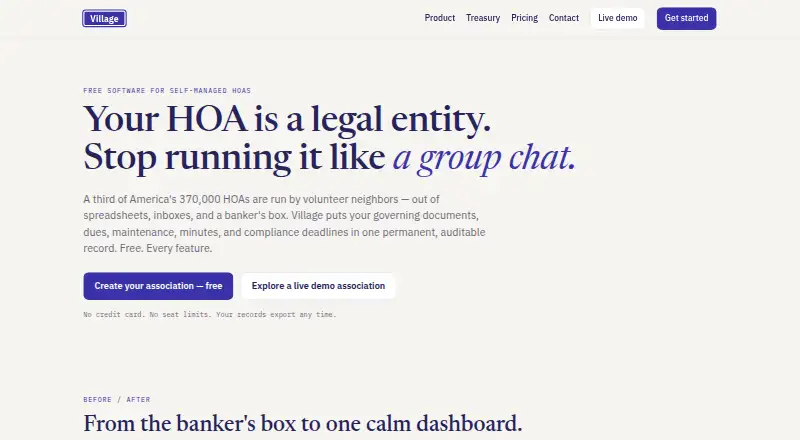
Village is web software for self-managed homeowners associations and volunteer boards.
What Village is
Village is web software for self-managed homeowners associations and volunteer boards. It provides full-text search across CC&Rs, bylaws, and amendments, with section context and amendment history. Boards can track assessment cycles, use autopay by free ACH, monitor delinquencies, send reminders, and review a per-unit ledger. Maintenance requests can include photos, statuses, vendors, and costs. A calendar seeded with state information helps associations track matters such as annual meetings, notice periods, and reserve studies. Governance tools cover communications, voting, meeting minutes, and compliance tracking. Associations can export records in JSON, CSV, and PDF formats. The free plan is listed as $0.00 USD, billed forever, with every feature, no seat limits, and no credit card required. Village says it uses encryption, role-based and row-level access controls, private file storage with time-limited access, and append-only protection for official records. Its terms describe the product as an informational tool, not legal, financial, tax, accounting, or fiduciary advice. Online payments are described as a future feature.
Good
- Free plan includes every feature and no seat limits.
- Searches governing documents with section context and amendment history.
- Tracks dues, delinquencies, reminders, and per-unit ledgers.
- Records can be exported as JSON, CSV, and PDF.
- Includes voting and meeting-minute tools.
Watch out
- Online payments are described as a future feature.
- Village is not legal, financial, tax, accounting, or fiduciary advice.
- Card payments carry a homeowner-paid convenience fee when available.
Who it suits
Village suits self-managed HOAs and volunteer boards that want tools for records, dues, maintenance, and governance. Its maker also says developers can set up a new association before its first closing.
Verdict
Village brings common HOA records and routine board tasks into one web product, with a free plan and open-format exports. Associations should note that the terms position it as informational software rather than professional advice, and online payments are not yet described as available.
Plans and prices
From Village's own pricing page, checked 4 Oct 2026.
| Plan | Price | What it gives you |
|---|---|---|
| Free | Free | Every feature · no seat limits · no credit card · Forever |
The facts
Each one read from Village's own pages, with the date it was checked.
What it does
- Compliance
- A state-seeded calendar tracks items such as annual meetings, notice periods, and reserve studies.checked 4 Oct 2026
- Document search
- It provides full-text search across CC&Rs, bylaws, and amendments, with section context and amendment history.checked 4 Oct 2026
- Dues
- The product lists assessment cycles, autopay by free ACH, delinquency tracking, reminders, and a per-unit ledger.checked 4 Oct 2026
- Governance
- The terms describe tools for communications, governance and voting, meeting minutes, and compliance tracking.checked 4 Oct 2026
- Intended users
- The product is presented for self-managed HOAs and volunteer boards, and the maker says developers can set up a new association before its first closing.checked 4 Oct 2026
- Legal limitation
- The terms say Village is an informational software tool, not legal, financial, tax, accounting, or fiduciary advice.checked 4 Oct 2026
- Maintenance
- Maintenance requests can include photos, statuses, vendors, and costs.checked 4 Oct 2026
- Payment fees
- The homepage says ACH is free and card payments carry a small convenience fee paid by the homeowner choosing that method.checked 4 Oct 2026
- Payments status
- The terms describe online payments as a future feature, and the privacy policy says payment information will be handled by a payment processor when payments launch.checked 4 Oct 2026
- Privacy
- Village says it does not sell personal information or share it for cross-context behavioral advertising.checked 4 Oct 2026
- Purpose
- Village provides software for self-managed homeowners associations and their members.checked 4 Oct 2026
- Records export
- Associations can export records in open formats including JSON, CSV, and PDF from Settings.checked 4 Oct 2026
- Security
- The privacy policy says Village uses encryption in transit, role-based and row-level access controls, private file storage with time-limited access, and append-only protection for official records.checked 4 Oct 2026
- Support
- General questions and setup help go to [email protected]; the contact page also lists separate privacy and security email addresses.checked 4 Oct 2026
The full review of Village
Overview
Village brings self-managed associations’ documents and routine administration into a single web product. It is best suited to volunteer boards that want shared records and basic dues, maintenance, and governance tools without a software bill.
Its free plan is unusually broad on paper, but payment collection needs a careful distinction: Village describes dues workflows and free ACH autopay, while its terms say online payments are a future feature. Associations should confirm that the collection process meets their needs before relying on it.
Key features
Full-text search spans CC&Rs, bylaws, and amendments, with section context and amendment history. That makes Village a practical choice for boards that need to locate relevant provisions and follow how documents changed, rather than simply store files.
Dues tools cover assessment cycles, delinquency tracking, reminders, and per-unit ledgers, alongside free ACH autopay. These can help volunteer treasurers keep collection records organized. But autopay and tracking are not the same as a live online payment service: the terms position online payments as forthcoming. The homepage says card payments will carry a small convenience fee paid by the homeowner who chooses that method; when payments launch, a processor will handle payment information.
Maintenance requests can carry photos, statuses, vendor details, and costs, giving boards a way to follow work and its expense. A state-seeded calendar covers items such as annual meetings, notice periods, and reserve studies. Governance tools include communications, voting, meeting minutes, and compliance tracking. The product also offers basic accounting tools, though the stated scope does not establish a substitute for a full accounting system.
Records can be exported from Settings in JSON, CSV, and PDF. Open formats give an association a practical way to retain or move its records, rather than keeping them only inside the product. Village says it uses encryption in transit, role-based and row-level access controls, private file storage with time-limited access, and append-only protection for official records. It also says it does not sell personal information or share it for cross-context behavioral advertising.
Pricing
Village’s Free plan costs nothing, billed Forever. It includes every feature, has no seat limits, and requires no credit card. That removes the usual cost and seat-count trade-offs for small volunteer boards and gives larger associations room to include more participants without a per-seat charge.
The plan includes dues collection, basic accounting tools, and online voting, as well as the product’s document, maintenance, calendar, and governance functions. The important qualification is that online payments are described as a future feature, despite the dues tools and free ACH autopay. Boards should distinguish those workflow features from payment processing they can use today.
There is no paid tier to weigh against the free plan in the stated offering. Developers can also set up an association before its first closing, which may suit a new community preparing for operations; Village does not position itself as professional legal, financial, tax, accounting, or fiduciary advice.
Platforms
Village runs on the web. Boards seeking a dedicated mobile app should consider products with Android and iOS support instead.
Who it's for
Village fits self-managed HOAs and volunteer boards that need a shared place for governing documents, dues records, maintenance requests, calendars, and meeting work. Its no-seat-limit free plan is particularly compelling when a board wants to give members or volunteers access without adding license costs.
It is less suitable for associations that require a live online payment service now, a mobile app, or professional advice. General questions and setup help go to [email protected]; the contact page also provides separate privacy and security email addresses.
Pros and cons
- Pro: The Forever free plan includes every feature, has no seat limits, and needs no credit card, removing cost and user-count barriers for volunteer-run communities.
- Pro: Document search includes section context and amendment history, making it more useful for interpreting governing records than a file repository alone.
- Pro: JSON, CSV, and PDF exports support portability, while stated access controls and protections address sensitive association records.
- Con: Online payments remain a future feature, so boards needing residents to pay through an operational online service should look elsewhere for now.
- Con: The web-only platform may not suit communities that expect a dedicated Android or iOS app.
- Con: Village is informational software, not a source of legal, accounting, tax, financial, or fiduciary advice.
Alternatives
Homeowners Association Management Software is a useful place to compare the category if Village’s web-only setup or future-facing payment status does not fit.
- Neighborhood.online is another free web option, with a free trial; its free plan uses a hosted Neighborhood.online marketing website and includes ads on some pages.
- NeighborhoodHQ is worth considering if Android or iOS access matters; pricing is custom.
- SMPLR HOA is a paid alternative with Android, iOS, web, and a free trial. Its Community plan starts at $25 a month billed annually at the 25-home minimum; the monthly-billed rate is $32/month, and the per-home rate slides from $1.00 to $0.50 as community size grows.
- HOA Start offers web and mobile access; its Complete plan includes software features, a mobile app, marketing website, and admin dashboard, while Software Only is another plan option. Both use custom pricing.
- CINC is a paid web-based alternative.
- Perfect HOA is a paid Android, iOS, and web option with a free trial but no free plan. Its 0-25 units plan is $49 a month billed yearly.
- Condo Control is a paid web and mobile option; its Standard Living plan includes a resident portal, mobile app, online payments, maintenance requests, and storage, with custom pricing.
- Condo Manager is another paid web and mobile alternative.
Verdict
Choose Village if you run a self-managed HOA and want comprehensive shared records and routine board tools without a software charge or seat cap. Its export options and document search strengthen that case. Look elsewhere if online payment processing must work now, or if your community needs native mobile apps or professional guidance.
Alternatives to Village
- 1

HOA Simplify
AndroidiOSWebAPI7.7From $79 a month - 2
Perfect HOA
AndroidiOSWebAPI7.7 - 3
PayHOA
Web7.1From $49 a month - 4
HOA-I
AndroidiOSWeb7.0 - 5

SMPLR HOA
AndroidiOSWeb7.0From $25 a month - 6

TownSq
AndroidiOSWeb6.8From $90 a month