
Vapourkit
Vapourkit is a free, open-source desktop app for restoring and upscaling video on Windows and Linux.
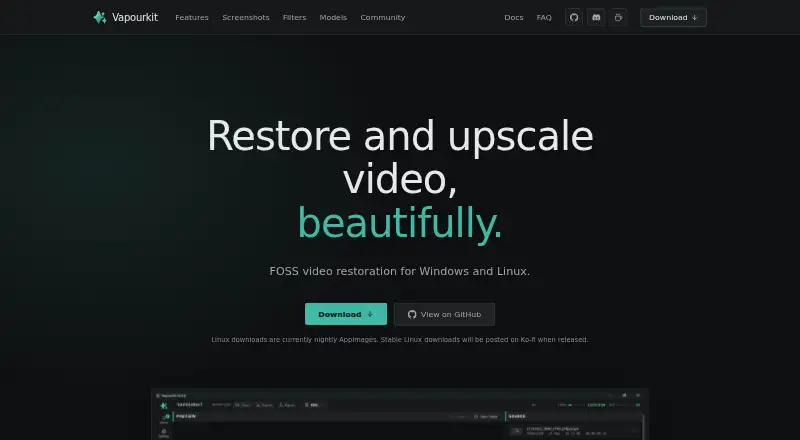
What Vapourkit is
Vapourkit is a free, open-source desktop app for restoring and upscaling video on Windows and Linux. It processes video with models and filters, including denoising, artifact removal, and frame interpolation. A real-time preview shows output as processing progresses, and users can adjust filters and run the workflow again. A side-by-side viewer compares source and result; Video Compare is built into Windows and optional on Linux. Users can queue several videos with custom workflows, write custom filters, and save or share portable workflow files. Listed models include TSPAN / TFDAT VSR, AnimeJaNai, and AnimeSharpV4, with import support for a user's own ONNX model. Inference options include TensorRT, DirectML, and NCNN Vulkan, depending on operating system and GPU. Windows has a stable download, while Linux downloads are nightly AppImages. Supported systems include Windows 10/11 x64 and compatible x86_64 glibc-based Linux distributions. The maker recommends at least 8 GB RAM and 6 GB VRAM.
Good
- Provides real-time output preview.
- Queues multiple videos with custom workflows.
- Supports custom filters and imported ONNX models.
- Free and open source under GPL 3.0.
- Includes denoising, artifact removal, and frame interpolation.
Watch out
- Linux downloads are nightly AppImages.
- DirectML is available only on Windows.
- Linux has a curated rather than full Windows filter catalog.
- The maker recommends at least 8 GB RAM and 6 GB VRAM.
Who it suits
Vapourkit suits people restoring or upscaling video, whether they want a simple processing workflow or custom filters and batch pipelines. Check its operating-system and hardware requirements, especially for Linux setup.
Verdict
Vapourkit combines video restoration tools with preview, comparison, and workflow customization. Windows has a stable download; Linux users should account for the nightly release and its narrower filter catalog.
Plans and prices
From Vapourkit's own pricing page, checked 4 Oct 2026.
| Plan | Price | What it gives you |
|---|---|---|
| Vapourkit | Free | Free, open-source app; Windows stable download; Linux nightly AppImage |
The facts
Each one read from Vapourkit's own pages, with the date it was checked.
What it does
- AI backends
- Its inference backends include TensorRT, DirectML, and NCNN Vulkan, with availability depending on operating system and GPU.checked 4 Oct 2026
- Batch processing
- Users can queue multiple videos with custom workflows.checked 4 Oct 2026
- Batch workflows
- Users can queue multiple videos with custom workflows and save or share .vkfilter and .vkworkflow files.checked 4 Oct 2026
- Comparison
- The app can compare source and output side by side; Video Compare is built in on Windows and optional on Linux.checked 4 Oct 2026
- Custom filters
- Users can write custom filters and use a platform-verified VapourSynth filter catalog, with more filters available on Windows.checked 4 Oct 2026
- Downloads
- Windows has a stable download, while Linux downloads are currently nightly AppImages; stable Linux downloads are planned for Ko-fi when released.checked 4 Oct 2026
- Filters
- The app includes a catalog of VapourSynth filters for tasks such as deinterlacing, interpolation, restoration, denoising, sharpening, anti-aliasing, dehalo, and debanding, and supports custom filters.checked 4 Oct 2026
- Inference backends
- The site lists TensorRT, DirectML, and NCNN Vulkan, with availability depending on operating system and GPU.checked 4 Oct 2026
- Integrations
- Vapourkit uses VapourSynth, FFmpeg, and AI inference backends; Linux setup requires Python, FFmpeg/ffprobe, and Vulkan, while Video Compare is optional there.checked 4 Oct 2026
- Intended users
- The maker presents Vapourkit for people restoring or upscaling video, from a simple load-and-process workflow to custom filters and batch pipelines.checked 4 Oct 2026
- License
- The project describes Vapourkit as free and open source, with a GPL 3.0 license.checked 4 Oct 2026
- Models
- Users can select bundled models or import their own ONNX model.checked 4 Oct 2026
- Open source
- The maker describes Vapourkit as free and open source, and its repository lists the GPL-3.0 license.checked 4 Oct 2026
- Preview
- Real-time preview shows output frames as processing advances, and users can adjust filters and rerun the pipeline.checked 4 Oct 2026
- Preview and comparison
- Vapourkit offers real-time output preview and a side-by-side source and output viewer; Video Compare is built in on Windows and optional on Linux.checked 4 Oct 2026
- Privacy and local setup
- Linux setup creates a private Python virtual environment under the user's configuration directory and does not install Python packages globally or require sudo.checked 4 Oct 2026
- Purpose
- Vapourkit is a video restoration and upscaling app that processes videos using models and filters.checked 4 Oct 2026
- Support
- The maker points users to Discord for help and feature requests, and says donations support development.checked 4 Oct 2026
- System requirements
- The maker recommends at least 8 GB RAM and 6 GB VRAM, and Linux requires Python 3.12 or 3.13, FFmpeg/ffprobe, and a working Vulkan runtime.checked 4 Oct 2026
- Workflow files
- Users can save and share portable .vkfilter and .vkworkflow files.checked 4 Oct 2026
Where it runs
- Linux setup
- Linux setup creates a private Python virtual environment and installs packages under the user's config directory without installing Python packages globally or requiring sudo.checked 4 Oct 2026
- Platform limitation
- DirectML is available on Windows only, and Linux uses a curated verified filter catalog rather than every filter in the Windows build.checked 4 Oct 2026
- Platform limits
- Vapourkit supports Windows 10/11 x64 and x86_64 glibc-based Linux distributions that can run the AppImage; Linux offers a curated verified filter catalog rather than the full Windows catalog.checked 4 Oct 2026
- Platform requirements
- The docs support Windows 10/11 x64 and x86_64 glibc-based Linux distributions that can run AppImage.checked 4 Oct 2026
The full review of Vapourkit
Vapourkit is a free, open-source desktop app for restoring and upscaling video with filters and AI models. It is best suited to people who want to shape repeatable local workflows, from one-off processing to batches. Its strength is the combination of preview, comparison and customization; Linux users trade a narrower filter catalog and nightly releases for that control.
Overview
Vapourkit brings VapourSynth filters, FFmpeg and AI inference into a video-processing workflow. Users can start with a load-and-process approach or build a more tailored pipeline with custom filters. Real-time preview shows output frames as processing advances, and users can adjust filters and rerun the pipeline. Side-by-side source and output comparison helps assess changes; Video Compare is built in on Windows and optional on Linux.
Key features
- Models and inference: Vapourkit includes TSPAN / TFDAT VSR, AnimeJaNai and AnimeSharpV4, and accepts users’ own ONNX models. TensorRT, DirectML and NCNN Vulkan are supported, with availability dependent on operating system and GPU. DirectML is Windows-only, so the available backend choices differ by platform.
- Filter catalog: The VapourSynth filters cover tasks including deinterlacing, interpolation, restoration, denoising, sharpening, anti-aliasing, dehalo and debanding. Custom filters extend that toolkit, but Linux users get a curated verified catalog rather than the full Windows selection. That matters most to users whose workflows depend on particular filters.
- Batch workflows: Users can queue multiple videos with custom workflows, then save or share portable .vkfilter and .vkworkflow files. This suits repeat jobs and workflows shared between users; it is more machinery than a simple one-file conversion calls for.
- Processing controls: Denoising, artifact removal and frame interpolation are supported. The live preview and source comparison give users ways to inspect output while refining a pipeline rather than relying only on the finished export.
Pricing
Vapourkit costs nothing. The free plan is the free, open-source app under GPL 3.0, with a stable Windows download and nightly Linux AppImages; there is no free trial because the app itself is free. There are no paid tiers, seat counts or processing quotas to weigh. The trade-off is operational rather than financial: Linux users must work with nightly builds and a smaller verified filter catalog.
Platforms
Vapourkit supports Windows 10/11 x64 and x86_64 glibc-based Linux distributions that can run AppImage. Windows has a stable download; Linux downloads are currently nightly, with stable Linux downloads planned for Ko-fi when released. The maker recommends at least 8 GB of RAM and 6 GB of VRAM. Linux also requires Python 3.12 or 3.13, FFmpeg/ffprobe and a working Vulkan runtime; setup creates a private Python environment under the user's configuration directory, without installing packages globally or requiring sudo. These requirements make Linux setup more involved, though it avoids changing the system-wide Python installation.
Who it's for
Vapourkit is a strong fit for video restorers and upscalers who want to combine AI models with a broad filter toolkit, inspect results as they process, and reuse custom batch pipelines. Its free, open-source license also suits users who value an inspectable project and portable workflow files. It is a weaker fit for Linux users who need stable releases or the full Windows filter catalog, and for anyone whose machine falls short of the recommended memory and VRAM.
Pros and cons
- Pro: Real-time preview and side-by-side comparison support iterative work, with Video Compare included on Windows.
- Pro: Custom filters, batch queues and portable workflow files make repeat processing more practical.
- Pro: The free GPL 3.0 app supports several inference backends and user-imported ONNX models.
- Con: Linux is limited to nightly AppImages and a curated subset of the Windows filter catalog.
- Con: DirectML is Windows-only, and backend availability also depends on the GPU.
- Con: Linux setup requires Python, FFmpeg/ffprobe and Vulkan, while the maker recommends 6 GB of VRAM and 8 GB of RAM.
Alternatives
For a broader comparison, browse AI Video Restoration Software.
- Aiarty Video Enhancer is a paid macOS and Windows option with a free version capped at videos under 120 seconds, watermarked exports and no batch export; its Standard License is $79 a year. Choose it if those platform and plan terms suit you better than Vapourkit's open-source workflow.
- Klarity is another free Linux and Windows restoration option, described as a local, offline image and video tool. It is worth considering if you want that alternative within the same desktop platforms.
- RestoraX is free, open-source MIT software for self-hosted GPU or CPU processing, across Linux, web, API and self-hosted deployments. Choose it if self-hosting or CPU processing is a priority.
- TensorPix is a freemium web, API and self-hosted option with a free plan that uses weekly login credits, supports up to 720p input and includes 1 GB of storage. It suits readers looking for a web-based option with a capped free tier.
- HitPaw VikPea spans Android, iOS, macOS, web, Windows and API, with a 1 Month License at $43.19 a month that automatically renews and can be canceled any time. Consider it if that broader platform range and paid licensing fit your needs.
- Cognitech Video Investigator is a paid Linux, macOS, web and Windows option, with Video Investigator Cloud at $1,399 a year. It is an alternative for readers considering a paid investigation-oriented tool.
- Intelion Video Lab offers a Windows and self-hosted module or standalone deployment with custom pricing.
- My Cognitech Cloud is a paid Linux, macOS, web and Windows option, with Video Investigator Cloud at $1,399 a year.
Verdict
Choose Vapourkit if you want a free, open-source video restoration workflow that pairs AI models with a substantial filter catalog, live preview and reusable batch pipelines. Those controls are its clearest reason to choose it. Look elsewhere if stable Linux releases or the complete Windows filter selection are essential, or if the recommended hardware and setup requirements are a poor fit.
Getting started
- Visit the Vapourkit website.
- Download the stable Windows build or the Linux nightly AppImage.
- Check that your system meets the supported Windows or Linux platform requirements.
- On Linux, ensure Python 3.12 or 3.13, FFmpeg/ffprobe, and a working Vulkan runtime are available.
- Load videos, select models or filters, and preview the output as processing advances.
- Adjust filters and rerun the pipeline, or queue multiple videos with a custom workflow.
Limits worth knowing
Linux downloads are currently nightly AppImages, and Linux offers a curated verified filter catalog rather than every filter in the Windows build. DirectML is available only on Windows. The maker recommends at least 8 GB RAM and 6 GB VRAM; Linux also requires Python 3.12 or 3.13, FFmpeg/ffprobe, and a working Vulkan runtime.
Questions
Is Vapourkit free?
Yes. The maker describes it as free and open source, with a GPL-3.0 license.
Which platforms does Vapourkit support?
It supports Windows 10/11 x64 and x86_64 glibc-based Linux distributions that can run AppImage.
Are stable downloads available for both platforms?
Windows has a stable download. Linux downloads are currently nightly AppImages.
Does Vapourkit support DirectML on Linux?
No. DirectML is available on Windows only; backend availability otherwise depends on operating system and GPU.
Can I use custom models and filters?
Users can import their own ONNX models and write custom filters. Vapourkit also lists TSPAN / TFDAT VSR, AnimeJaNai, and AnimeSharpV4.
What does Linux setup require?
Linux requires Python 3.12 or 3.13, FFmpeg/ffprobe, and a working Vulkan runtime. Its setup creates a private Python environment under the user’s configuration directory without requiring sudo or installing Python packages globally.
Alternatives to Vapourkit
- 1
TensorPix
Free planAndroidiOSWebAPI8.3From $5.50 a month - 2
HitPaw VikPea
AndroidiOSWebAPI7.8From $99.99 a year - 3

Pixop
Free planWebAPILinuxSelf-hosted7.6From $0.02 a month - 4
Phoenix Upscaler
WebAPILinuxWindows7.1$2.99 one-time - 5
Surveillant Forensic Video Enhancement
AndroidiOSWebAPI6.9From $49 a month - 6

Aiarty Video Enhancer
Free planmacOSWindows6.8From $79 a year