TrueLayer Data API
TrueLayer Data API provides identity, account, transaction, and balance data for integrated banks through a single interface.
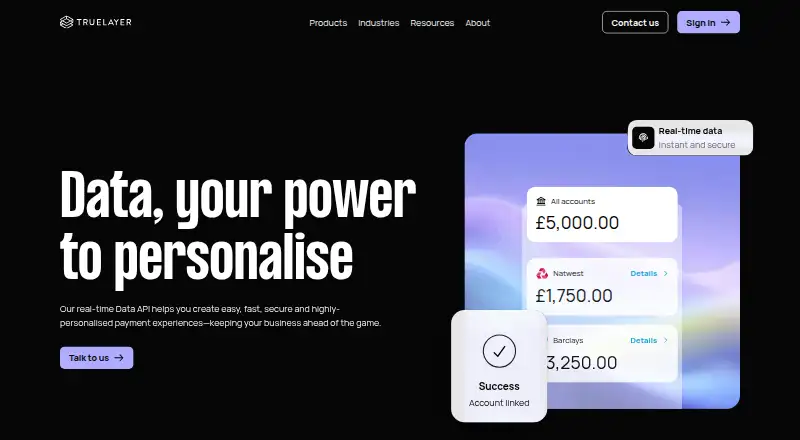
What TrueLayer Data API is
TrueLayer Data API provides identity, account, transaction, and balance data for integrated banks through a single interface. Account data can include a holder's name, account number, and IBAN; card data can include the card network, last four digits, and name on card, with balances and transactions at card level. Listed uses include account verification and aggregation, affordability checks, rewards and insights, and money management. TrueLayer offers a customizable user journey or a custom authentication flow for regulated customers. Non-regulated customers and agents of TrueLayer customers must use the customizable flow. Documentation lists client libraries for Node.js, Python, Java, and .NET, plus web and mobile SDKs and hosted payment-page options. The free Sandbox plan is for testing with mock data and has no production access. Production pricing is based on volume and use case; it requires a registered business or commercial entity, a signed commercial agreement, and KYB/KYC. TrueLayer requires HTTPS and says data is encrypted at rest and in transit, including with TLS 1.2. Identical Data API requests are cached for one hour, and persistently unreasonable request volumes may be throttled or blocked.
Good
- Single interface provides several types of bank data.
- Supports account verification and affordability checks.
- Client libraries include Node.js, Python, Java, and .NET.
- Free Sandbox supports testing with mock data.
Watch out
- Sandbox has no production access.
- Production pricing is not listed.
- Production access requires a commercial agreement and KYB/KYC.
- Identical requests are cached for one hour.
Who it suits
TrueLayer Data API suits businesses building financial services that need bank account, card, transaction, or balance data. Non-regulated customers should note that they must use TrueLayer's customizable authentication flow.
Verdict
TrueLayer Data API offers a broad set of bank and card data for listed financial use cases, with SDK and library options. Sandbox is limited to mock-data testing; production requires a commercial agreement and KYB/KYC.
Plans and prices
From TrueLayer Data API's own pricing page, checked 1 Oct 2026.
| Plan | Price | What it gives you |
|---|---|---|
| Sandbox | Free | Testing with mock data · no production access · Free |
| Production | Priced on request | Registered businesses/commercial entities · signed commercial agreement · KYB/KYC required · Priced based on volume and use case |
The facts
Each one read from TrueLayer Data API's own pages, with the date it was checked.
What it does
- Account data
- Account data can include account-holder name, account number, IBAN and related account information.checked 1 Oct 2026
- API security
- TrueLayer requires HTTPS for API connections and says data is encrypted at rest and in transit using protocols such as TLS 1.2.checked 1 Oct 2026
- Authentication
- TrueLayer offers a ready-made customizable user journey or a custom authentication flow for regulated customers.checked 1 Oct 2026
- Caching limit
- TrueLayer operates a one-hour cache for identical Data API requests and may throttle or block persistently unreasonable volumes.checked 1 Oct 2026
- Card data
- The API can return card network, last four digits and name on card, with balance and transaction data available at card level.checked 1 Oct 2026
- Core function
- The Data API provides access to identity, account, transaction and balance data for integrated banks through a single interface.checked 1 Oct 2026
- Financial features
- TrueLayer lists account verification, account aggregation, affordability checks, rewards and insights, and money management as Data API use cases.checked 1 Oct 2026
- Frontend options
- TrueLayer documentation lists a Web SDK, mobile SDKs and hosted payment-page options.checked 1 Oct 2026
- Integration libraries
- TrueLayer documentation lists client libraries for Node.js, Python, Java and .NET.checked 1 Oct 2026
- Non-regulated users
- Non-regulated customers and agents of TrueLayer customers must use TrueLayer’s customizable flow.checked 1 Oct 2026
- Regulation
- TrueLayer states that it is regulated by the UK Financial Conduct Authority and that TrueLayer (Ireland) Ltd is authorised by the Central Bank of Ireland.checked 1 Oct 2026
- Security certifications
- TrueLayer states that it has ISO 27001 certification, SOC 2 Type 2 coverage for 1 February 2023 to 31 January 2024, and Cyber Essentials and Cyber Essentials Plus accreditation.checked 1 Oct 2026
- Support
- TrueLayer support operates Monday to Friday from 8 AM to 8 PM GMT through Help Centre chat and tickets.checked 1 Oct 2026
The company
- Founded
- 2016checked 28 Sep 2026
- Headquarters
- London, United Kingdomchecked 28 Sep 2026
The full review of TrueLayer Data API
Overview
TrueLayer Data API is a bank-data integration service for businesses building financial products, rather than a consumer finance app. It is best suited to teams that need identity, account, card and transaction data across integrated banks; production access comes with commercial and KYB/KYC requirements.
Its breadth of data and integration options make it a strong fit for account verification, aggregation and related financial services. It is less suitable for experimentation that needs real production data without a commercial commitment.
Key features
Bank and card data
The API can return identity, account, credit card, transaction, balance, standing-order and direct-debit data in JSON, with a real-time refresh frequency. Account records can include the holder’s name, account number and IBAN; card data can include the network, last four digits and name on the card, plus card-level balances and transactions. That range supports use cases from account verification and affordability checks to rewards, insights and money management, but it is data infrastructure for services built by its customers, not a ready-made budgeting product.
Connection and authentication
Connection methods include redirect, embedded, app-to-app and API-only/custom UI flows. Customers can use TrueLayer’s customizable user journey, while regulated customers may build a custom authentication flow. Non-regulated customers and agents of TrueLayer customers must use the customizable flow, which limits their control over that part of the experience.
Developer and security provisions
Client libraries are listed for Node.js, Python, Java and .NET, alongside a Web SDK, mobile SDKs and hosted payment-page options. These give integration teams several implementation routes. TrueLayer requires HTTPS and says data is encrypted at rest and in transit using protocols such as TLS 1.2. It states that it holds ISO 27001 certification, SOC 2 Type 2 coverage for 1 February 2023 to 31 January 2024, and Cyber Essentials and Cyber Essentials Plus accreditation. It also states that it is regulated by the UK Financial Conduct Authority and that TrueLayer (Ireland) Ltd is authorised by the Central Bank of Ireland.
Identical Data API requests are cached for one hour. Persistently unreasonable request volumes may be throttled or blocked, so systems requiring repeated immediate retrieval of unchanged data need to account for that constraint. Support is available through Help Centre chat and tickets Monday to Friday, 8 AM to 8 PM GMT.
Pricing
Sandbox: free (billed Free). It provides mock-data testing with no production access, making it appropriate for evaluation and integration work before launch. It cannot validate a live production connection.
Production: custom pricing, based on volume and use case. It is for registered businesses or commercial entities and requires a signed commercial agreement plus KYB/KYC. This is the relevant option for a live service, but teams must contact TrueLayer to establish the commercial terms.
Platforms
TrueLayer lists support for Android, iOS, web and API. The platform range, mobile SDKs and Web SDK give businesses options for connecting apps and browser-based services to the API.
Who it's for
Data API is aimed at businesses and developers building financial products that need bank and card data for verification, aggregation, affordability, rewards or money-management features. The Sandbox suits teams preparing an integration with mock data. Production is for commercial entities prepared to complete KYB/KYC and agree commercial terms. It is not a fit for individual users seeking an off-the-shelf personal finance app, or for teams that need production access without a commercial agreement.
Pros and cons
- Pros: Broad account, card and payment-account data types support multiple financial use cases through one interface.
- Pros: Redirect, embedded, app-to-app and API-only/custom UI connection methods, plus client libraries and SDKs, offer implementation choices.
- Pros: A free mock-data Sandbox lets teams prepare integrations without a production commitment.
- Cons: Sandbox has no production access; live use requires a commercial agreement and KYB/KYC.
- Cons: Non-regulated customers and agents must use TrueLayer’s customizable authentication flow rather than a custom one.
- Cons: The one-hour cache for identical requests and possible throttling of persistently unreasonable volumes can constrain repeated data retrieval.
Alternatives
For a broader category comparison, see Open Banking Payment Platforms and Bank Connectivity Software.
Trustly is another paid option across Android, API, iOS and web; its merchant pricing is also custom. Volt is a paid alternative across the same platforms, with custom pricing. Choose between them and TrueLayer based on the product fit your business needs; the stated facts do not establish a feature advantage for either.
Fire Payments API is another paid option without a free plan, with custom corporate pricing on request; consider it if you want to discuss a tailored business account and API arrangement with Fire. TrueLayer Payments is the related paid TrueLayer product, but it has no free plan; choose it for a payments-product comparison rather than assuming it provides the same data API offer.
Noda uses transaction-based pricing tailored to business needs and supports API and web, so it may suit teams comparing transaction-based commercial terms. Plaid offers eligible US and Canada teams created on or after April 15, 2026 free trial access, including up to 10 Production Items; consider it if that eligibility and trial structure suit your evaluation. Salt Edge Payment Initiation is a paid API and web option with pricing available through sales. Brite Payments is a paid alternative for Android, iOS and web.
Verdict
Choose TrueLayer Data API if you are building a commercial financial service that needs a broad set of bank and card data, multiple connection routes and established developer options. Its mock-data Sandbox lowers the cost of getting an integration started, but it is not a substitute for live access: production requires a commercial agreement and KYB/KYC. Look elsewhere if you need a consumer-facing app out of the box or cannot take on those production requirements.
Getting started
- Visit https://truelayer.com/data/.
- Use the free Sandbox plan to test with mock data.
- Choose a listed connection method: redirect, embedded, app-to-app, or API-only/custom UI.
- Use a client library, SDK, or hosted payment-page option listed in the documentation.
- For production, be a registered business or commercial entity and complete a signed agreement and KYB/KYC.
Limits worth knowing
The free Sandbox is limited to mock-data testing and has no production access. Production pricing is based on volume and use case, and requires a registered business or commercial entity, a signed commercial agreement, and KYB/KYC.
Questions
Is TrueLayer Data API free?
A free Sandbox plan is available for testing with mock data. Production pricing is based on volume and use case.
Can the Sandbox be used in production?
No. The Sandbox plan has no production access.
What data does the API provide?
Supported data types include identity, account, credit card, transactions, balances, standing orders, and direct debits.
Which platforms and developer options are listed?
The listed platforms are Android, API, iOS, and web. Documentation lists Node.js, Python, Java, and .NET client libraries, plus web and mobile SDKs and hosted payment-page options.
Can customers use a custom authentication flow?
Regulated customers can use a custom flow. Non-regulated customers and agents of TrueLayer customers must use the customizable TrueLayer flow.
What security and regulatory information does TrueLayer state?
TrueLayer states that it is regulated by the UK Financial Conduct Authority and that TrueLayer (Ireland) Ltd is authorised by the Central Bank of Ireland. It requires HTTPS and says data is encrypted in transit and at rest; it also states ISO 27001 certification, SOC 2 Type 2 coverage for 1 February 2023 to 31 January 2024, and Cyber Essentials and Cyber Essentials Plus accreditation.
Alternatives to TrueLayer Data API
- 1

Plaid
AndroidiOSWebAPI6.6 - 2

Lean Payments
AndroidiOSWebAPI6.4 - 3

Crezco
WebAPI6.1From £10 a month - 4
Pay by Bank from allpay
AndroidiOSWeb6.1 - 5

TrueLayer Payments
AndroidiOSWebAPI6.1 - 66.0