Thinger.io
Thinger.io is an open-source cloud platform for prototyping, scaling and managing connected products.
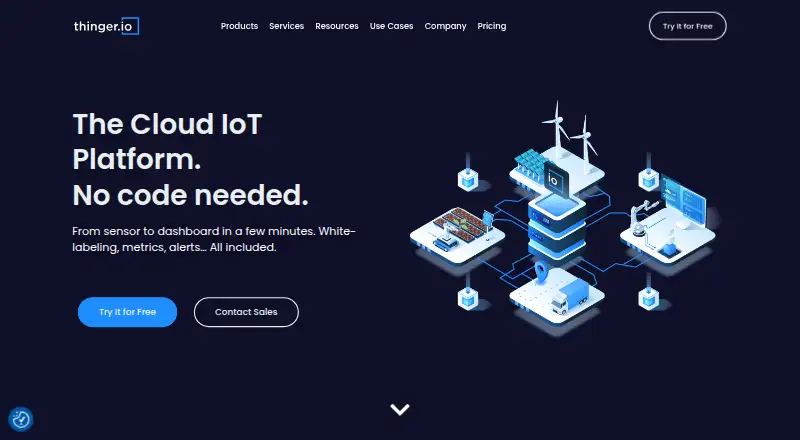
What Thinger.io is
Thinger.io is an open-source cloud platform for prototyping, scaling and managing connected products. It supports two-way communication with Linux, Arduino, Raspberry Pi, MQTT devices, Sigfox, LoRaWAN and internet API resources. Device data can be stored in Data Buckets and shown in dashboards with built-in or custom widgets, including real-time views. A Node-RED rule engine can trigger events and data values. REST API calls provide access to platform features, while access tokens allow third-party services to connect without sharing account credentials. Marketplace integrations include Node-RED, VS Code, Jupyter, Grafana, Prometheus, The Things Stack and Sigfox. Cloud plans use dedicated AWS instances, with EU, US and Asia regions; the pricing page states GDPR compliance and ISO 27001. A lifetime Community Platform account is listed as free, with limited features for learning and prototyping. Cloud plans list device, storage, plugin and product allowances, but no prices. Thinger.io lists community support, with extended support on paid licenses.
Good
- Supports multiple devices and connectivity options.
- Stores data and provides real-time dashboards.
- Node-RED rule engine can trigger events.
- REST API and access tokens support integrations.
- Lifetime Community Platform account is listed as free.
Watch out
- Free account has limitations for learning and prototyping.
- Plan limits can block actions beyond allowances.
- Pricing page says no free trial; homepage says otherwise.
Who it suits
Thinger.io may suit developers and teams prototyping or managing connected products across the listed device ecosystems, particularly those needing dashboards, automation or API access.
Verdict
Thinger.io combines device connectivity, data storage, dashboards and automation in an open-source cloud platform. Check plan allowances and trial terms, which are described differently across its pages.
Plans and prices
From Thinger.io's own pricing page, checked 14 Oct 2026.
| Plan | Price | What it gives you |
|---|---|---|
| Cloud Free | Free | community cloud · fair limits · no credit card |
| Community Platform | Free | Lifetime freemium account; limited features |
| Cloud Small | €45 a month | 100 devices · 40 GB storage · 2 plugins · 1 product · community support · Billed annually (€540/year) |
| Small | €49 a month | 100 devices · 40 GB storage · community support · 540 EUR billed yearly |
| Cloud Medium | €179 a month | 1,000 devices · 80 GB storage · 5 plugins · 5 products · white labeling · unlimited customers · Billed annually (€2148/year) |
| Medium | €199 a month | 1,000 devices · 80 GB storage · white labeling · unlimited customers · 2,148 EUR billed yearly |
| Cloud Large | €319 a month | 2,500 devices · 320 GB storage · 15 plugins · 10 products · white labeling · unlimited customers · SSO · daily backups included · Billed annually (€3828/year) |
| Large | €349 a month | 2,500 devices · 320 GB storage · white labeling · unlimited customers · SSO · daily backups · 3,828 EUR billed yearly |
| Enterprise | Priced on request | custom infrastructure · multi-region HA · WAF/private networking · custom SLA · dedicated technical account manager |
The facts
Each one read from Thinger.io's own pages, with the date it was checked.
What it does
- Access tokens
- Access tokens provide scoped REST access to platform features and can be revoked.checked 14 Oct 2026
- Alarms
- Paid plans include alarms and notifications for operational conditions.checked 14 Oct 2026
- API
- All platform features can be accessed through REST API calls, with access tokens used to authorize third-party services without sharing account credentials.checked 7 Oct 2026
- Automation
- The platform includes a Node-RED rule engine for triggering events and data values.checked 7 Oct 2026
- Dashboards
- The platform provides live dashboards that can be arranged as maps, plant schematics, customer portals and other custom views.checked 14 Oct 2026
- Data and dashboards
- Users can store device data in Data Buckets and display real-time or stored data in dashboards with built-in or custom widgets.checked 7 Oct 2026
- Documentation depth
- Documentation covers device setup, Arduino variants, server deployment, APIs, access tokens, HTTP devices, endpoints and mobile usage.checked 14 Oct 2026
- Endpoints
- Endpoints can call webhooks, email, SMS, REST services, IFTTT, Telegram or other HTTP destinations.checked 14 Oct 2026
- HTTP limitation
- The HTTP-device integration documentation warns that HTTP devices do not expose all platform capabilities and recommends the software client when available.checked 14 Oct 2026
- Integrations
- The marketplace lists integrations for Node-RED, Grafana, Jupyter, Prometheus, The Things Stack, LORIOT, ChirpStack and Sigfox.checked 14 Oct 2026
- Legal entity
- The maker identifies the legal company as INTERNET OF THINGER S.L., based in Las Rozas de Madrid, Spain.checked 14 Oct 2026
- Limit: hardware compatibility
- A G2 reviewer reports that some ESP versions and other market devices are unsupported and require hardware modifications.checked 14 Oct 2026
- Limit: support and pricing clarity
- Spotsaas lists unclear pricing, limited review data and potentially limited enterprise-grade support as drawbacks.checked 14 Oct 2026
- Notable limits
- The pricing page says an instance blocks new actions that would exceed plan limits, such as registering devices beyond the plan allowance.checked 7 Oct 2026
Money
- Community complaint: free alarms
- Community users report that free accounts may lack alarm rules, limiting threshold-triggered email alerts.checked 14 Oct 2026
- Free plan limits
- The documentation describes the free account as a lifetime freemium account with limitations for learning and prototyping.checked 7 Oct 2026
The company
- Company founding
- LinkedIn lists the company as founded in 2015.checked 14 Oct 2026
- Company size
- LinkedIn lists Thinger.io as a privately held Madrid company with 2–10 employees.checked 14 Oct 2026
- Founded
- 2018checked 28 Sep 2026
- Headquarters
- Moralzarzal, Madrid, Spainchecked 28 Sep 2026
- Maker and history
- Thinger.io is developed by INTERNET OF THINGER SL, a Spanish company; the project began in 2015 and became a company in 2018.checked 7 Oct 2026
Where it runs
- Device connectivity
- It supports bidirectional device communication with Linux, Arduino, Raspberry Pi, MQTT devices, Sigfox, LoRaWAN, and internet API resources.checked 7 Oct 2026
- Device control
- Devices expose resources that users can control from dashboards, the REST API or AI agents.checked 14 Oct 2026
- Mobile apps
- The official mobile app connects to the community console or a private instance and is available for Android and iOS.checked 14 Oct 2026
The full review of Thinger.io
Thinger.io is an open-source cloud platform for connecting and managing IoT devices, handling their data, and building dashboards and automation. It is best suited to developers and teams that want one platform for prototyping and scaling connected products. Its breadth is a strength, but users should weigh the free account’s limits against the device, storage, and plugin allowances they need.
Overview
Thinger.io brings device connectivity, data storage, dashboards, and event automation into a single IoT platform. Bidirectional communication spans Linux, Arduino, Raspberry Pi, MQTT devices, Sigfox, LoRaWAN, and internet API resources, giving teams several ways to connect hardware and services.
Data Buckets store device data, while dashboards can show live or stored information through built-in or custom widgets. A Node-RED rule engine can trigger events and data values. That combination makes Thinger.io more than a device registry, but it also means teams should assess whether its plan allowances fit their deployments before building around it.
Key features
Connectivity, data, and automation
Real-time communication and stream processing support applications that need current device values, while Data Buckets and dashboards also cover stored data. Custom widgets offer room to shape monitoring views. Node-RED provides an event and data-value rule engine, and the Marketplace includes integrations such as VS Code, Jupyter, Grafana, Prometheus, The Things Stack, and Sigfox.
API access and hosting
REST API calls expose platform features, and access tokens let third-party services authenticate without sharing account credentials. Cloud plans run on private, dedicated AWS instances, with EU, US, and Asia regions offered. The pricing page states GDPR compliance and ISO 27001. These hosting and security provisions may suit organizations with regional or compliance requirements, while enterprise customers can choose custom infrastructure and multi-region high availability.
Pricing
Thinger.io uses a freemium model. Community Platform costs nothing and is a lifetime freemium account with limited features, intended for learning and prototyping. Its device limit is 100, but the free account remains capped in features; an instance blocks actions that would exceed its plan limits, such as registering devices beyond the allowance. That makes it a useful starting point, not a safe assumption for an expanding deployment.
Cloud Small has custom pricing and includes 100 devices, 40 GB of storage, 2 plugins, and 1 product. It suits a modest deployment that needs a managed cloud instance, though the published device ceiling matches the stated 100-device limit.
Cloud Medium has custom pricing and includes 1,000 devices, 80 GB of storage, 5 plugins, and 5 products. It is a better fit for multiple products or a larger device fleet, but storage rises less sharply than device capacity. Cloud Large has custom pricing and includes 2,500 devices, 320 GB of storage, 15 plugins, and 10 products, making it the broadest listed cloud tier for larger deployments.
Enterprise has custom pricing and adds custom infrastructure, multi-region high availability, a custom SLA and compliance, and a dedicated technical account manager. It is the clearest fit for organizations that need tailored hosting or a named technical contact. Community support is listed for the platform; extended support is available with paid licenses.
Trial terms are inconsistent: the pricing page says there is no free trial, while the homepage advertises an unlimited free trial without a credit card. Confirm the applicable terms before treating a trial as part of a purchasing decision.
Platforms
Thinger.io supports Android, iOS, Linux, web, API, and self-hosted access. The company homepage links to Android and iOS apps. This range covers mobile clients, browser-based management, API integrations, and self-hosted deployments.
Who it's for
Thinger.io fits developers and product teams that need device connectivity alongside storage, dashboards, and automation, particularly when they value an open-source platform and REST API access. Its integrations can support workflows involving tools such as Grafana or Jupyter. The free account is most appropriate for learning and prototyping; teams planning a production fleet should compare device, storage, plugin, and product allowances across paid tiers.
It is less compelling for someone seeking an uncomplicated app for a single device or a clearly priced cloud tier: its listed plans require custom pricing, and the free account has feature limitations. Its project began in 2015 and became a company, INTERNET OF THINGER SL, in 2018; the company is based in Moralzarzal, Madrid, Spain.
Pros and cons
Pros
- Broad device connectivity: Support spans several hardware ecosystems, protocols, and API resources, reducing the need to center a project on one device family.
- One platform for data and action: Buckets, live and stored dashboards, and Node-RED rules connect monitoring with event-driven workflows.
- Flexible access and hosting: REST API tokens, self-hosted access, regional AWS cloud instances, and an enterprise infrastructure option address varied deployment needs.
- Lifetime entry point: The free Community Platform plan gives learners and prototype builders a way to start without a recurring plan price.
Cons
- Paid plan prices are custom: Buyers cannot compare the listed cloud tiers by price alone.
- Free account has limited features: The lifetime account is positioned for learning and prototyping, and plan limits block actions that exceed allowances.
- Trial terms conflict: The pricing page and homepage describe trial availability differently, so prospective customers should verify terms.
Alternatives
Consider ThingsBoard if a published free tier is useful: its Free plan is free and includes 5 devices, 5 assets, and 1M data points per month; it also offers a free trial. Consider Datacake if a small fixed-price hobby tier is a better match: its Free plan includes 5 devices and its Hobby plan costs €25 a month for up to 25 devices and one year of data retention.
OpenRemote is another free, self-hosted IoT platform with community support. Ubidots may suit non-commercial projects, with its STEM plan offering 3 free devices. Arduino IDE is a free, open-source development environment rather than a comparable cloud IoT platform. Kaa IoT Platform offers a free plan for 5 devices and paid cloud tiers. Losant Enterprise IoT Platform offers API and self-hosted platforms with a Launch plan priced at $250 a month. Mender is a Linux and web platform focused on over-the-air updates, with a free plan and a Basic plan at $34 a month for up to 50 devices.
For broader comparisons, browse IoT Device Management Platforms and IoT Analytics Software.
Verdict
Thinger.io is a strong fit for developers and teams that want an open-source IoT platform spanning connectivity, data, dashboards, and automation, with API access and multiple hosting paths. The main reason to choose it is that breadth; the main reason to look elsewhere is the combination of limited free features, custom-priced cloud tiers, and unclear trial terms. Start with the lifetime account for learning or prototyping, and confirm allowances and trial terms before committing to a deployment.
Getting started
- Open the Thinger.io website
- Choose the lifetime Community Platform account or discuss a cloud plan
- Connect supported devices or internet API resources
- Store device data in Data Buckets
- Create dashboards with built-in or custom widgets
- Configure Node-RED rules or REST API access tokens
Limits worth knowing
The Community Platform account is free for life but has limited features for learning and prototyping. The documentation lists a 100-device limit, and plans block actions that would exceed their allowances.
Questions
Is Thinger.io open source?
Yes. It is described as an open-source cloud IoT platform.
Is there a free plan?
Yes. Community Platform is listed as free as a lifetime freemium account with limited features.
Does it offer a free trial?
The pricing page says there is no free trial, while the homepage advertises an unlimited free trial without a credit card.
Which platforms are supported?
Platforms listed include Android, API, iOS, Linux, self-hosted, and web.
What devices and protocols can connect?
It supports Linux, Arduino, Raspberry Pi, MQTT devices, Sigfox, LoRaWAN, and internet API resources.
Who develops Thinger.io?
It is developed by INTERNET OF THINGER SL, a Spanish company based in Moralzarzal, Madrid.
Alternatives to Thinger.io
- 1

TDengine
Free planOpen sourceWebAPILinuxmacOS8.3Free plan - 2

ThingsBoard
Free planAndroidiOSWebAPI8.2From $49 a month - 3
Ubidots
Free planAndroidiOSWebAPI8.0From $99 a month - 4
OpenRemote
Free planOpen sourceAndroidiOSWebAPI7.9Free plan - 5

Apache IoTDB
Free planOpen sourceWebAPILinuxmacOS7.7Free plan - 6
Datacake
Free planAndroidiOSWebAPI7.4From €25 a month