Mender
Mender is a device and fleet management platform for delivering over-the-air software updates and managing edge devices.
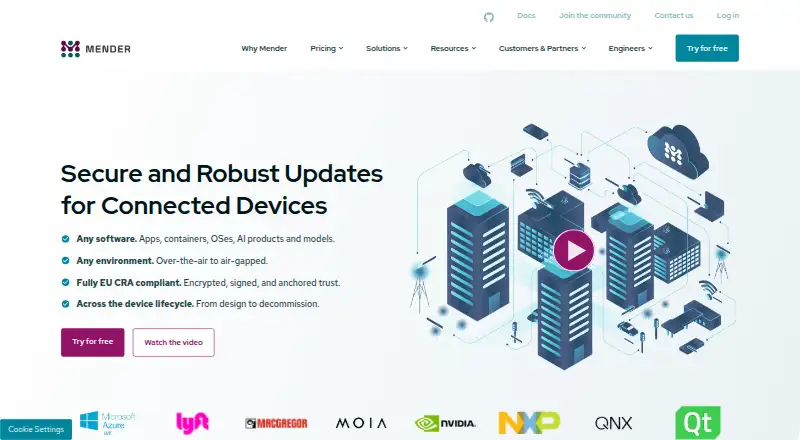
What Mender is
Mender is a device and fleet management platform for delivering over-the-air software updates and managing edge devices. It supports fleet update management and workload deployment, and works with Debian, Ubuntu, Raspberry Pi OS, Yocto Project, and Zephyr OS devices. Teams can choose hosted or on-premise deployment. The Free plan provides core Mender over-the-air update features, open-source software, and access to the Mender Hub community forum. The paid Basic plan costs $34/mo, billed monthly, and covers up to 50 devices. Professional costs $291/mo, billed monthly, for up to 250 devices. Enterprise includes Professional features plus phased rollouts, dynamic deployments, role-based access control, mutual TLS authentication, and hosted or on-premise deployment. Mender is accessible through Linux and the web, and was founded in 2008. The free option gives teams a way to use its core update capabilities, while the paid tiers set explicit device capacities and Enterprise adds deployment and access controls.
Good
- Free plan includes core over-the-air update features.
- Free software is open source and includes the Mender Hub forum.
- Supports edge device and fleet update management.
- Works with five listed device operating systems.
- Hosted and on-premise deployment options are available.
- Workload deployment is supported.
Watch out
- Basic is limited to 50 devices.
- Professional costs $291/mo for up to 250 devices.
Who it suits
Mender suits teams managing software updates across connected Linux-based devices, including fleets using Debian, Ubuntu, Raspberry Pi OS, Yocto Project, or Zephyr OS. It can serve organizations that want hosted or on-premise deployment and need device limits that scale from 50 to 250 devices on stated paid tiers.
Verdict
Pick Mender if you need over-the-air updates and fleet management, with hosted or on-premise deployment options. The free plan includes core features and is open source; look elsewhere if you need more than 250 devices at a tier with a stated capacity or require listed Enterprise pricing.
Plans and prices
From Mender's own pricing page, checked 24 Sep 2026.
| Plan | Price | What it gives you |
|---|---|---|
| Free | Free | Core Mender over-the-air update features · Open source · Mender Hub community forum |
| Basic | $34 a month | Up to 50 devices · billed monthly |
| Professional | $291 a month | Up to 250 devices · billed monthly |
| Enterprise | Priced on request | Everything in Professional · Phased rollouts · Dynamic deployments · RBAC · Mutual TLS authentication · Hosted or on-premise |
The facts
Each one read from Mender's own pages, with the date it was checked.
The company
- Founded
- 2008checked 4 Oct 2026
The full review of Mender
Mender is a fleet-management platform for over-the-air software updates to edge devices. It is best suited to teams managing supported Linux or Zephyr systems that want an open-source starting point and a route to hosted or on-premise deployment. Its main strength is the combination of device updates and workload management; advanced rollout and access controls require Enterprise.
Overview
Mender combines fleet update management with edge-device management and workload deployment. The Free plan includes core over-the-air update features as open-source software, plus access to the Mender Hub community forum. That makes it a sensible option for a pilot or a small team able to work with community support, while the paid device tiers give growing fleets a clearer capacity path.
Key features
- Over-the-air updates: Core update features are available on Free, so teams can start without a subscription. Paid plans add defined device ceilings: Basic supports up to 50 devices and Professional up to 250. Those caps aid budgeting, but teams must move up a tier as their fleet outgrows its allowance.
- Device and workload management: Mender supports edge-device management and workload deployment, broadening its role beyond operating-system updates. The supported workload types are not established, so teams with specific deployment requirements should confirm fit before committing.
- Operating-system support: Supported systems include Debian, Ubuntu, Raspberry Pi OS, Yocto Project and Zephyr OS. That is a useful range for Linux-based edge devices, but it does not make Mender a general-purpose endpoint manager for other platforms.
- Deployment choice: Enterprise can be hosted or on-premise. This flexibility is valuable for organizations with infrastructure requirements that rule out a single deployment model, though it sits in the custom-priced tier.
- Enterprise controls: Phased rollouts, dynamic deployments, role-based access control and mutual TLS authentication are included in Enterprise. These are meaningful fleet and security controls, but their restriction to the top tier raises the cost of adopting them for teams that do not need a larger device allowance.
Pricing
Mender uses a freemium model, with paid plans billed monthly. Free costs nothing and includes core Mender over-the-air update features, open-source software and the Mender Hub community forum. It is the best fit for experimentation and teams whose needs are met by the core feature set; it does not come with a stated device capacity.
Basic costs $34 a month, billed monthly, for up to 50 devices. It gives a small fleet a paid tier with a defined ceiling. Professional costs $291 a month, billed monthly, for up to 250 devices, making it the option for teams that need more room than Basic allows. Neither tier includes the Enterprise features described for phased rollouts, dynamic deployments, RBAC, mutual TLS or hosted and on-premise choice.
Enterprise has custom pricing and includes everything in Professional, plus those rollout and access controls and both deployment options. It suits organizations that need those capabilities, but custom pricing makes it less straightforward to budget than the fixed monthly tiers.
Platforms
Mender is available on Linux and the web. Its supported device operating systems are Debian, Ubuntu, Raspberry Pi OS, Yocto Project and Zephyr OS. Teams should check that their device fleet aligns with this supported set before choosing it.
Who it's for
Mender is a strong fit for teams managing edge-device fleets that need over-the-air updates, workload deployment and a free open-source entry point. Basic and Professional suit fleets of up to 50 and 250 devices respectively; organizations that need phased rollouts, dynamic deployments, access controls or mutual TLS should consider Enterprise. It is a weaker fit for teams whose fleets exceed 250 devices at a stated-capacity tier or who require a fixed Enterprise price.
Pros and cons
- Pro: Core over-the-air updates are free and open source, lowering the barrier to a pilot or initial deployment.
- Pro: Both edge-device management and workload deployment are supported, alongside fleet updates.
- Pro: Debian, Ubuntu, Raspberry Pi OS, Yocto Project and Zephyr OS support covers several common edge-device environments.
- Con: Basic and Professional top out at 50 and 250 devices, respectively, so larger fleets need Enterprise or another approach.
- Con: Phased rollouts, dynamic deployments, RBAC and mutual TLS are Enterprise-only, putting advanced fleet controls behind custom pricing.
Alternatives
ThingsBoard is worth considering for teams that want a freemium platform with a free trial and a free plan covering five devices, five assets and 1M data points per month. Siemens Opcenter is a paid alternative with a free trial, and its Opcenter X Essentials plan covers order management, track and trace, and non-conformance management, with SaaS, VPC and on-premises availability. EdgeX Foundry is a free alternative with a free plan and no free trial. ZEDEDA Edge Intelligence Platform is a paid option for Linux and web. KubeEdge is a free Linux option. Fogwing Edge is a paid web option. Wind River Studio is a paid web option. AWS IoT Greengrass uses pay-as-you-go pricing at $0.16 a month per active Core device; its first three Core devices per month are included for one year under the Free Tier.
For more options, browse IoT Edge Platforms and IoT Device Management Platforms.
Verdict
Mender is a good choice for teams that need open-source over-the-air updates and a clear path from a small fleet to paid capacity tiers. Its edge-device and workload management support adds useful scope, while Enterprise offers both hosted and on-premise deployment with stronger rollout and access controls. Look elsewhere if your fleet needs more than 250 devices at a stated-capacity tier or if custom Enterprise pricing does not suit your budget.
Getting started
- Visit https://mender.io/.
- Choose the Free plan or a paid plan billed monthly.
- Select hosted or on-premise deployment.
- Use the web or Linux access route.
- Connect devices running Debian, Ubuntu, Raspberry Pi OS, Yocto Project, or Zephyr OS.
Limits worth knowing
Basic costs $34/mo, billed monthly, for up to 50 devices. Professional costs $291/mo, billed monthly, for up to 250 devices; the Free plan includes core over-the-air update features.
Questions
Is Mender free?
Yes. The Free plan costs nothing and includes core over-the-air update features, open-source software, and the Mender Hub community forum.
How much do the paid plans cost?
Basic costs $34/mo, billed monthly, for up to 50 devices. Professional costs $291/mo, billed monthly, for up to 250 devices.
What is included with Enterprise?
Enterprise includes everything in Professional, plus phased rollouts, dynamic deployments, RBAC, mutual TLS authentication, and hosted or on-premise deployment.
Which device operating systems are supported?
Supported operating systems are Debian, Ubuntu, Raspberry Pi OS, Yocto Project, and Zephyr OS.
Can Mender be deployed on-premise?
Yes. Mender supports both hosted and on-premise deployment.
Is Mender open source?
The Free plan includes open-source Mender software.
Alternatives to Mender
- 1

ThingsBoard
Free planAndroidiOSWebAPI8.2From $49 a month - 2

Siemens Opcenter
WebAPISelf-hostedWindows7.0 - 3
ZEDEDA Edge Intelligence Platform
WebAPILinuxmacOS6.3 - 4
EdgeX Foundry
APILinuxmacOSSelf-hosted5.3 - 5
AWS IoT Greengrass
LinuxWindows5.2$0.16 usage-based - 6
Fogwing Edge
Web4.6