OpenRemote
OpenRemote is a free, open-source IoT platform that brings different protocols and data sources into one management system.
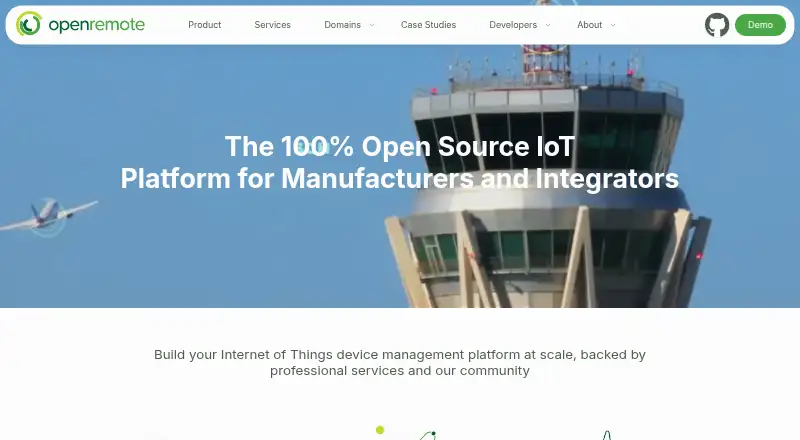
What OpenRemote is
OpenRemote is a free, open-source IoT platform that brings different protocols and data sources into one management system. Designed for professional integrators, its stated audiences include manufacturers, system integrators, and governments. Users can define asset types and the information to track, then automate actions with When-Then rules, a visual Flow Editor, or Groovy scripting. Dashboards support live monitoring, historical trends, and alerts when attributes pass set thresholds. Built-in protocol agents cover options such as HTTP, MQTT, Bluetooth, LoRaWAN, KNX, and ModBus. Assets and attributes are available through REST API and WebSockets. Keycloak provides OAuth2/OpenID Connect and role-based access control, while Realms keep users and data logically isolated. Hawkbit integration supports edge-device firmware updates and security patch rollouts. OpenRemote uses a container-first deployment approach and provides a Docker Compose setup for its manager, database, identity service, and map server. The code is licensed under AGPLv3, with commercial licenses available for organizations seeking an exemption from the stated source-sharing obligation. Community support is included with the free option.
Good
- Free Community option with community support
- Supports a broad range of built-in protocol agents
- Dashboards include live monitoring and threshold alerts
- REST API and WebSockets expose assets and attributes
- Supports firmware updates and security patch rollouts
Watch out
- AGPLv3 includes a source-sharing obligation for closely interacting software
- Commercial license is needed for an exemption from that obligation
- Professional support options have prices on request
Who it suits
OpenRemote suits professional integrators and organizations such as manufacturers, system integrators, and governments that need to manage connected assets and automate IoT workflows. It may also fit teams seeking a self-hosted platform with protocol integrations and APIs.
Verdict
OpenRemote combines asset management, protocol support, automation, dashboards, and APIs in an open-source IoT platform. Organizations should review the AGPLv3 terms and support options against their deployment and licensing needs.
Plans and prices
From OpenRemote's own pricing page, checked 15 Oct 2026.
| Plan | Price | What it gives you |
|---|---|---|
| Support Voucher | Priced on request | Full featured IoT platform · Self hosting · AWS Marketplace · Email issue support · Training and consultancy · 40 support hours · Valid 8 months |
| Managed Service | Priced on request | Full featured IoT platform · Managed hosting · Company CI/CD · Custom mobile app · SLA · Concept and feature development · Training and consultancy · Optional commercial licence |
| Professional Community | Free | Full featured IoT platform · Self hosting · AWS Marketplace · Community support |
The facts
Each one read from OpenRemote's own pages, with the date it was checked.
What it does
- AI and forecasting
- The product lists machine-learning/statistical forecasting and an MCP server for AI clients to query and manage assets, users, and realms.checked 15 Oct 2026
- API
- OpenRemote provides HTTP REST, WebSocket, and MQTT manager APIs, with OpenAPI references for the HTTP interface.checked 15 Oct 2026
- APIs
- Assets and attributes are exposed through a unified REST API and WebSockets.checked 5 Oct 2026
- API security
- HTTP API access uses OAuth2 OpenID access tokens with authorization-code and client-credentials flows; anonymous operations can be limited.checked 15 Oct 2026
- Asset management
- Users can define asset types and the attributes they need to track.checked 5 Oct 2026
- Asset model
- The product supports custom asset types and attributes for modeling devices and other entities.checked 15 Oct 2026
- Automate
- Users can define smart logic, flow rules, and scripts to automate IoT systems.checked 15 Oct 2026
- Automation
- Automation options include When-Then rules, a visual Flow Editor, and Groovy scripting.checked 5 Oct 2026
- AWS availability
- A dated maker announcement says the software became available free on AWS Marketplace on April 29, 2025, while AWS infrastructure charges still apply.checked 15 Oct 2026
- Connect
- The platform links and manages devices and other data sources through one manager interface.checked 15 Oct 2026
- Dashboards and alerts
- The built-in dashboard builder supports live monitoring, historical trend analysis, and alerts when attributes exceed thresholds.checked 5 Oct 2026
- Dashboards and maps
- Dashboard tools cover live, historical, and alert data, while mapping includes geofencing, custom layers, floor plans, and OpenStreetMap.checked 15 Oct 2026
- Data storage
- Persistent data uses PostgreSQL with TimescaleDB for time-series storage.checked 15 Oct 2026
- Deployment
- OpenRemote describes itself as container-first and provides a Docker Compose setup for deploying the manager, database, identity service, and map server.checked 5 Oct 2026
- Developer requirements
- The development environment requires Docker and Compose plus Java 21, Git, Git LFS, Node 20.19 or newer, Yarn 3.2 or newer, and JAVA_HOME.checked 15 Oct 2026
- Documentation
- Documentation includes user guides, deployment material, developer guides, REST API references, JavaDoc links, configuration guidance, and protocol-agent instructions.checked 15 Oct 2026
- Edge operation
- Edge gateways and gateway tunneling support deployments close to devices and remote sites.checked 15 Oct 2026
- Extensibility
- Extensions are separate Java artifacts that can add protocol agents, asset types, setup tasks, container services, rules, and reusable backend logic.checked 15 Oct 2026
- Extension limitation
- Extensions currently require build-time inclusion in a custom project and cannot be enabled or disabled dynamically in the Manager UI.checked 15 Oct 2026
- Firmware updates
- The platform supports over-the-air firmware management through Hawkbit.checked 15 Oct 2026
The company
- Company profile
- LinkedIn describes OpenRemote as a privately held Eindhoven IT-services company founded in 2015 with 11–50 employees.checked 15 Oct 2026
- Founded
- 2015checked 28 Sep 2026
Where it runs
- Custom applications
- Web components support bespoke customer applications with installation flows and asset views.checked 15 Oct 2026
- Google Play app
- The official OpenRemote v3 Android app connects hosted projects for viewing, controlling, and monitoring assets; the listing shows 1K+ downloads and no displayed star rating or review count.checked 15 Oct 2026
The full review of OpenRemote
Overview
OpenRemote is a self-hosted IoT platform for professional integrators and organizations that need to bring varied devices and data sources together. It is a strong fit for teams that want control over integration and deployment; organizations seeking a ready-managed service or avoiding open-source licensing obligations should weigh other options.
Key features
Teams can define their own asset types and tracked attributes, then connect systems through agents for HTTP, SNMP, ModBus, MQTT, Bluetooth, LoRaWAN, Serial, TCP, UDP, KNX, Velbus and openWeather. That breadth is useful in mixed environments, where a single platform can handle many connection types. The tradeoff is that the flexible setup is aimed at professional integrators rather than buyers looking for a narrowly packaged device tool.
Automation ranges from When-Then rules and a visual Flow Editor to Groovy scripting. This gives teams room to start with visual workflows and use code when they need more control, though Groovy is not a fit for teams that want to avoid scripting altogether. Dashboards support live monitoring, historical trends and threshold alerts; real-time stream processing and machine-learning tools extend the analytical scope.
A unified REST API and WebSockets expose assets and attributes to other systems. Keycloak provides OAuth2/OpenID Connect and role-based access control, while Realms logically separate users and data. Hawkbit integration supports edge-device firmware updates and security patch rollouts, bringing device maintenance into the same platform.
OpenRemote is container-first, with a Docker Compose deployment covering its manager, database, identity service and map server. Self-hosting gives organizations deployment control, but also means they must be prepared to operate the platform. The code is under AGPLv3; organizations that need an exemption from its source-sharing obligation for closely interacting additional software can seek a commercial license.
Pricing
OpenRemote offers a free Professional Community option with the full-featured platform, self-hosting, AWS Marketplace access and community support. It suits technically capable teams that can manage their own deployment and rely on community help.
The Support Voucher adds email support for issues, training and consultancy, with 40 hours of support valid for eight months. It is a better fit for teams that want expert assistance without moving to managed hosting. The Managed Service plan includes managed hosting, company CI/CD, a custom mobile app, an SLA, concept and platform-feature development, training and consultancy; an optional commercial license is also available. This is the more suitable route for organizations wanting provider involvement in operations and development. Both paid plans use custom pricing.
All three options include the full-featured platform, so the choice is chiefly about support and hosting rather than a reduced feature tier. The Community option leaves support to the community; the voucher is time-limited, while Managed Service adds hosted operation and an SLA. Teams should account for the AGPLv3 terms or consider the optional commercial license where applicable.
Platforms
OpenRemote supports Android, iOS, Linux, web, API access and self-hosted deployment. Its container-first approach makes self-hosting central to the deployment model, while the mobile platforms and APIs support access beyond the server environment.
Who it's for
Manufacturers, system integrators and governments are among the intended audiences, and the platform is explicitly designed for professional integrators. It is particularly suited to organizations managing varied assets, protocols and automation in one system. A team without deployment capacity may prefer the Managed Service; those unwilling to accept the AGPLv3 terms should examine licensing before adopting it.
Pros and cons
Pros
- Broad built-in protocol coverage can reduce separate integration work across heterogeneous systems.
- Flexible asset definitions, visual and scripted automation, dashboards and APIs serve both operational monitoring and system integration needs.
- Firmware-update support, identity controls and logical data separation cover important management and access requirements.
Cons
- Container-first self-hosting places deployment and operation demands on the customer unless they choose Managed Service.
- Groovy scripting may be a barrier for teams seeking strictly no-code automation.
- AGPLv3 source-sharing terms require attention, and the commercial-license route may be necessary for some organizations.
Alternatives
ThingsBoard is worth considering for buyers who prefer a freemium alternative with a free tier capped at five devices, five assets and one million data points per month, plus a free trial.
Thinger.io may suit teams comparing cloud-oriented device capacities: its Cloud Small plan covers 100 devices and 40 GB of storage, while Cloud Medium covers 1,000 devices.
Datacake is a more defined small-deployment option, with a free five-device plan and a Hobby plan at €25 a month for up to 25 devices and one year of data retention.
Ubidots may be preferable for non-commercial projects, with a free STEM plan for three devices and a free trial.
Arduino IDE is a different kind of choice for developers who want an open-source coding environment rather than an IoT management platform.
Kaa IoT Platform offers a freemium route with a five-device free plan and a $9.99 a month cloud option for up to five devices.
Losant Enterprise IoT Platform is another freemium alternative, with a Launch plan at $250 a month covering 100,000 payloads monthly and 90 days of data retention.
Mender is the more focused alternative when over-the-air device updates are the priority; its free tier includes core update features, and its Basic plan covers up to 50 devices for $34 a month.
For broader category comparisons, see IoT Device Management Platforms and IoT Analytics Software.
Verdict
OpenRemote is best for professional integrators and organizations that need a flexible, self-hosted IoT platform spanning protocols, automation, monitoring and device upkeep. Its strongest reason to choose it is the breadth of those capabilities within one system; the main reasons to look elsewhere are the operational burden of self-hosting and the need to assess AGPLv3 licensing carefully.
Alternatives to OpenRemote
- 1
Thinger.io
Free planOpen sourceAndroidiOSWebAPI8.5Free plan - 2

TDengine
Free planOpen sourceWebAPILinuxmacOS8.3Free plan - 3

ThingsBoard
Free planAndroidiOSWebAPI8.2From $49 a month - 4
Ubidots
Free planAndroidiOSWebAPI8.0From $99 a month - 5

Apache IoTDB
Free planOpen sourceWebAPILinuxmacOS7.7Free plan - 6

Datacake
Free planAndroidiOSWebAPI7.4From €25 a month